Quick summary
- Quad ministers put critical minerals and rare earth supply chains high on the New Delhi agenda.
- India and the United States also signed a bilateral framework on critical minerals cooperation.
- The next test is whether the framework turns into projects, investment and processing capacity.
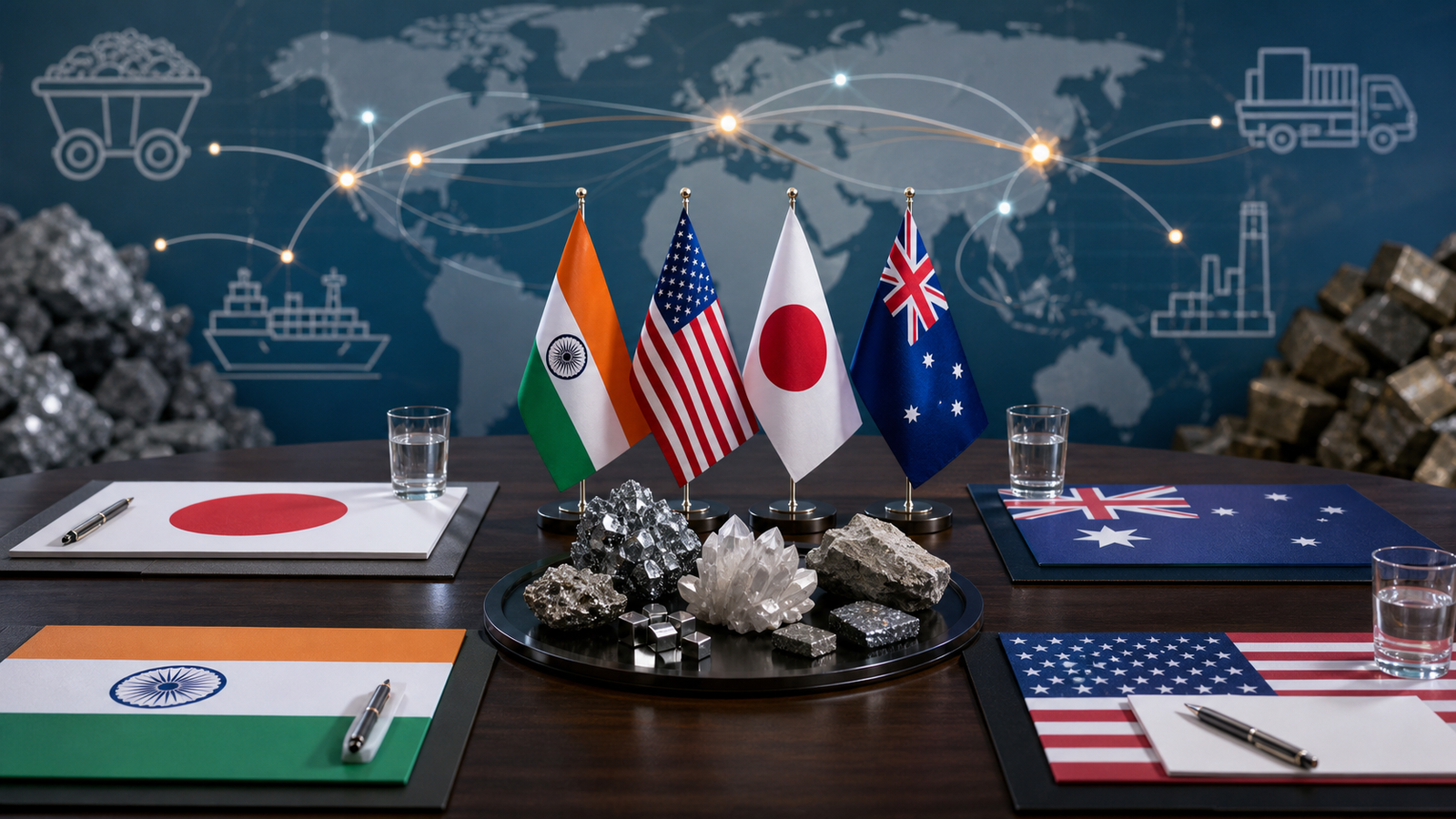
The Quad foreign ministers' meeting in New Delhi has moved critical minerals from a technical supply-chain issue to a central strategic priority for India, the United States, Japan and Australia.
The four partners announced a new Quad Critical Minerals Initiative Framework after talks in New Delhi on May 26. According to official material released by Australia's foreign minister, the framework is meant to coordinate investment and economic policy tools across mining, processing and recycling.
For India, the timing is significant. New Delhi and Washington also signed a bilateral framework on critical minerals and rare earth elements during U.S. Secretary of State Marco Rubio's visit, placing the issue alongside trade, energy, defence and Indo-Pacific security.
Why critical minerals matter
Critical minerals are used in electric vehicles, batteries, semiconductors, clean energy equipment, defence systems and advanced electronics. Rare earth elements are especially important for magnets, sensors and high-performance industrial components.
Supply-chain dependence has become a strategic concern because processing capacity is concentrated in a small number of countries. That makes mineral access a national-security and industrial-policy issue, not only a mining issue.
India's opportunity
India is trying to position itself as a larger part of alternative supply chains. Business Standard reported that Quad partners intend to mobilise up to $20 billion in government and private-sector support for critical mineral supply chains.
The challenge is execution. Exploration, processing, environmental approvals, recycling capacity and long-term financing all take time. But the latest agreements give India a stronger diplomatic platform to attract investment and technology partnerships.
What to watch next
The first test will be whether the Quad framework turns into specific projects, financing announcements and processing capacity, rather than remaining a diplomatic statement.
For Indian industry, the most important signals will be project locations, private-sector partners, mineral categories and whether the framework improves access for battery, semiconductor, defence and clean-energy manufacturers.
Sources and references
- Associated Press: Quad ministers announce new Indo-Pacific initiatives
- Australian Foreign Minister: Quad Critical Minerals Initiative Framework
- Business Standard: Quad launches critical minerals initiative
- Al Jazeera: India, US strike critical minerals deal
Why it matters
Critical minerals are central to batteries, semiconductors, clean energy and defence manufacturing, making supply-chain resilience a strategic issue for India and its partners.
What happens next
Watch for specific project announcements, private-sector partners, financing details and mineral categories covered by the Quad framework.