Short answer
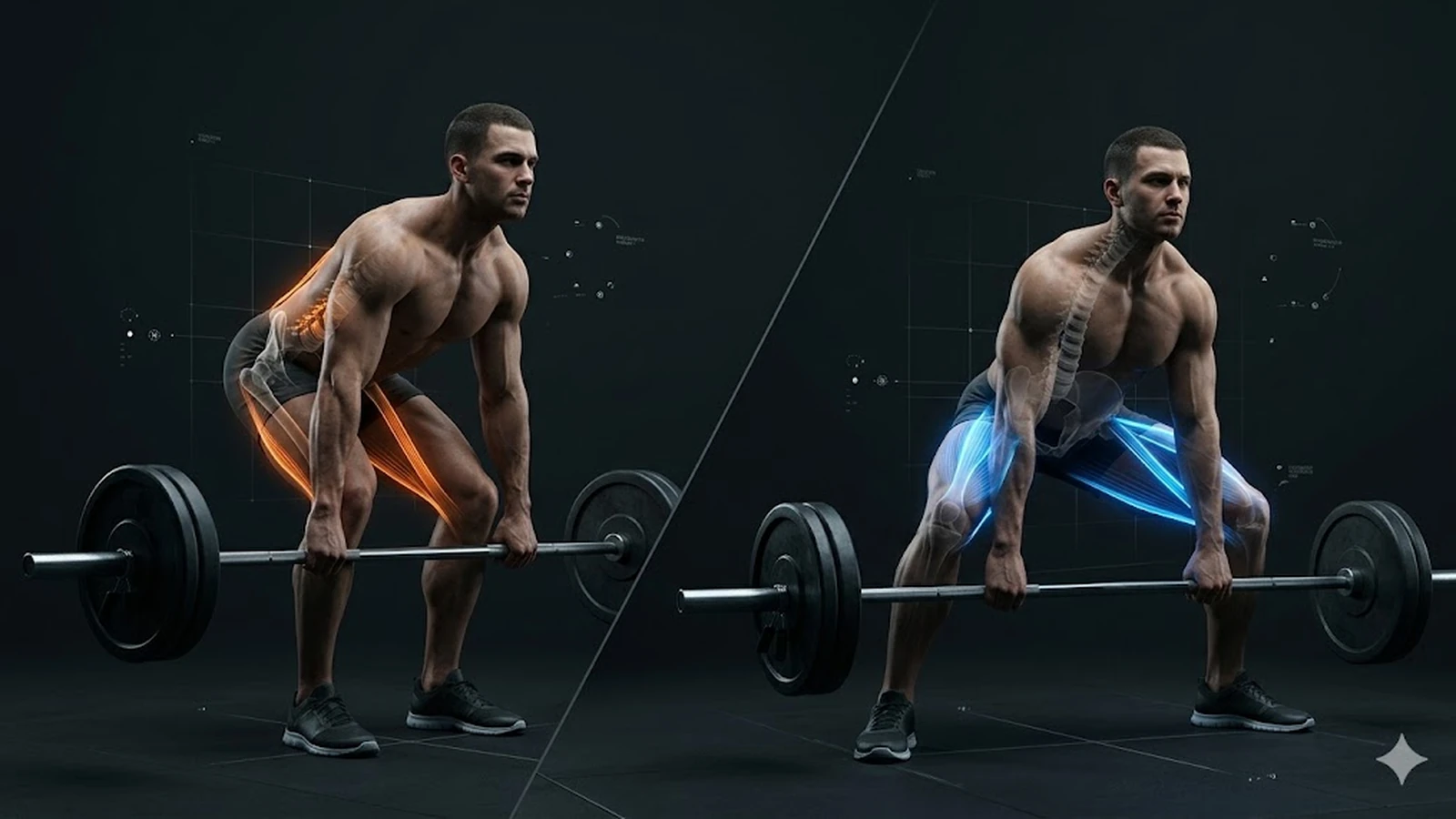
Conventional deadlifts and sumo deadlifts both train the same major lift pattern effectively. Research cited in this guide shows sumo tends to increase quadriceps and tibialis anterior activation, while conventional deadlifts showed greater medial gastrocnemius activity in the key EMG comparison. Neither style is automatically superior; the best choice depends on anatomy, goals, comfort and injury history.


Research source disclaimer. Research cited in this article is sourced from peer-reviewed studies indexed in PubMed, NIH/NCBI-linked sources, or reputable journals where available.
Introduction
The deadlift builds the glutes, hamstrings, lower back, core and grip like few other lifts. But the conventional-versus-sumo debate often turns into identity instead of training logic.
Sumo is not automatically cheating. Conventional is not automatically better. Both are legal, useful and demanding. The research points to different loading patterns, not one universal winner.
Anatomy and biomechanics: what changes between styles
| Feature | Conventional deadlift | Sumo deadlift |
|---|---|---|
| Stance | Hip-width to shoulder-width | Wide, often 1.5-2x shoulder width |
| Hands | Outside the knees | Inside the knees |
| Torso angle | More horizontal at the start | More vertical at the start |
| Hip height | Higher | Lower |
| Range of motion | Longer bar path | Shorter bar path |
| Likely emphasis | Hip hinge and posterior-chain coordination | Quads, adductors and hip position |
The sumo stance creates a more vertical torso at the start. The conventional stance usually requires a stronger hip hinge. Those position changes are useful coaching details, but they should not be treated as a promise that one style is safer for every lifter.
The science: what the research reveals
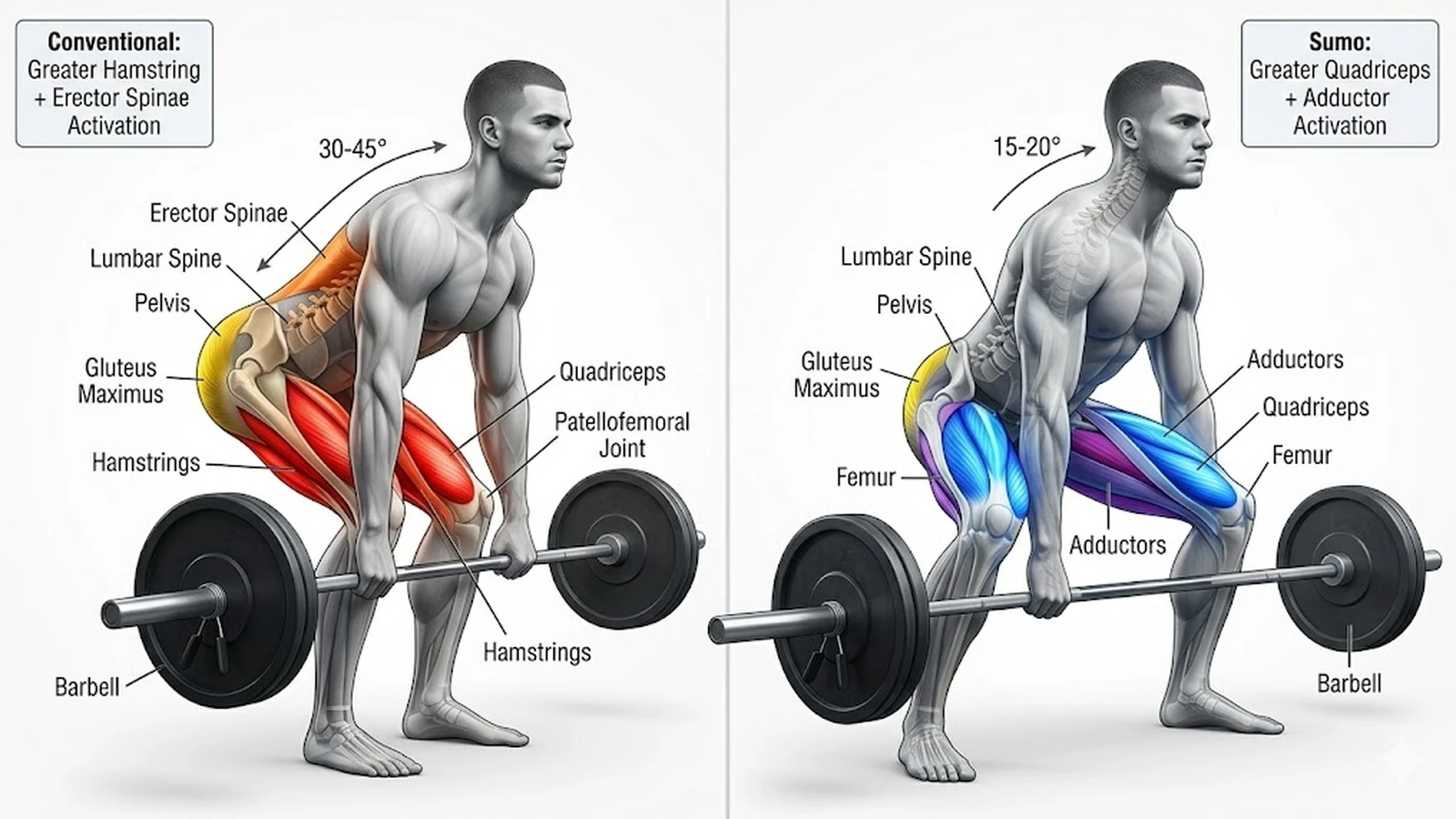
Sumo deadlifts showed greater vastus medialis, vastus lateralis and tibialis anterior activity; conventional deadlifts showed greater medial gastrocnemius activity.
Biomechanical analysis found the sumo group used a wider stance and more vertical trunk, with different ankle, knee and hip moments.
No overall 1RM difference appeared between styles in deadlift-naive participants, but torso length may influence which style fits better.
Three-dimensional analysis adds context for joint loading and body position differences between sumo and conventional styles.
Practical application
| Goal | Style | Sets | Reps | Load | Tempo |
|---|---|---|---|---|---|
| Strength | Either | 3-5 | 3-6 | 80-90% 1RM | 2-0-1 |
| Hypertrophy | Either | 3-4 | 8-12 | 65-80% 1RM | 3-0-1 |
| Quad/adductor emphasis | Sumo | 3-4 | 8-12 | 60-75% 1RM | 3-0-1 |
| Hip-hinge practice | Conventional | 3-4 | 6-10 | 60-80% 1RM | 3-0-1 |
| Technique rebuilding | Either, light | 3 | 8-10 | Light to moderate | 3-1-1 |
Who should use which option?
| Profile | Recommended style | Rationale |
|---|---|---|
| Healthy beginner | Conventional | Teaches the basic hip hinge and posterior-chain position. |
| Powerlifter | Either | Choose the strongest competition-legal style for your build. |
| Longer torso | Sumo may fit | A more upright start may feel easier to organize. |
| Shorter torso | Conventional may fit | May create a stronger starting position. |
| Discomfort in one style | Test the other style light | Use comfort, control and qualified coaching feedback rather than forcing one variation. |
Common mistakes
| Mistake | Why it is a problem | Fix |
|---|---|---|
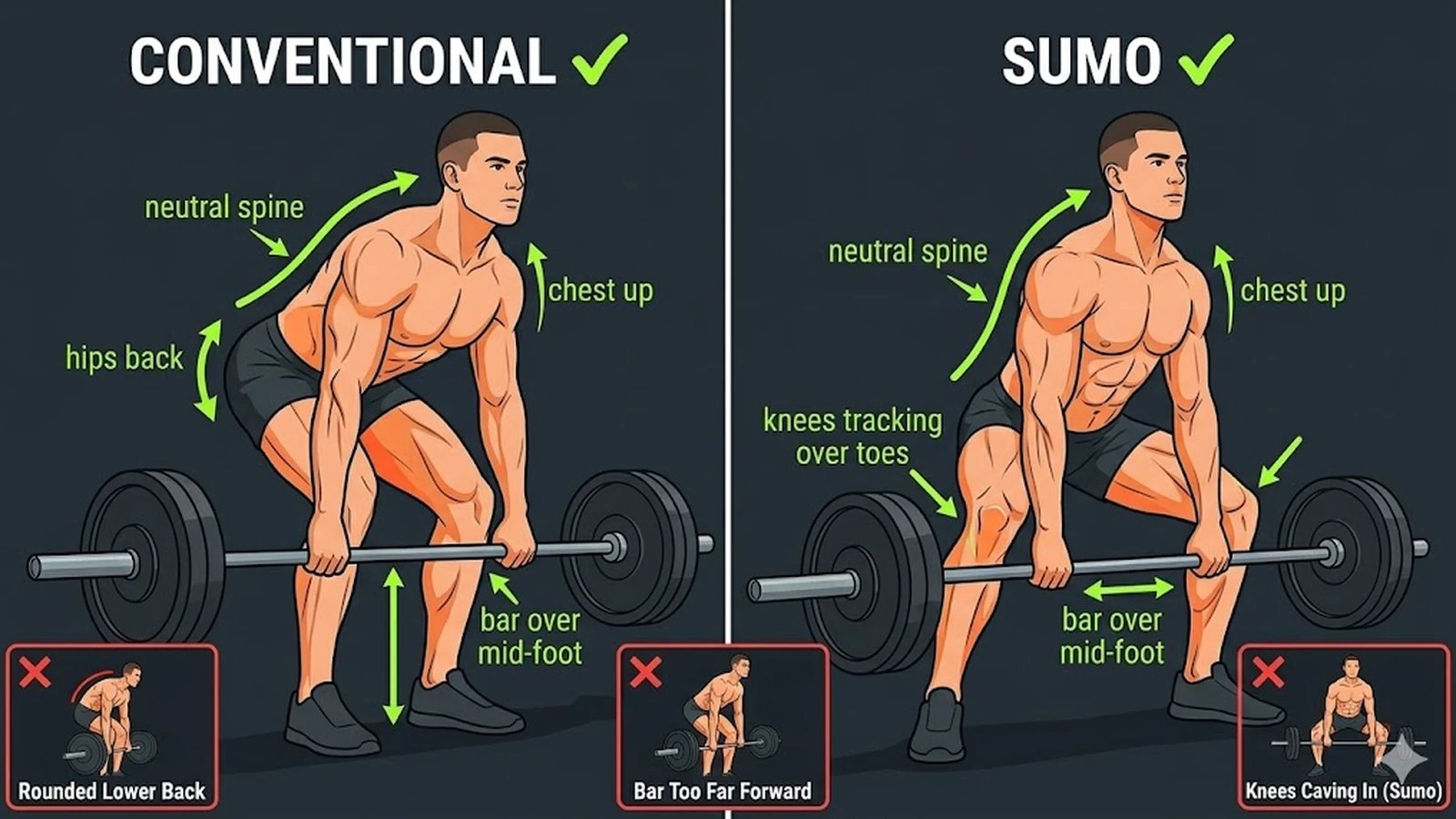
| Rounding the lower back | Increases lumbar stress. | Brace harder, reduce load and keep neutral spine. |
| Hips rising too fast | Turns the lift into a lower-back pull. | Push the floor away and let hips and shoulders rise together. |
| Bar drifting forward | Increases the moment arm on the back. | Keep the bar against shins and thighs. |
| Knees caving in sumo | Can irritate knees and groin. | Drive knees over toes and lower load. |
| Jerking the bar | Breaks position before tension is set. | Pull slack out first, then drive. |
Sample workout integration
- Strength focus: conventional deadlift 5 x 5, barbell rows 3 x 8, leg curls 3 x 10, plank 3 x 60 sec.
- Hypertrophy focus: sumo deadlift 4 x 8-10, hip thrusts 3 x 12, Bulgarian split squats 3 x 8 per leg, face pulls 3 x 15.
- Mixed focus: conventional deadlift 3 x 5, sumo deadlift 3 x 8, Romanian deadlift 3 x 10, walking lunges 3 x 10 per leg.
When to stop or modify
Stop if you feel sharp lower-back, hip or knee pain, pain that worsens during the pull, joint locking, catching, giving way, or pain that persists after training. New lifters should start light and master the hinge before chasing load. If you have a history of back injury, get qualified guidance before heavy deadlifting.
Takeaway
Conventional and sumo deadlifts are both legitimate strength lifts. The strongest verified comparison in this article shows different muscle-activation patterns: sumo had more quadriceps and tibialis anterior activity, while conventional had more medial gastrocnemius activity.
For most lifters, the smartest answer is to test both, keep the one that fits your body best as the main lift, and use the other as a secondary variation when it supports your goals.
Sources and references
- Escamilla RF, et al. Electromyographic analysis of sumo and conventional deadlifts. PubMed PMID: 11932579
- Escamilla RF, et al. Biomechanical analysis of the deadlift. PubMed PMID: 11474337
- Cholewa JM, et al. Anthropometrical determinants of deadlift variant performance. PubMed PMID: 31427866
- Escamilla RF, et al. Three-dimensional biomechanical analysis of deadlift styles. PubMed PMID: 10912892