
The short answer
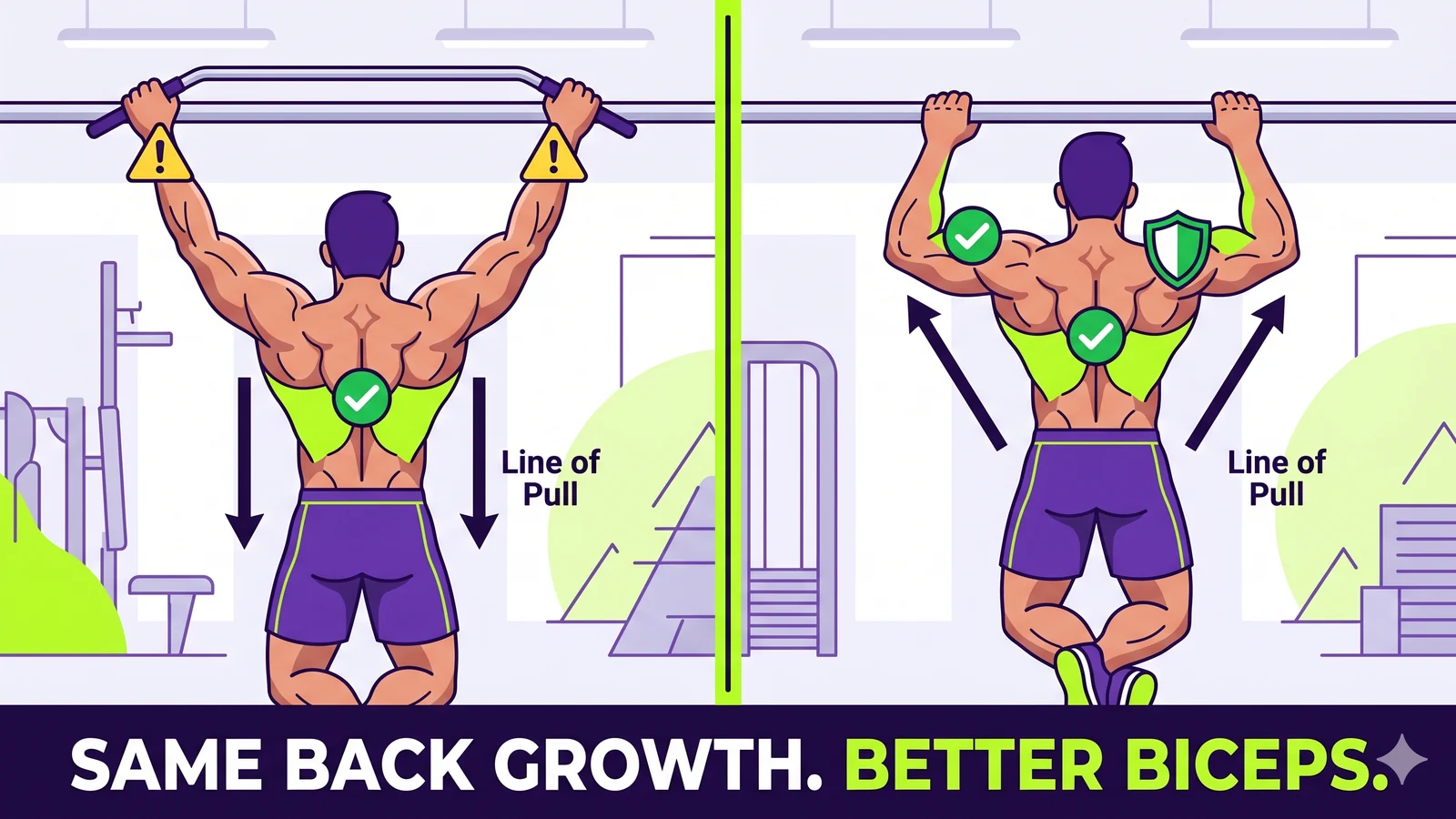
If your goal is overall back growth, you do not need to force one perfect grip forever. A pronated grip can be useful for lat-focused pulldown and pull-up work, but a supinated chin-up can still train the back strongly while shifting more help to the biceps and elbow flexors. The best long-term grip is the one you can load, control and repeat without shoulder or elbow pain.
Quick decision guide
- Use pronated grip when you want a classic back-focused pull and it feels natural on your shoulders.
- Use supinated grip when you want more biceps contribution, easier reps, or a pulling angle that feels smoother.
- Use neutral grip when your shoulders or elbows dislike the extremes.
- Do not chase pain. A grip that pinches the shoulder is not automatically more effective just because it looks harder.

Research links are PubMed-indexed. The practical cues below are based on studies linked through PubMed, the National Library of Medicine search database. This does not mean PubMed endorses the article.
The Anatomy: More Than Just Lats
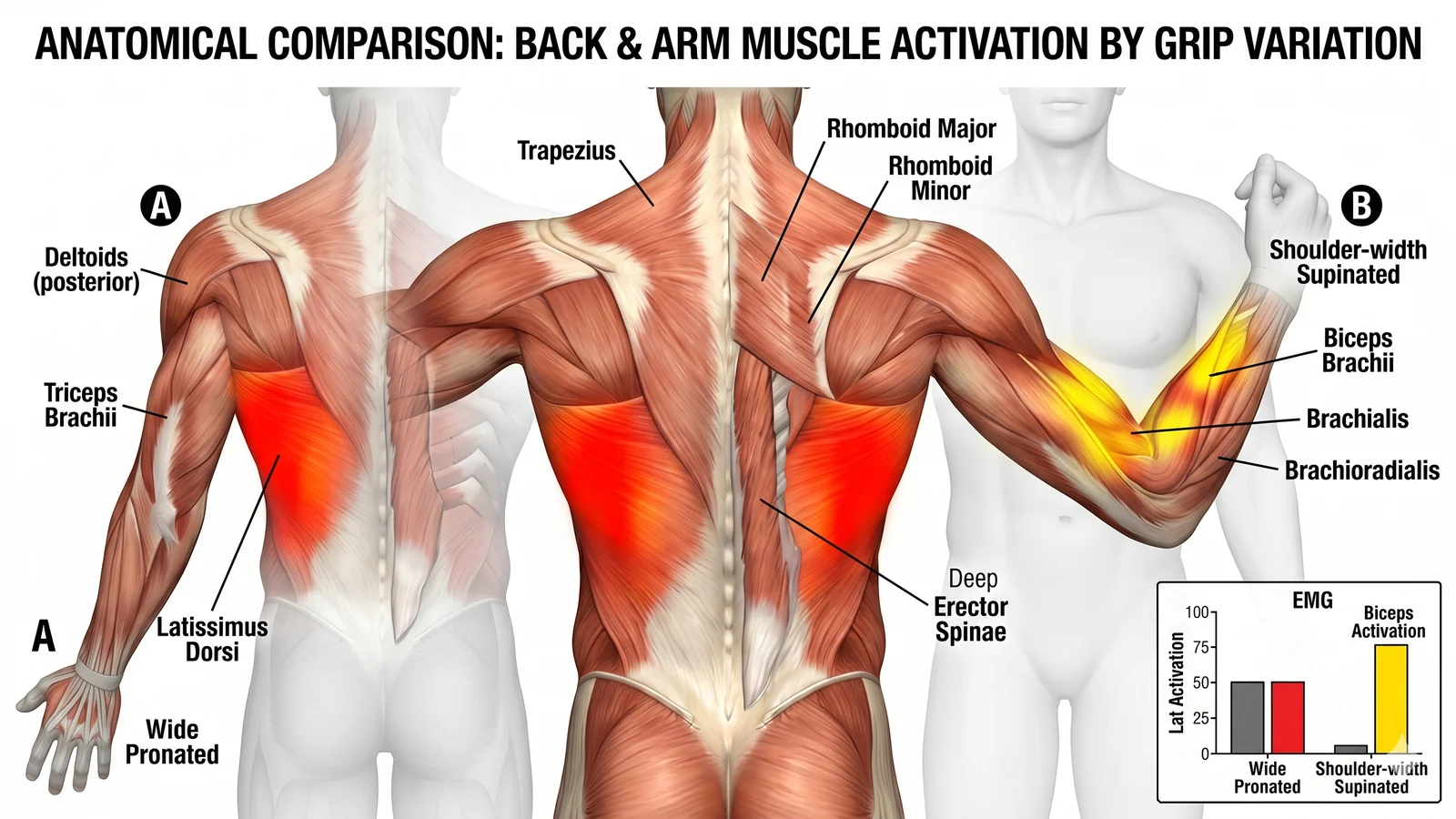
The latissimus dorsi is a large back muscle that helps pull the upper arm down and toward the body. But a real pull-up is never only a lat exercise. The biceps, brachialis, brachioradialis, mid-back, rotator cuff, trunk and grip all help decide how the rep feels.
That is why two people can do the same exercise and feel different things. A palms-away pull-up may feel more "back dominant" for one lifter, while a palms-toward-you chin-up may let another lifter use better range of motion, cleaner reps and more weekly volume.
The Science: What the Research Reveals
During lat pulldowns, a pronated grip produced greater latissimus dorsi activity than a supinated grip. This supports using pronated pulling when lat emphasis is the specific goal.
Grip width changed strength and activation in the lat pulldown, but the practical message is not "widest always wins." Strong setup and repeatable pulling still matter.
Pull-up, chin-up and rotating-handle variations changed elbow motion and muscle activation patterns, showing why chin-ups often feel more biceps-friendly.
Pull-up variations can be used together in training. The authors discussed using multiple variants with systematic progression for broader strengthening.
Practical Application: Finding Your Optimal Grip
Use grip as a training tool, not a loyalty test. If a coach says one grip is always superior, ask: superior for what goal, for which joint position, and for which person?
| Your goal | Best starting grip | What to watch |
|---|---|---|
| Build lats | Pronated or neutral | Keep shoulders down, pull elbows toward ribs, avoid shrugging. |
| Get first pull-up | Supinated or neutral | Use the biceps help, but do not let the shoulder roll forward at the top. |
| Train around shoulder irritation | Neutral first | Stop if there is sharp pain, pinching, numbness or lingering joint pain. |
| Add back volume | Rotate grips | Use one main grip and one secondary grip each week instead of changing randomly every set. |
A simple 4-week grip plan
- Weeks 1-2: Make neutral or supinated chin-ups your volume builder if you need more reps.
- Weeks 1-2: Add pronated pulldowns for controlled lat-focused work.
- Weeks 3-4: Swap the priority: pronated pull-ups first, then supinated or neutral as the back-off variation.
- Every week: Keep one grip stable long enough to measure progress. Changing every session makes the signal noisy.
Technique cues that matter more than grip wars
When to change the grip immediately
Change the variation if you feel sharp front-shoulder pain, elbow tendon pain that worsens set to set, numbness, or pain that stays after training. This guide is educational fitness content, not medical advice. If pain persists, get assessed by a qualified clinician or sports professional.
The takeaway
Pronated grips can be a strong choice for lat-focused pulling, and the classic wide pull-up has a reason to exist. But the science does not say that supinated chin-ups are useless for back growth. Chin-ups still load the lats while bringing more elbow-flexor help, which can mean better reps, more volume and better consistency for many lifters.
The smartest training answer is simple: use pronated, supinated and neutral grips on purpose. Pick the main grip based on your current goal, then keep the variation that lets you progress without joint pain.
Sources and references
- Lusk SJ, Hale BD, Russell DM. Grip width and forearm orientation effects on muscle activity during the lat pull-down. PubMed PMID: 20543740
- Andersen V, et al. Effects of grip width on muscle strength and activation in the lat pull-down. PubMed PMID: 24662157
- Youdas JW, et al. Surface electromyographic activation patterns during pull-up, chin-up, or perfect-pullup rotational exercise. PubMed PMID: 21068680
- Dickie JA, et al. Electromyographic analysis of muscle activation during pull-up variations. PubMed PMID: 28011412
- Snarr RL, et al. Electromyographical comparison of a traditional, suspension device, and towel pull-up. PubMed PMID: 28828073
- Buonsenso A, et al. Back muscle activation during lat pulldown exercise: effects of grip variations and forearm orientation. PubMed PMID: 40981044