Here's what the science shows
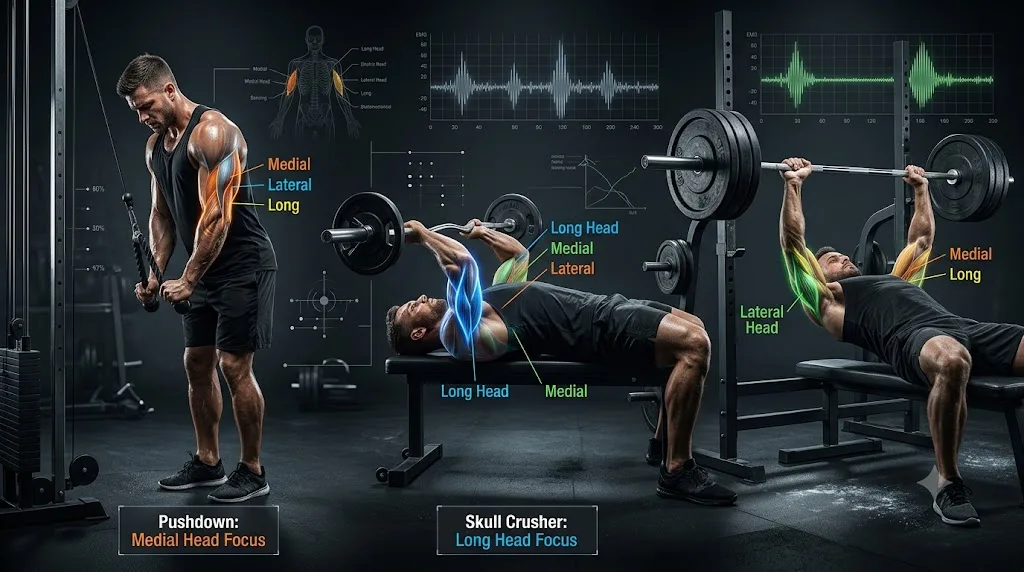
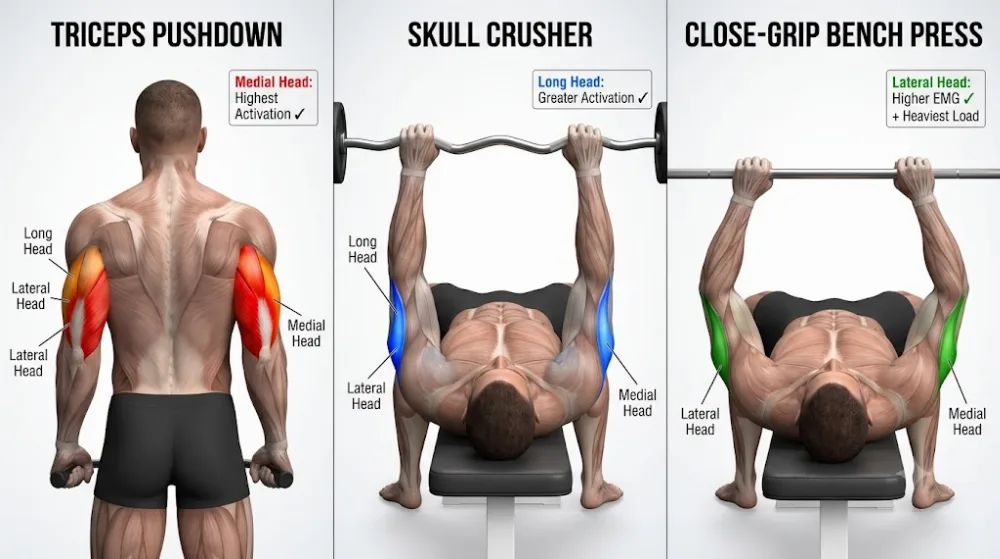
The triceps make up roughly two-thirds of your upper arm mass — bigger arms start with triceps training. Skull crushers elicit greater long head activation compared to pushdowns due to shoulder positioning. The close-grip bench press produces significantly higher EMG activity in the triceps compared to wider grip variations. During the triceps pushdown, the medial head produces significantly greater RMS EMG than the lateral head (p = .041; d = 0.62) and long head (p = .021; d = 0.70). The long head contributes to elbow extension more at shoulder elevation and the medial head takes over at 90° and above of shoulder elevation. The takeaway: use all three — close-grip bench press for heavy compound loading, skull crushers for long head development, and pushdowns for medial head emphasis and pump work.
Quick answer: which triceps exercise is best for you?
Each exercise targets the triceps differently. Close-grip bench press is best for heavy compound loading and overall mass. Skull crushers are ideal for long head development and biceps peak. Triceps pushdowns are superior for medial head emphasis, pump work and joint-friendly volume.
Triceps Pushdown
Best for medial head emphasis, pump work and elbow-friendly volume. Produces the highest medial head RMS EMG compared to the lateral and long heads. Ideal for finishing sets and high-rep work.
Skull Crusher
Best for long head development and biceps peak. Shoulder positioning stretches the long head, placing it under greater mechanical tension. Elicits greater long head activation compared to pushdowns.
Close-Grip Bench Press
Best for heavy loading, overall triceps mass and lateral head development. Allows the heaviest loads and produces significantly higher triceps EMG compared to wider grip variations.
Introduction
If you want bigger arms, you need to train your triceps. Here's why: the triceps make up roughly two-thirds of your upper arm's muscle mass. Neglect them, and you'll never have the arms you want.
But with so many triceps exercises to choose from, which ones actually work best? The three most popular — triceps pushdowns, skull crushers, and close-grip bench press — each claim to be the ultimate triceps builder.
The research tells a clear story: each exercise targets the triceps differently. The triceps has three heads — the long head, lateral head, and medial head — and each exercise emphasises different heads in different ways.
This guide breaks down what the peer-reviewed research says about triceps pushdowns, skull crushers and close-grip bench press — for muscle activation, head-specific targeting and practical application.
Anatomy / Biomechanics: The Three Heads of the Triceps
The Triceps Brachii
The triceps is a three-headed muscle located at the back of the upper arm:
| Head | Origin | Primary Function | Best Targeted By |
|---|---|---|---|
| Long Head | Infraglenoid tubercle of the scapula (crosses the shoulder joint) | Elbow extension + shoulder extension | Skull crushers, overhead extensions |
| Lateral Head | Posterior surface of the humerus, superior to the radial groove | Elbow extension | Close-grip bench press, pushdowns |
| Medial Head | Posterior humerus, inferior to the radial groove (deepest head) | Elbow extension (primary stabiliser) | Pushdowns, all extension exercises |
How Each Exercise Changes the Movement
| Feature | Triceps Pushdown | Skull Crusher | Close-Grip Bench Press |
|---|---|---|---|
| Joint action | Single-joint (elbow extension) | Single-joint (elbow extension) | Multi-joint (elbow + shoulder) |
| Shoulder position | Arms at sides (neutral) | Arms overhead or at 90° | Arms at 45-70° from torso |
| Long head activation | Lower (shoulder not elevated) | Highest (shoulder positioned for stretch) | Moderate |
| Medial head activation | Highest (primary stabiliser) | Moderate | Moderate |
| Lateral head activation | Moderate | Moderate | Highest (heavy loading) |
| Load capacity | Moderate | Moderate-Low | Highest |
| Stability demand | Low | Moderate | Highest |
The key insight: shoulder position determines which head of the triceps does the most work. When your shoulder is elevated (as in skull crushers), the long head is stretched and more active. When your arms are at your sides (as in pushdowns), the medial head takes over.
The Science: What the Research Reveals
Source 1: Triceps Pushdown — Medial Head Dominates
Study: Martin-Diala C, Peaguda J, Liscano J, Signorile J. Electromyographic Activity Of The Heads Of The Triceps Brachii During Selected Exercises. Med Sci Sports Exerc. 2023;55(9S):543-544. Full text
What it found: Twenty-four participants performed triceps pushdowns, low cable pullovers, and high cable pullovers at 70% 1RM. EMG electrodes measured activity in all three heads of the triceps.
- Medial head (pushdown): Produced significantly greater RMS EMG than lateral head (MD ± SE = 111.8 ± 53.6 μV; p = .041; d = 0.62)
- Medial head (pushdown): Produced significantly greater RMS EMG than long head (MD ± SE = 126.5 ± 53.6 μV; p = .021; d = 0.70)
- Low cable pullover: Medial head > long head (MD ± SE = 189.9 ± 54.5 μV; p < .001; d = 1.03)
- Low cable pullover: Lateral head > long head (MD ± SE = 110.7 ± 54.5 μV; p = .046; d = 0.60)
Key takeaway: The triceps pushdown is excellent for targeting the medial head of the triceps — the deep stabiliser that adds thickness to the back of your arm. It also produces significant lateral head activation.
Source 2: Skull Crusher — Long Head Activation
Study: Boehm et al. (2015) — cited in BOXROX analysis. BOXROX
What it found: Researchers compared EMG activity between skull crushers and pushdowns.
- Long head activation: Greater in skull crushers compared to pushdowns
- Reason: Shoulder positioning in skull crushers stretches the long head
- Overhead exercises: Particularly effective in creating hypertrophic stimulus via mechanical tension
Key takeaway: The skull crusher is the superior choice for long head development. By positioning your arms overhead or at 90°, you stretch the long head (which crosses the shoulder joint), placing it under greater mechanical tension.
Source 3: The Role of Shoulder Position — Long Head vs Medial Head
Study: Kholinne E, et al. The different role of each head of the triceps brachii muscle in elbow extension. Acta Orthop Traumatol Turc. 2018;52(3):201-205. PubMed ID: 29503079
What it found: Ten healthy participants performed elbow extension tasks at five different shoulder elevation angles (0°, 45°, 90°, 135°, 180°). Kinematics and EMG were recorded for each head.
- 0° elevation: Long head — significantly higher muscle force and activation than lateral and medial heads (p < 0.05)
- 90°, 135°, 180°: Medial head — significantly higher muscle force than long and lateral heads (p < 0.05)
Key takeaway: This study explains why different exercises target different heads. When your shoulder is elevated (as in skull crushers), the long head is more active. When your arms are at your sides (as in pushdowns), the medial head takes over. This is biomechanically determined — not gym lore.
Source 4: Close-Grip Bench Press — Heavy Loading and Triceps Activation
Study: Saeterbakken et al. (2017) — cited in BOXROX analysis. BOXROX
What it found: Researchers compared EMG activity between close-grip and wider grip bench press variations.
- Triceps EMG: Significantly higher in close-grip bench press compared to wider grip variations
- Lateral head: A decrease in grip width induced larger EMG activity of the lateral head of the triceps brachii
- Load capacity: The close-grip bench press allows significantly heavier loads than isolation exercises
Key takeaway: The close-grip bench press is the superior choice for heavy compound loading and lateral head development. It allows you to lift significantly more weight than isolation exercises, creating greater mechanical tension across all three heads.
Source 5: Triceps Pushdown — Fatigue and Intensity Effects
Study: Hussain J, et al. Muscle Fatigue in the Three Heads of Triceps Brachii During Intensity and Speed Variations of Triceps Push-Down Exercise. Front Physiol. 2020;11:112. PubMed ID: 32153422
What it found: Twenty-five subjects performed triceps pushdowns at three intensities (30%, 45%, and 60% 1RM) and speeds (slow, medium, fast) until failure.
- Rate of fatigue: Increases with intensity and speed for all three heads
- Head differences: "The three heads do not work in unison under any of the conditions"
- Speed effects: Changes in speed affect the lateral and long heads
- Intensity effects: Changes in intensity affect all heads to a greater extent
Key takeaway: The triceps heads fatigue differently based on exercise intensity and speed. This reinforces the need to vary your triceps training — different intensities and tempos will challenge different heads.
Step-by-Step Instructions: How to Do Each Triceps Exercise Correctly
Triceps Pushdown (Cable)
- Set up — attach a straight or rope handle to a high pulley.
- Grip — grasp the handle with palms facing down (pronated grip).
- Position — stand close to the cable, elbows tucked at your sides, shoulders down.
- Push — extend your elbows, pushing the handle down toward your thighs.
- Squeeze — pause at the bottom, squeezing your triceps.
- Return — control the ascent (2-3 seconds) until your forearms are parallel to the floor.
- Repeat — keep your upper arms stationary throughout.
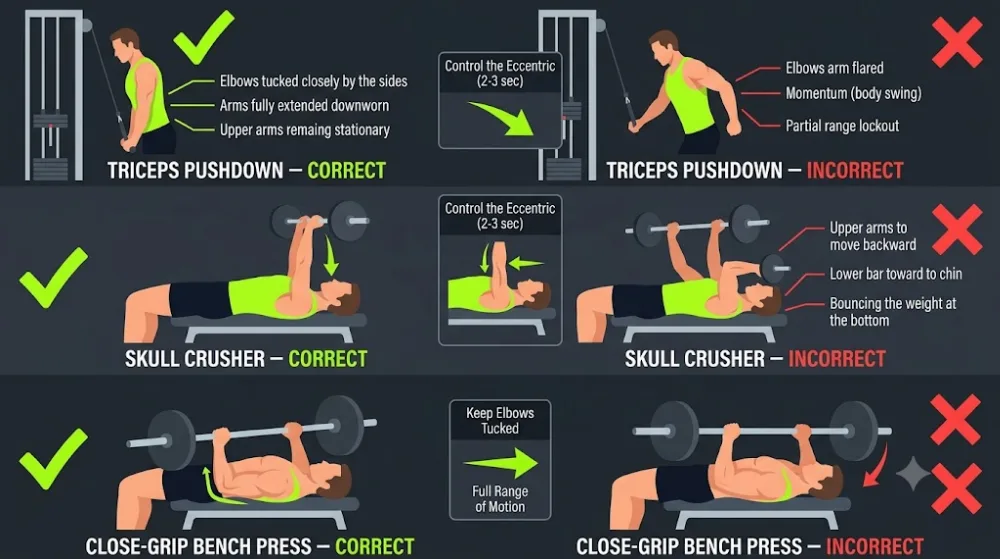
Key cues: Elbows tucked — don't let them flare out. Upper arms stationary — only your forearms should move. Full extension — lock out at the bottom (but don't hyperextend).
Skull Crusher (Lying Triceps Extension)
- Set up — lie on a flat bench with a barbell or EZ-bar held above your chest.
- Position — arms extended straight up (perpendicular to the floor), hands shoulder-width apart.
- Lower — bend at the elbows, lowering the bar toward your forehead (or slightly behind).
- Stretch — feel the stretch in your triceps (especially the long head).
- Press — extend your elbows, pressing the bar back to the start position.
- Squeeze — pause at the top.
- Repeat — keep your upper arms perpendicular to the floor throughout.
Key cues: Upper arms fixed — don't let them drift back or forward. Lower to forehead — not your nose or chin. Control the eccentric — 3-4 seconds for maximum long head stimulation.
Close-Grip Bench Press
- Set up — lie on a flat bench, hands shoulder-width apart (or slightly narrower).
- Grip — hands approximately 1-1.5x shoulder width (much narrower than standard bench).
- Position — shoulder blades retracted, feet planted, elbows tucked.
- Lower — control the bar to your lower chest, keeping elbows close to your body.
- Press — drive the bar up, focusing on triceps extension.
- Lock out — extend arms fully.
- Repeat — maintain tension throughout.
Key cues: Elbows tucked — keep them at 45° from your torso. Bar to lower chest — not your upper chest. Full lockout — squeeze your triceps at the top.
Recommended Sets, Reps and Load
| Goal | Exercise | Sets | Reps | Load | Notes |
|---|---|---|---|---|---|
| Heavy compound loading | Close-Grip Bench Press | 3-5 | 6-10 | 75-85% 1RM | Highest load capacity |
| Long head development | Skull Crusher | 3-4 | 8-12 | 65-75% 1RM | Stretches the long head |
| Medial head emphasis | Triceps Pushdown | 3-4 | 10-15 | 65-75% 1RM | Highest medial head activation |
| Triceps pump / volume | Triceps Pushdown | 3 | 15-20 | Light | High reps for blood flow |
| Strength | Close-Grip Bench Press | 4-5 | 4-6 | 80-90% 1RM | Heavy triples or fives |
Who Should Use Which Option
| Profile | Recommended | Rationale |
|---|---|---|
| Maximising overall triceps mass | Close-Grip Bench Press (primary) + Pushdowns (accessory) | Heavy loading + targeted work |
| Long head / biceps peak | Skull Crusher (primary) | Long head activation is highest here |
| Medial head / arm thickness | Triceps Pushdown (primary) | Medial head activation is highest here |
| Elbow sensitivity | Triceps Pushdown (lighter load) | Less elbow stress than skull crushers |
| Shoulder sensitivity | Triceps Pushdown (arms at sides) | Least shoulder involvement |
| Complete triceps development | All three (periodised) | Targets all three heads differently |
| Strength athlete | Close-Grip Bench Press | Highest load and transfer to pressing |
Comparison Table: Triceps Pushdown vs Skull Crusher vs Close-Grip Bench Press
| Option | Best For | Muscle Emphasis | Load Capacity | Joint Stress | Practical Cue |
|---|---|---|---|---|---|
| Triceps Pushdown | Medial head, pump work, volume | Medial head (highest RMS EMG) | Moderate | Low | "Elbows tucked, push down, squeeze" |
| Skull Crusher | Long head, biceps peak, isolation | Long head (greater activation vs pushdown) | Moderate-Low | Moderate-High | "Upper arms fixed, lower to forehead, control the eccentric" |
| Close-Grip Bench Press | Heavy loading, overall mass, lateral head | Lateral head (higher EMG vs wide grip) | Highest | Moderate | "Elbows tucked, bar to lower chest, squeeze at top" |
Common Mistakes Table
| Mistake | Why It Is a Problem | Fix |
|---|---|---|
| Elbows flaring (pushdown) | Reduces triceps tension; shifts to shoulders | Keep elbows tucked at your sides |
| Using momentum (pushdown) | Reduces muscle tension; increases injury risk | Control both phases; no swinging |
| Lowering to nose/chin (skull crusher) | Reduces long head stretch; increases elbow stress | Lower to forehead or slightly behind |
| Upper arms moving (skull crusher) | Reduces isolation; changes leverage | Keep upper arms perpendicular to floor |
| Grip too narrow (close-grip bench) | Increases wrist and elbow stress | Hands shoulder-width apart (not too narrow) |
| Elbows flaring (close-grip bench) | Reduces triceps emphasis; increases shoulder stress | Keep elbows at 45° from torso |
| Not achieving full range of motion | Reduces muscle damage stimulus; limits growth | Full extension at bottom/top |
| Only doing one variation | Misses other heads; limits growth | Use all three in rotation |
Sample Workout Integration
Workout 1: Heavy Triceps Day (Strength Focus)
- Close-Grip Bench Press — 4 sets of 6-8 reps at 80% 1RM (heavy compound loading)
- Skull Crusher — 3 sets of 10-12 reps (moderate load) (long head focus)
- Triceps Pushdown — 3 sets of 12-15 reps (moderate load) (medial head + pump)
Workout 2: Hypertrophy Focus
- Close-Grip Bench Press — 3 sets of 8-10 reps at 75% 1RM (compound mass builder)
- Overhead Triceps Extension — 3 sets of 10-12 reps (moderate load) (long head stretch)
- Triceps Pushdown (rope) — 3 sets of 12-15 reps (moderate load) (full triceps contraction)
Workout 3: Push Day Finisher (for Pressers)
- Triceps Pushdown — 3 sets of 12-15 reps (light load) (between pressing sets)
- Skull Crusher — 3 sets of 10-12 reps (moderate load) (after main pressing)
- Close-Grip Bench Press — 3 sets of 8-10 reps (moderate load) (as a finisher)
Recommended Weekly Volume
| Training Status | Sets per Week | Recommendation |
|---|---|---|
| Beginner | 6-9 sets | 2 sessions/week, 2-3 exercises |
| Intermediate | 10-15 sets | 2-3 sessions/week |
| Advanced | 15-20 sets | 3 sessions/week, periodised |
Warning / Safety Section: When to Stop or Modify
Stop the exercise immediately if you experience sharp, stabbing pain in the elbow, wrist or shoulder; pain that worsens during the movement (not just muscle burn); joint locking, catching or giving way; or pain that persists after your workout.
- Elbow pain: skull crushers may aggravate elbows; switch to pushdowns with lighter weight.
- Shoulder pain: close-grip bench press may stress shoulders; use pushdowns instead.
- Wrist pain: use an EZ-bar for skull crushers; use a rope attachment for pushdowns.
- New to these exercises: start with pushdowns to learn the movement pattern safely.
- Key safety principles: control the eccentric (2-3 seconds for pushdowns, 3-4 seconds for skull crushers), don't ego lift, keep upper arms stationary for isolation exercises, use full range of motion, use spotters for close-grip bench (especially with heavy loads), progress gradually (1.25-2.5 kg per session), and listen to your body — pain is information, not something to push through.
Takeaway
The research is clear: triceps pushdowns, skull crushers and close-grip bench press each serve a different purpose — and the best approach is to use all three.
Triceps pushdowns produce the highest medial head activation of the three exercises. They are ideal for pump work, volume and elbow-friendly training.
Skull crushers elicit greater long head activation compared to pushdowns due to shoulder positioning. They are ideal for long head development and biceps peak.
Close-grip bench press produces significantly higher triceps EMG compared to wider grip variations and allows the heaviest loads. It is ideal for overall triceps mass and strength.
Shoulder position matters — when your shoulder is elevated (skull crushers), the long head is more active. When your arms are at your sides (pushdowns), the medial head takes over.
The best approach for most lifters: Periodise your training. Use close-grip bench press for heavy compound work, skull crushers for long head development, and triceps pushdowns for medial head emphasis and volume. Train your triceps 2-3 times per week and progressively overload over time.
Complete Reference List
- Hussain J, et al. Muscle Fatigue in the Three Heads of Triceps Brachii During Intensity and Speed Variations of Triceps Push-Down Exercise. Front Physiol. 2020;11:112. PubMed ID: 32153422
- Kholinne E, et al. The different role of each head of the triceps brachii muscle in elbow extension. Acta Orthop Traumatol Turc. 2018;52(3):201-205. PubMed ID: 29503079
- Martin-Diala C, Peaguda J, Liscano J, Signorile J. Electromyographic Activity Of The Heads Of The Triceps Brachii During Selected Exercises. Med Sci Sports Exerc. 2023;55(9S):543-544. Full text
- BOXROX analysis (citing Boehm et al., 2015). Isolation vs Compound Lifts
- BOXROX analysis (citing Saeterbakken et al., 2017). Triceps Training for Aesthetic Arms
- Lehman et al., 2005 — Grip width and triceps EMG comparison. PubMed Search