
The practical answer
If you intentionally slow the eccentric phase of upper-body pressing and pulling to 3-4 seconds, you increase mechanical tension and controlled muscle damage. That signal can support muscle protein synthesis and structural remodeling, as long as the load is controlled and recovery is respected.
Use this when
- You want more hypertrophy stimulus from moderate weights.
- Your form breaks down when you chase heavier loads too quickly.
- You are training bench press, rows, pulldowns, overhead press or lateral raises.
- You can tolerate extra soreness and recover before the next hard session.

Research links are PubMed-indexed. This guide uses PubMed-linked studies and reviews for the science discussion. PubMed is a research database; it does not endorse this article.
Introduction: the most underrated variable in your workout
Walk into a commercial gym and you will see the same pattern everywhere: lifters explode the weight up, then let gravity pull it back down. The concentric phase gets all the attention, while the eccentric phase becomes a rushed reset before the next rep.
That is a missed opportunity. The lowering phase can create a strong hypertrophy signal because the muscle lengthens while still producing force. When you control that phase for 3-4 seconds, you turn gravity into a training tool instead of letting it steal the rep.
The anatomy: what happens inside the muscle during eccentric contractions
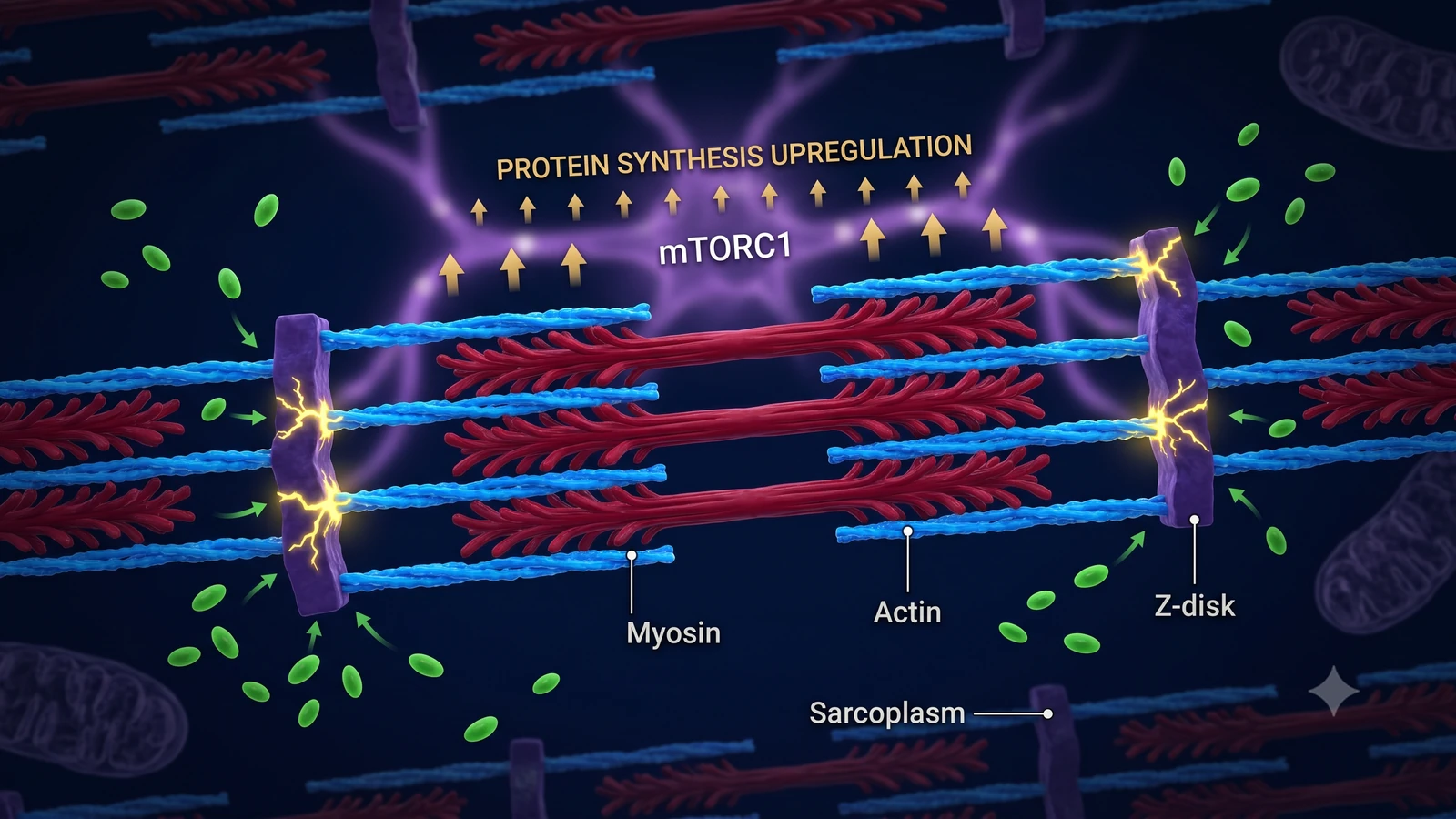
Muscle fibers contain thousands of sarcomeres, the small contractile units built from actin and myosin filaments. During a concentric contraction, myosin pulls on actin and the sarcomere shortens. During an eccentric contraction, the muscle lengthens under tension while the cross-bridges are still resisting the load.
This creates high mechanical stress across the sarcomere. With enough dose, that stress can disrupt structures such as Z-disks and titin filaments. That micro-damage is not the same as injury when programmed responsibly; it is a stress signal that tells the body to repair and remodel.
The science: what the research reveals
Reviewed morphological, cellular and molecular responses to eccentric exercise, including sarcomere disruption and remodeling signals.
Compared eccentric and concentric training effects on strength and hypertrophy in a meta-analysis.
Reviewed how movement tempo influences resistance-exercise performance and adaptation.
Summarized risks and benefits of eccentric muscle contractions, including the need for careful progression.
The 3-4 second eccentric sweet spot
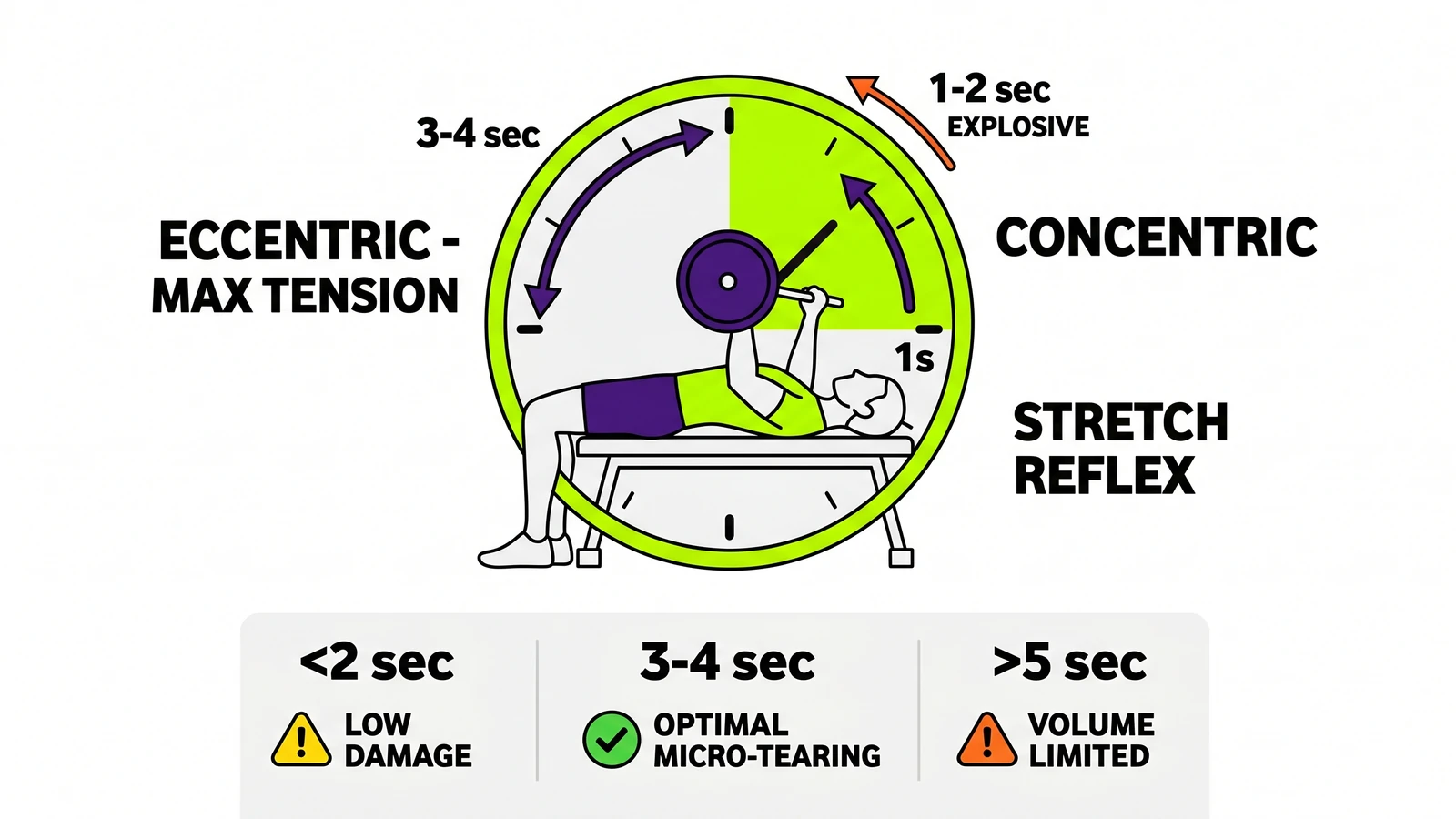
Tempo is a programming variable. A rushed lowering phase often fails to use the eccentric advantage. But an extremely slow lowering phase can reduce the total work you can complete because fatigue rises quickly.
For most upper-body hypertrophy work, the useful middle ground is a 3-4 second eccentric: slow enough to increase tension and control, but not so slow that every set becomes a low-volume grind.
| Eccentric speed | What it usually does | Best use |
|---|---|---|
| Under 2 seconds | Fast, efficient, but often less controlled. | Power work, warm-ups, or technical sets. |
| 3-4 seconds | High tension with enough volume to be useful. | Main hypertrophy work for pressing and pulling. |
| Over 5 seconds | Very fatiguing and can reduce total reps/load. | Occasional technique or rehab-style work, not every set. |
The mechanotransduction cascade: how micro-tears become muscle growth
When sarcomeres experience controlled disruption, mechanical stress is converted into biochemical signaling. Immune cells help clear damaged material, satellite cells support remodeling, and pathways involved in muscle protein synthesis become more active after training.
That repair process is why eccentric work can create more soreness than normal training. Soreness is not the goal by itself, but it is a sign that the dose should be introduced gradually.
Practical application: how to implement eccentric overload
Step-by-step protocol
- Choose a load you can control. Start 15-20% lighter than your normal 8-10 rep working weight.
- Use a 3-1-1-1 tempo. Lower for 3-4 seconds, pause for 1 second, lift in 1-2 seconds, then reset for 1 second.
- Apply it to the right lifts. Bench press, rows, pulldowns, overhead press and lateral raises work well.
- Start small. Use 2 controlled sets per muscle group in week one before increasing volume.
Sample upper-body integration
| Exercise | Sets | Reps | Tempo |
|---|---|---|---|
| Barbell bench press | 3-4 | 8-10 | 4-1-1-1 |
| Dumbbell row | 3-4 | 10-12 | 4-1-1-1 |
| Lat pulldown | 3 | 10-12 | 4-1-1-1 |
| Seated dumbbell press | 3 | 8-10 | 4-1-1-1 |
Important warnings
Expect more delayed soreness. Start conservatively, especially if you have not used slow eccentrics before. Muscle burn and soreness are normal; sharp joint pain is not. If shoulder, elbow or wrist pain appears, reduce the load, shorten the eccentric, change the exercise, or get qualified assessment.
Common objections
The takeaway
Intentional eccentric overload is one of the simplest ways to make upper-body training more productive without adding complicated exercises. Slow the lowering phase to 3-4 seconds, keep the movement controlled, and use a load that lets you finish clean reps.
The movement tempo you choose is not arbitrary. It changes the signal your muscles receive. Gravity is free; use it to build muscle.
Sources and references
- Hyldahl RD, Hubal MJ. Lengthening our perspective: morphological, cellular, and molecular responses to eccentric exercise. PubMed PMID: 24167133
- Schoenfeld BJ, Ogborn D, Krieger JW. Effects of eccentric vs concentric training on muscle strength and hypertrophy. PubMed PMID: 25226313
- Wilk M, Zajac A, Tufano JJ. The influence of movement tempo on resistance exercise performance and muscle adaptation. PubMed PMID: 35226278
- Flann KL, LaStayo PC, McClain DA, et al. Muscle damage and muscle remodeling: a review. PubMed PMID: 21799125
- Proske U, Morgan DL. Muscle damage from eccentric exercise. PubMed PMID: 15831047
- Hody S, Croisier JL, Bury T, et al. Eccentric muscle contractions: risks and benefits. PubMed PMID: 30770419