Here's what the science shows
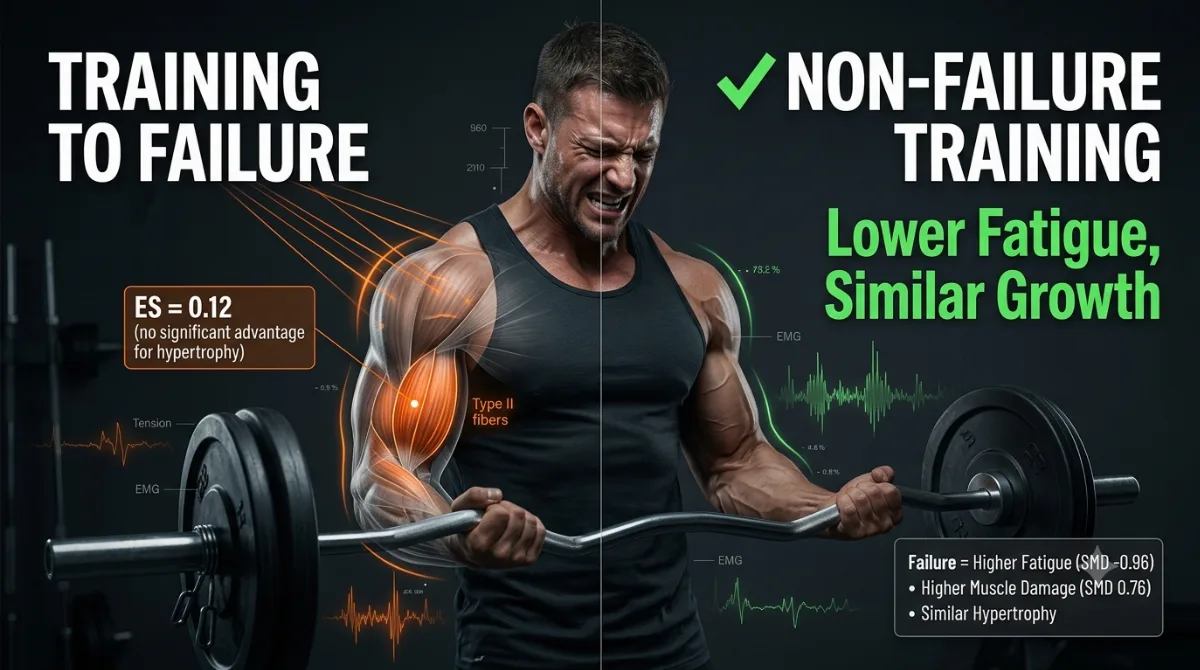
Training to failure is one of the most debated topics in strength training. A 2023 systematic review with meta-analysis found no evidence that training to momentary muscular failure is superior to non-failure training for muscle hypertrophy. However, for resistance-trained individuals, a separate meta-analysis found a significant effect of training to failure for muscle hypertrophy (ES = 0.15). The trade-off? Training to failure significantly increases acute fatigue (SMD -0.96), muscle damage (SMD 0.76), and perceived exertion (SMD 1.93) compared to non-failure training. It may also lengthen recovery times, potentially impairing performance in subsequent sessions. The takeaway: training to failure can be useful when applied strategically — for the final set of an exercise, for trained individuals, or when volume is low — but should not be used on every set to avoid excessive fatigue and recovery debt.
Quick answer: should you train to failure?
The research shows that training to failure is not necessary for muscle growth for most people. A 2023 meta-analysis found no evidence that failure training is superior for hypertrophy. However, for trained individuals, failure may provide a small additional benefit (ES = 0.15) — but at the cost of significantly more fatigue, muscle damage and recovery time.
Use Failure Strategically
Best used on the final set of an exercise only — not every set. Ideal for isolation exercises, not compounds. Useful for trained individuals who need a stronger stimulus.
Avoid Failure Most of the Time
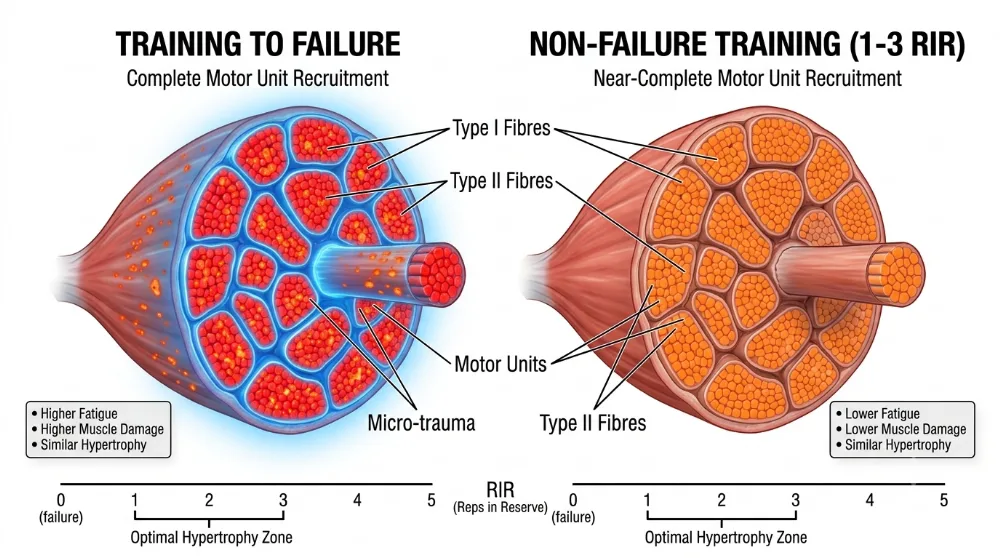
For most sets, stop 1-3 reps short of failure (RIR 1-3). This produces similar hypertrophy with significantly less fatigue, muscle damage and recovery demand.
Never Use Failure For
Beginners, compound lifts (squats, deadlifts, bench press), strength-focused training, or when you're not fully recovered from previous sessions.
Introduction
Walk into any gym and you'll hear it: "One more rep! Push to failure!" It's the battle cry of lifters everywhere. The idea is simple — if you push every set to the point where you physically can't do another rep, you're maximising muscle growth.
But is that actually true?
The research on training to failure tells a more complex story. Training to failure can be a powerful tool — but only when used strategically. Used too often, it can bury you in fatigue, impair recovery and actually slow your progress.
This guide breaks down what the peer-reviewed research says about training to failure — for muscle growth, strength gains, fatigue, recovery and practical application.
Anatomy / Biomechanics: What Happens When You Train to Failure?
The Physiology of Failure
When you perform a set to failure, several things happen:
| Mechanism | What Happens | Why It Matters |
|---|---|---|
| Motor unit recruitment | As fatigue sets in, higher-threshold motor units (type II fibres) are recruited to maintain force production | May stimulate more muscle fibres |
| Mechanical tension | The final reps are performed with maximum effort | Key driver of hypertrophy |
| Metabolic stress | Accumulation of metabolites (lactate, hydrogen ions) | May contribute to muscle growth signalling |
| Muscle damage | Micro-trauma to muscle fibres | Stimulates repair and growth, but requires recovery |
The Argument FOR Training to Failure
Proponents argue that training to failure is necessary because:
- It ensures full motor unit recruitment (Henneman's size principle)
- It creates maximal mechanical tension on muscle fibres
- It may be particularly beneficial for trained individuals who need a stronger stimulus
The Argument AGAINST Training to Failure
Critics point out that training to failure:
- Significantly increases fatigue compared to non-failure training
- Increases muscle damage and recovery time
- May not be necessary for hypertrophy — non-failure training produces similar results
- Can impair performance in subsequent sessions if used too frequently
The Science: What the Research Reveals
Source 1: The Big Question — Does Training to Failure Build More Muscle?
Study: Influence of Resistance Training Proximity-to-Failure on Skeletal Muscle Hypertrophy: A Systematic Review with Meta-analysis. Sports Medicine. 2023;53:649-665. Full text
What it found: This comprehensive review analysed 15 studies comparing training to failure vs non-failure for muscle hypertrophy.
- Set failure vs non-failure: Trivial advantage for failure training (ES = 0.19, p = 0.045)
- Momentary muscular failure vs non-failure: No significant difference (ES = 0.12, p = 0.343)
- Velocity loss thresholds: Higher velocity loss (closer to failure) did not always elicit greater hypertrophy
- Moderating factors: No moderating effect of volume load (p = 0.884) or relative load (p = 0.525)
Conclusion: "There is no evidence to support that resistance training performed to momentary muscular failure is superior to non-failure resistance training for muscle hypertrophy."
Key takeaway: For the average lifter, training to failure is not necessary for muscle growth. Stopping 1-3 reps short of failure produces similar hypertrophy with less fatigue.
Source 2: A Closer Look — Trained Individuals May Benefit More
Study: Effects of Resistance Training Performed to Repetition Failure or Non-Failure on Muscular Strength and Hypertrophy: A Systematic Review and Meta-Analysis. J Sport Health Sci. 2022;11(2):202-211. PubMed ID: 33497853
What it found: This meta-analysis of 15 studies found:
- Overall hypertrophy: No significant difference between failure and non-failure (ES = 0.22)
- Overall strength: No significant difference (ES = -0.09)
- Trained individuals: Significant effect of training to failure for hypertrophy (ES = 0.15)
- Volume non-equated studies: Non-failure training favoured for strength gains (ES = -0.32)
Key takeaway: For beginners and intermediates, training to failure is unnecessary. For advanced lifters, taking sets to failure may provide a small additional benefit for hypertrophy — but at the cost of increased fatigue.
Source 3: The Dark Side — Fatigue, Muscle Damage and Recovery
Study: Effects of Resistance Training to Muscle Failure on Acute Fatigue: A Systematic Review and Meta-Analysis. Sports Med. 2022;52(5):1103-1125. PubMed ID: 34881412
What it found: This meta-analysis of 20 studies compared acute fatigue responses between failure and non-failure training.
- Biomechanical properties (decrease): SMD -0.96 (p < 0.001)
- Metabolic response (increase): RMD 4.48 mmol·L⁻¹ (p < 0.001)
- Muscle damage (increase): SMD 0.76 (p = 0.001)
- Perceived exertion (RPE): SMD 1.93 (p < 0.001)
- 48h post-exercise muscle damage: SMD 0.86 (p = 0.002)
Key takeaway: Training to failure significantly increases fatigue, muscle damage and perceived exertion compared to non-failure training. The effects last for at least 48 hours post-exercise.
Source 4: Recovery Implications — Failure Lengthens Recovery Time
Study: The Importance of Recovery in Resistance Training Microcycle Construction. Journal of Human Kinetics. 2024;91:205-223. PMC ID: PMC11057610
What it found: This review examined how training variables affect recovery between sessions.
- "Training to failure may lengthen recovery times, potentially impairing performance; however, it may be suitable if implemented strategically ensuring adequate recovery between sessions of similar exercises or muscle groups."
- "Higher volumes may increase recovery demands, especially when paired with training to failure."
Key takeaway: Training to failure increases recovery demands. If you train to failure on every set, you may not be fully recovered for your next session — leading to accumulated fatigue and reduced performance.
Source 5: Non-Failure Training May Be Better for Strength
Study: Effects of Resistance Training Performed to Repetition Non-Failure on Exercise Performance in Healthy Adults: A Systematic Review and Meta-Analysis. 2026. Full text
What it found: This meta-analysis of 20 studies (556 participants) compared non-failure vs failure training.
- Dynamic strength: Non-failure training superior to failure (SMD = 0.24, p = 0.01)
- Hypertrophy: No significant difference
- Muscular endurance: No significant difference
- Power: No significant difference
Key takeaway: For strength gains, stopping short of failure may actually be superior to training to failure. For hypertrophy, both approaches are equally effective.
Practical Application
When to Use Training to Failure
| Scenario | Recommendation | Rationale |
|---|---|---|
| Final set of an exercise | ✅ Use failure | Maximises stimulus without excessive fatigue across all sets |
| Trained/advanced lifters | ✅ Use sparingly | May provide small additional hypertrophy benefit |
| Low volume training | ✅ Use | When total volume is low, failure can help ensure adequate stimulus |
| Plateau breaking | ✅ Use temporarily | Can help overcome stagnation |
| Every set | ❌ Avoid | Excessive fatigue, poor recovery |
| Compound exercises (squats, deadlifts) | ❌ Avoid | High injury risk; excessive CNS fatigue |
| Beginners | ❌ Avoid | Unnecessary; hypertrophy similar without failure |
| Strength-focused training | ❌ Avoid | Non-failure may be superior for strength |
How to Implement Training to Failure Strategically
The "One Set to Failure" Rule
The most practical approach: take only the final set of each exercise to failure.
| Set | Approach |
|---|---|
| Set 1 | 1-2 reps short of failure (RIR 1-2) |
| Set 2 | 1-2 reps short of failure (RIR 1-2) |
| Set 3 | To failure (0 RIR) |
Why: This maximises the stimulus on the last set while minimising fatigue accumulation across the session.
The "RIR" Approach (Reps in Reserve)
Instead of training to failure on every set, use the RIR (Reps in Reserve) method:
| Goal | Recommended RIR |
|---|---|
| Hypertrophy (most sets) | 1-3 RIR |
| Hypertrophy (final set) | 0 RIR (failure) |
| Strength | 1-3 RIR |
| Power | 3-5 RIR |
What is RIR? RIR stands for "Reps in Reserve" — how many more reps you could have performed with perfect form.
Example: If you're doing 10 reps and you feel you could have done 2 more with good form, you're at RIR 2.
The "Velocity Loss" Method
Research shows that higher velocity loss thresholds (closer to failure) don't always produce more growth. Instead:
- Stop when rep speed slows significantly (not when you fail)
- This typically corresponds to ~20-30% velocity loss
- Provides sufficient stimulus with less fatigue
Recommended Training Approach by Experience Level
| Training Status | Sets to Failure | Notes |
|---|---|---|
| Beginner (<1 year) | 0 per exercise | Focus on form, stop 2-3 reps short |
| Intermediate (1-3 years) | 1 per exercise (final set) | Use failure sparingly |
| Advanced (3+ years) | 1-2 per exercise | May benefit from failure on some sets |
| Strength focus | 0 per exercise | Non-failure may be better for strength |
Sample Workout Integration
Workout with Strategic Failure (Hypertrophy Focus)
- Bench Press — 4 sets of 8-10 reps (RIR: 2, 2, 1, 0) — Only final set to failure
- Incline Press — 3 sets of 10-12 reps (RIR: 2, 1, 0) — Final set only
- Cable Flyes — 3 sets of 12-15 reps (RIR: 2, 1, 0) — Final set only
- Triceps Pushdown — 3 sets of 12-15 reps (RIR: 1, 1, 0) — Final set only
Workout WITHOUT Failure (Strength Focus)
- Squat — 4 sets of 5-8 reps (RIR 1-2) — No failure — preserve CNS
- Deadlift — 3 sets of 5 reps (RIR 1-2) — No failure — high injury risk
- Leg Press — 3 sets of 10 reps (RIR 1-2) — No failure
- Leg Curl — 3 sets of 12 reps (RIR 1-2) — No failure
Who Should Use Which Approach
| Profile | Frequency of Failure | Rationale |
|---|---|---|
| Beginner | 0% of sets | Form > intensity; no need for failure |
| Hypertrophy-focused | 20-30% of sets (final sets only) | Maximises stimulus with manageable fatigue |
| Strength-focused | 0% of sets | Non-failure may be better for strength gains |
| Advanced bodybuilder | 30-50% of sets | May benefit from failure on some sets |
| Powerlifting | 0-10% of sets | Technique and CNS preservation are priority |
| Athlete (in-season) | 0% of sets | Avoid excessive fatigue that impairs sport performance |
Comparison Table: Training to Failure vs Non-Failure Training
| Factor | Training to Failure | Non-Failure Training |
|---|---|---|
| Hypertrophy (general) | Similar (ES = 0.12-0.19) | Similar |
| Hypertrophy (trained individuals) | Small advantage (ES = 0.15) | Slightly less |
| Strength gains | Similar or slightly worse | May be superior (SMD = 0.24) |
| Acute fatigue | Significantly higher (SMD -0.96) | Lower |
| Muscle damage | Significantly higher (SMD 0.76) | Lower |
| Perceived exertion | Significantly higher (SMD 1.93) | Lower |
| Recovery time | Longer | Shorter |
| Injury risk | Higher (especially on compounds) | Lower |
| Suitability for beginners | ❌ Not recommended | ✅ Recommended |
| Suitability for advanced lifters | ✅ Can be useful | ✅ Recommended |
| Suitability for compounds | ❌ Avoid | ✅ Recommended |
Common Mistakes Table
| Mistake | Why It Is a Problem | Fix |
|---|---|---|
| Taking every set to failure | Excessive fatigue, poor recovery, reduced performance | Limit failure to final sets only |
| Training to failure on compound lifts | High injury risk; excessive CNS fatigue | Use failure only on isolation exercises |
| Training to failure too frequently | Accumulated fatigue; overtraining | Use failure sparingly (1-2x per exercise) |
| Not leaving reps in reserve (RIR) | Unnecessary fatigue without extra gains | Stop at RIR 1-3 for most sets |
| Using failure as a beginner | Unnecessary; increases injury risk | Build a foundation first |
| Ignoring recovery after failure sets | Impaired next session performance | Ensure adequate recovery |
| Using failure for strength training | May impair strength gains | Stop short of failure for strength |
| Not monitoring fatigue | Overtraining; performance plateaus | Track recovery, adjust volume |
Warning / Safety Section: When to Avoid Training to Failure
Avoid training to failure if you're a beginner (unnecessary and risky), you're performing compound lifts (squats, deadlifts, bench press, overhead press), you're in a strength-focused phase (non-failure may be better for strength), you're not fully recovered from previous sessions, or you have poor form — fatigue compromises technique and increases injury risk.
Signs You're Overdoing It
| Sign | What It Means | Action |
|---|---|---|
| Decreased performance in subsequent sessions | Accumulated fatigue | Reduce frequency of failure training |
| Persistent soreness >48 hours | Excessive muscle damage | Reduce volume and failure frequency |
| Poor sleep or mood | Systemic fatigue | Take a deload week |
| Loss of motivation | Overreaching | Reduce intensity |
| Joint pain | Technique breakdown due to fatigue | Stop failure training on that exercise |
- Key safety principles: Limit failure to 1-2 sets per exercise — not every set. Avoid failure on compounds — use isolation exercises for failure sets. Prioritise form over intensity — fatigue breaks down form. Use RIR (Reps in Reserve) — stop 1-3 reps short for most sets. Monitor recovery — if you're not recovered, you're not progressing. Periodise failure training — use it in blocks, not year-round. Listen to your body — pain is information, not something to push through.
Takeaway
The research is clear: training to failure is not the "secret weapon" it's often made out to be — but it can be a useful tool when applied strategically.
For hypertrophy, training to failure is not significantly better than stopping 1-3 reps short of failure for most people. A 2023 meta-analysis found no evidence that failure training is superior for muscle growth.
For strength, non-failure training may actually be superior (SMD = 0.24).
For trained individuals, failure training may provide a small additional benefit for hypertrophy (ES = 0.15) — but at the cost of significantly more fatigue, muscle damage and recovery time.
The trade-off is clear: training to failure increases fatigue, muscle damage and perceived exertion significantly compared to non-failure training. It also lengthens recovery times, potentially impairing performance in subsequent sessions.
The best approach for most lifters: Use the "1-3 reps in reserve" (RIR) method for most sets. Reserve training to failure for the final set of an exercise — and only on isolation exercises, not compounds. This maximises the stimulus while keeping fatigue manageable.
Complete Reference List
- Influence of Resistance Training Proximity-to-Failure on Skeletal Muscle Hypertrophy: A Systematic Review with Meta-analysis. Sports Medicine. 2023;53:649-665. Full text
- Effects of Resistance Training Performed to Repetition Failure or Non-Failure on Muscular Strength and Hypertrophy: A Systematic Review and Meta-Analysis. J Sport Health Sci. 2022;11(2):202-211. PubMed ID: 33497853
- Effects of Resistance Training to Muscle Failure on Acute Fatigue: A Systematic Review and Meta-Analysis. Sports Med. 2022;52(5):1103-1125. PubMed ID: 34881412
- The Importance of Recovery in Resistance Training Microcycle Construction. J Hum Kinet. 2024;91:205-223. PMC ID: PMC11057610
- Effects of Resistance Training Performed to Repetition Non-Failure on Exercise Performance in Healthy Adults: A Systematic Review and Meta-Analysis. 2026. Full text
- Effect of Resistance Training to Muscle Failure vs. Volitional Interruption at High- and Low-Intensities on Muscle Mass and Strength. J Strength Cond Res. 2018;32(1):162-169. PubMed Search
- Acute fatigue and recovery responses to resistance training performed to momentary muscular failure. 2026. PubMed Search