The science-backed answer
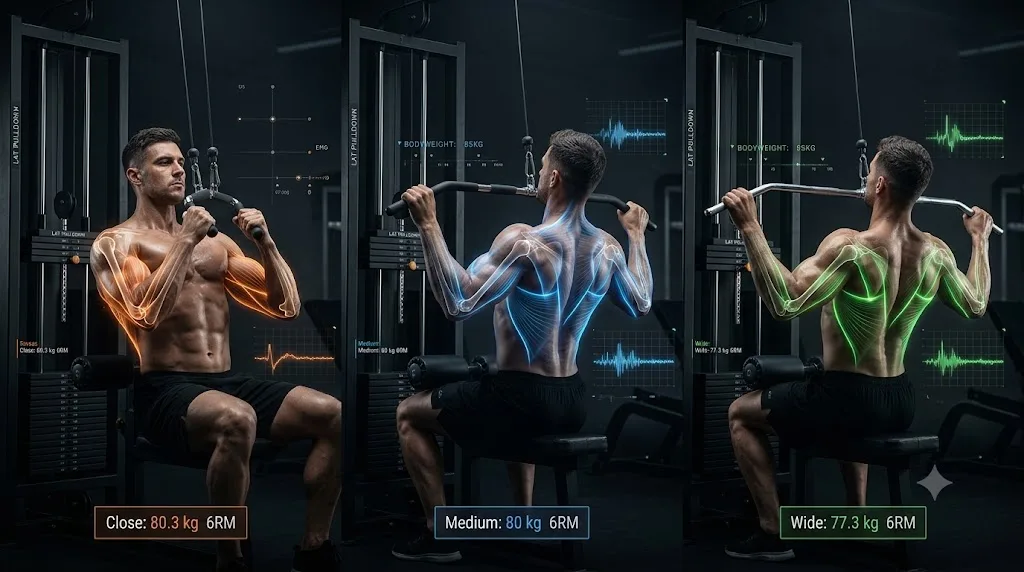
The lat pulldown is one of the most popular back exercises, but grip width may matter less than many lifters think. A 2014 study by Andersen and colleagues found similar muscle activation between narrow, medium and wide grips for the latissimus dorsi, trapezius and infraspinatus. However, narrow and medium grips allowed slightly heavier 6RM loads than wide grip.
A newer 2025 study also reported that grip variations may not significantly alter latissimus dorsi recruitment, challenging the common idea that wider automatically means better for lat growth.
Quick answer: which lat pulldown grip is best?
For most lifters, a medium grip around 1.5 times shoulder width is the best default choice. It offers a strong balance of load, range of motion, back activation and shoulder comfort.
Wide grip
Best for lat-to-biceps ratio and eccentric lat emphasis, but it usually allows less load and can increase shoulder stress.
Medium grip
Best all-round option for most lifters because it balances strength, activation, comfort and technique.
Close grip
Best for heavier loading, greater elbow flexion, more biceps involvement and shoulder comfort.
Introduction
The lat pulldown is one of the most versatile exercises in the gym. It helps build a wider back, strengthens the shoulders and supports better posture. But one question keeps coming up: how wide should your grip be?
Some lifters swear by a wide grip because they believe it is the only way to build a V-taper. Others prefer a close grip because it feels stronger and gives a better stretch. Medium grip often gets ignored, even though the research suggests it may be the most practical option for many people.
The truth is more nuanced. Grip width does not dramatically change lat activation, but it does affect load capacity, biceps involvement, range of motion and shoulder comfort.
Anatomy: what muscles work during the lat pulldown?
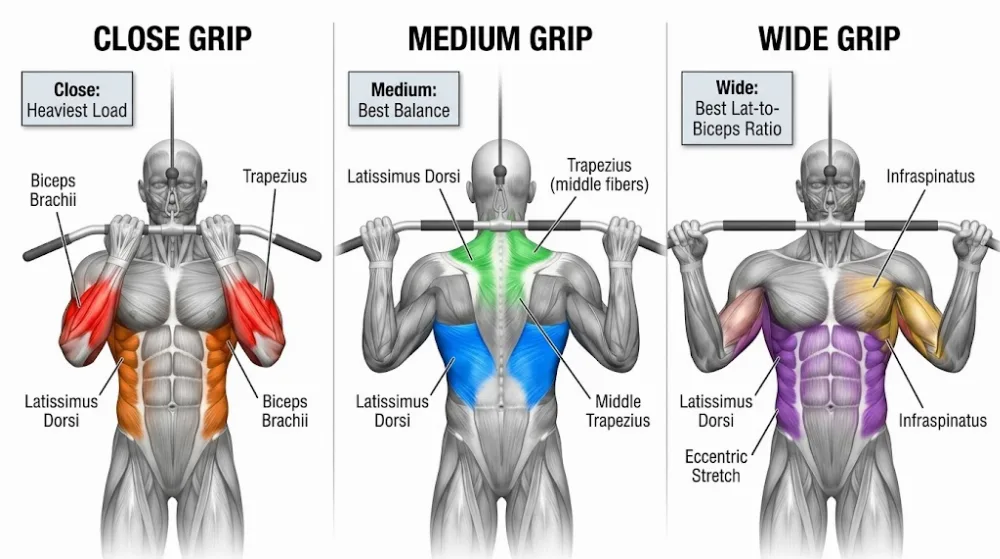
The lat pulldown is mainly a vertical pulling exercise. The latissimus dorsi is the main target, but several other muscles help control the movement.
| Muscle | Role in the lat pulldown |
|---|---|
| Latissimus dorsi | Primary back-width muscle; performs shoulder adduction and extension. |
| Middle trapezius | Helps retract the shoulder blades. |
| Lower trapezius | Supports scapular depression and control. |
| Posterior deltoid | Assists shoulder extension during the pull. |
| Infraspinatus | Supports shoulder external rotation and stability. |
| Biceps brachii | Assists with elbow flexion. |
| Teres major | Assists the latissimus dorsi in shoulder adduction. |
How grip width changes the movement
Grip width changes the mechanics of the lift. A close grip usually allows more elbow flexion and heavier loading. A wide grip reduces range of motion and may increase shoulder stress. A medium grip sits between both extremes.
| Feature | Close grip | Medium grip | Wide grip |
|---|---|---|---|
| Hand position | Inside or around shoulder width | About 1.5x shoulder width | About 2x shoulder width |
| Range of motion | Greater elbow flexion | Balanced | Reduced elbow flexion |
| Biceps involvement | Higher | Moderate | Lower |
| Lat emphasis | Moderate | Balanced | Slightly higher during eccentric phase |
| Load capacity | Highest in the 2014 study | Nearly highest in the 2014 study | Lowest in the 2014 study |
| Shoulder stress | Lower | Moderate | Higher |
The science: what the research says
2014 grip-width study
Andersen and colleagues compared narrow, medium and wide pronated grips during 6RM lat pulldowns. Narrow and medium grips allowed heavier loads than wide grip, but overall EMG activation was similar for the latissimus dorsi, trapezius and infraspinatus.
Practical takeaway: medium grip may offer a small practical advantage, but most lifters can expect similar hypertrophy potential across grips between 1 and 2 times shoulder width.
2025 grip-variation study
A 2025 electromyographic study reported no significant difference in latissimus dorsi activation across several grip variations. This challenges the common assumption that one grip width always targets the lats better.
Practical takeaway: choose the grip that allows good control, comfort and full range of motion.
Lat-to-biceps ratio research
Research comparing traditional back exercises found that wide grip pulldowns can produce a strong latissimus-to-biceps activation ratio. This may make the wide grip useful when the goal is reducing arm dominance.
Practical takeaway: wide grip can be useful, but it is not automatically superior for total back growth.
Forearm orientation research
Lusk and colleagues found that forearm orientation matters. A front pulldown with a pronated grip was recommended for targeting the latissimus dorsi, while grip width alone did not strongly change lat activation.
Practical takeaway: pull to the front with a controlled pronated grip. Avoid behind-the-neck pulldowns.
Wide vs medium vs close grip lat pulldown
| Option | Best for | Muscle emphasis | Strength/load | Safety note | Practical cue |
|---|---|---|---|---|---|
| Wide grip | Lat focus, eccentric emphasis, lat-to-biceps ratio | Lats, especially during controlled lowering | Usually lower load | More shoulder stress | Elbows wide, pull to chest, control the lowering |
| Medium grip | Overall back development | Balanced lats, traps and biceps | Strong loading potential | Moderate shoulder stress | Natural grip, pull to upper chest, squeeze shoulder blades |
| Close grip | Heavy loading, biceps involvement, shoulder comfort | Lats plus more biceps | Often allows the heaviest load | Usually easiest on shoulders | Elbows back, full range, feel the stretch |
How to do each lat pulldown grip correctly
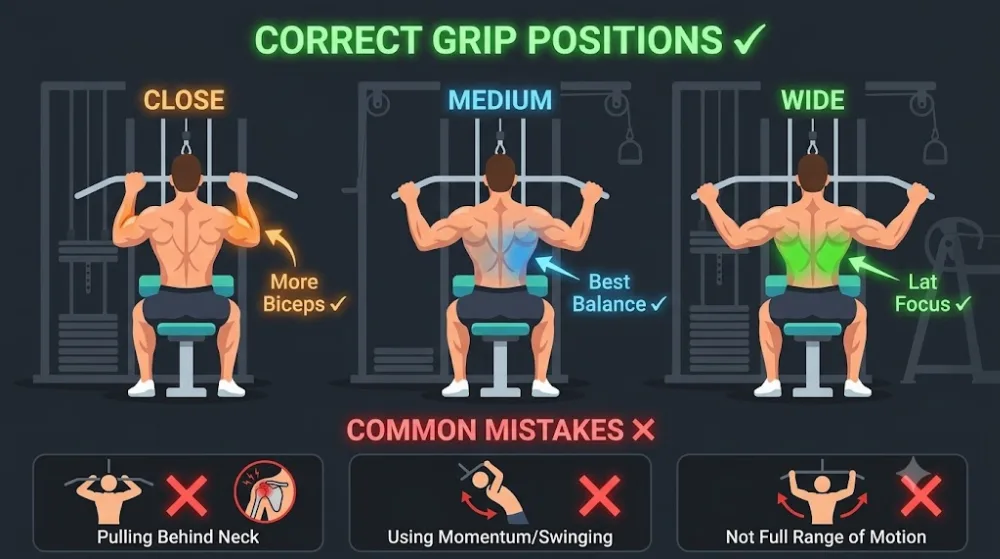
Wide grip lat pulldown
- Sit on the machine with your thighs secured under the pad.
- Grip the bar about 2 times shoulder width.
- Keep your chest up, shoulders down and core braced.
- Drive your elbows down and back.
- Pull the bar to the upper chest, not behind the neck.
- Control the return for 2–3 seconds.
Medium grip lat pulldown
- Grip the bar about 1.5 times shoulder width.
- Use a comfortable pronated grip.
- Pull the bar toward the upper chest.
- Focus on driving the elbows down rather than pulling with the hands.
- Pause briefly at the bottom and control the eccentric.
Close grip lat pulldown
- Use a shoulder-width or slightly narrower grip.
- Allow a full stretch at the top without losing shoulder control.
- Drive the elbows back and down.
- Expect more biceps involvement.
- Use this grip when shoulder comfort or heavier loading is the priority.
Recommended sets, reps and load
| Goal | Grip | Sets | Reps | Load | Notes |
|---|---|---|---|---|---|
| Overall back strength | Medium | 3–4 | 8–10 | 75–80% 1RM | Best balance of strength and activation |
| Lat focus | Wide | 3–4 | 8–12 | 65–75% 1RM | Emphasise the lowering phase |
| Biceps plus back | Close | 3–4 | 10–12 | 65–75% 1RM | More biceps involvement |
| Lat-to-biceps ratio | Wide pronated | 3 | 8–10 | 70–80% 1RM | Useful when arms dominate the movement |
| Strength | Narrow or medium | 3–5 | 5–8 | 80–85% 1RM | Heavier loads are usually possible |
Who should use which grip?
| Lifter profile | Recommended grip | Reason |
|---|---|---|
| Most lifters | Medium grip | Best mix of strength, activation and comfort. |
| Trying to reduce arm dominance | Wide pronated grip | Can improve the lat-to-biceps emphasis. |
| Heavy loading focus | Narrow or medium grip | Usually allows more weight than wide grip. |
| Eccentric emphasis | Wide grip | May increase lat and infraspinatus activation during the lowering phase. |
| Shoulder discomfort | Medium or close grip | Often places less stress on the shoulder than a very wide grip. |
| Beginner | Medium grip | Most natural and easiest to learn. |
Common lat pulldown mistakes
| Mistake | Why it is a problem | Fix |
|---|---|---|
| Using momentum | Reduces back tension and increases injury risk. | Control the eccentric for 2–3 seconds. |
| Pulling behind the neck | Can increase shoulder stress and reduce useful lat focus. | Pull to the front of the upper chest. |
| Partial range of motion | Limits stretch and contraction quality. | Use a full stretch at the top and full contraction at the bottom. |
| Grip too wide | Can reduce load capacity and increase shoulder stress. | Use medium grip for most main working sets. |
| Pulling with the hands | Makes the biceps dominate. | Think about driving the elbows down and back. |
| Shrugging during the pull | Reduces lat focus and shoulder control. | Keep shoulders depressed throughout the movement. |
Sample back workouts using different pulldown grips
Workout 1: overall back development
- Medium grip lat pulldown — 4 sets of 8–10 reps
- Barbell row — 3 sets of 10 reps
- Seated cable row — 3 sets of 10–12 reps
- Face pulls — 3 sets of 15 reps
Workout 2: lat focus and eccentric emphasis
- Wide grip lat pulldown — 4 sets of 10–12 reps with slow lowering
- Close grip lat pulldown — 3 sets of 10–12 reps
- Dumbbell row — 3 sets of 10 reps per side
- Straight arm pulldown — 3 sets of 12 reps
Workout 3: strength and heavy loading
- Narrow grip lat pulldown — 5 sets of 5–8 reps
- Medium grip lat pulldown — 3 sets of 8–10 reps
- Barbell row — 3 sets of 8–10 reps
- Face pulls — 3 sets of 15 reps
Safety: when to stop or modify
Stop the exercise immediately if you feel sharp shoulder, elbow or wrist pain, joint locking, catching, giving way or pain that continues after your workout.
- Shoulder impingement: avoid very wide grips and never pull behind the neck. Use medium or close grip.
- Elbow irritation: reduce load and consider neutral-grip attachments.
- Wrist pain: avoid excessive wrist extension and use a grip that feels natural.
- Beginners: start with medium grip and master control before experimenting.
Takeaway
Grip width in the lat pulldown matters, but not in the simple way many gym lifters believe. Wide grip does not automatically mean more lat growth. Medium grip usually gives the best balance of strength, comfort and activation. Close grip can be useful for heavier loading and shoulder comfort. Wide grip can still be valuable when the goal is eccentric lat emphasis or a better lat-to-biceps ratio.
The best approach is to use a medium grip for most main sets, add wide grip for controlled eccentric work and use close grip when heavier loading or joint comfort is the priority.
Complete reference list
- Andersen V, Fimland MS, Wiik E, Skoglund A, Saeterbakken AH. Effects of Grip Width on Muscle Strength and Activation in the Lat Pull-Down. J Strength Cond Res. 2014;28(4):1135-1142. PubMed ID: 24662157.
- Buonsenso A, Di Fonza D, Di Claudio G, et al. Electromyographic Analysis of Back Muscle Activation During Lat Pulldown Exercise: Effects of Grip Variations and Forearm Orientation. J Funct Morphol Kinesiol. 2025;10(3):345.
- Variations in muscle activation levels during traditional latissimus dorsi weight training exercises: An experimental study. Dynamic Medicine. 2004;3:4.
- Lusk SJ, Hale BD, Russell DM. Grip width and forearm orientation effects on muscle activity during the lat pull-down. J Strength Cond Res. 2010;24(7):1895-1900. PubMed ID: 20543730.
- A Comparative Electromyographical Investigation of Muscle Utilization Patterns Using Various Hand Positions During the Lat Pull-Down.