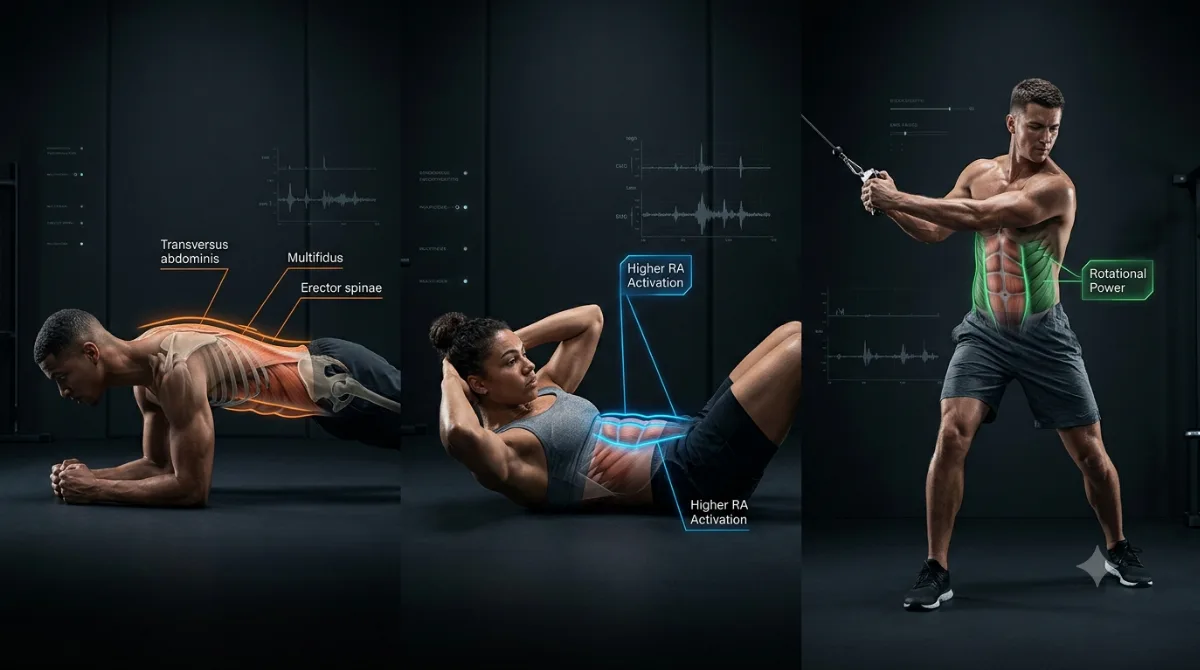
Here's what the science shows
Different core exercises target different muscles — and the "best" exercise depends on your goal. Crunches produce significantly higher rectus abdominis activation than planks, making them superior for six-pack development. However, planks are better for spinal stabilisation and can effectively target the multifidus and erector spinae. Side planks are superior for oblique and lumbar paraspinal recruitment. The cable woodchop is the go-to for rotational core strength, making it essential for athletes and functional training. The takeaway: use all three — crunches for rectus abdominis hypertrophy, planks for spinal stability and endurance, and cable woodchops for rotational power and functional core strength.
Quick answer: which core exercise is best for you?
Each core exercise serves a different purpose. Crunches are best for six-pack development and rectus abdominis hypertrophy. Planks are superior for spinal stabilisation, back health and endurance. Cable woodchops are the go-to for rotational power and functional strength for athletes.
Plank
Best for spinal stability, posture and core endurance. Targets the transversus abdominis, multifidus and erector spinae. Essential for back health and injury prevention.
Crunch
Best for six-pack development and rectus abdominis hypertrophy. Produces significantly higher RA activation than planks (p < 0.01). Ideal for aesthetic core development.
Cable Woodchop
Best for rotational power, functional strength and athletic performance. Essential for sports like golf, tennis, baseball and combat sports.
Introduction
The core is arguably the most misunderstood muscle group in the gym. Walk into any weight room and you'll see people doing crunches, holding planks, or swinging cables — each claiming their method is the "best" way to build a strong core.
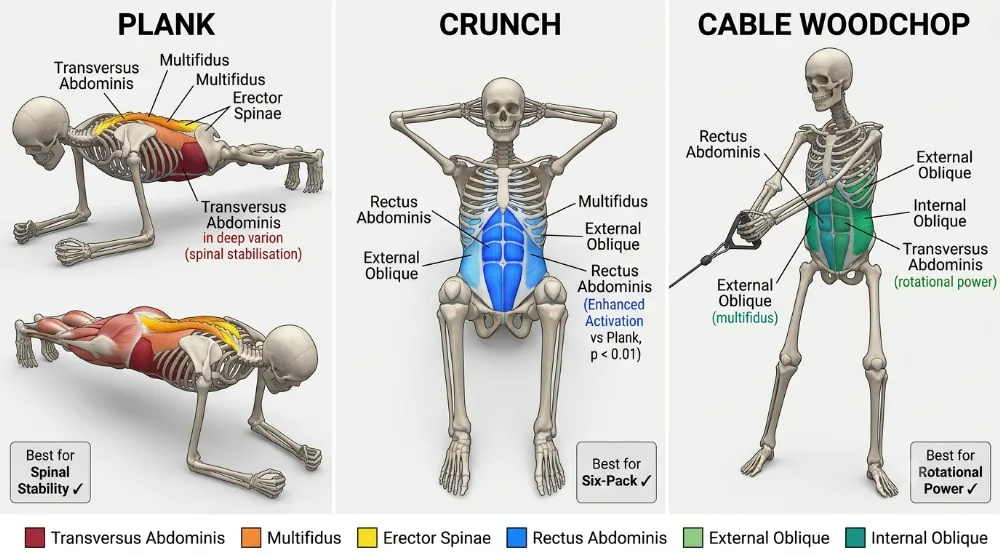
But here's the truth: there is no single best core exercise. The core isn't one muscle — it's a complex system of muscles with different functions. The rectus abdominis (your "six-pack") flexes your spine. The obliques rotate and stabilise your torso. The deeper stabilisers (transversus abdominis, multifidus) protect your spine.
Each exercise targets different parts of this system. Crunches build the six-pack. Planks build spinal stability and endurance. Cable woodchops build rotational power and functional strength.
This guide breaks down what the peer-reviewed research says about planks, crunches and cable woodchops — for muscle activation, functional strength and practical application.
Anatomy / Biomechanics: The Core Muscle System
The Primary Core Muscles
| Muscle | Location | Primary Function | Best Targeted By |
|---|---|---|---|
| Rectus Abdominis (Upper/Lower) | Front of abdomen, from ribs to pelvis | Spinal flexion (crunching motion) | Crunches |
| External Oblique | Side of abdomen (superficial) | Trunk rotation, lateral flexion | Side planks, woodchops |
| Internal Oblique | Side of abdomen (deep to external) | Trunk rotation, stabilisation | Woodchops, rotational exercises |
| Transversus Abdominis | Deepest abdominal layer | Core stabilisation, spinal support | Planks, hollow-body holds |
| Multifidus | Deep spinal muscles | Spinal stability and segmental control | Planks, bird-dog |
| Erector Spinae | Lower back, along spine | Spinal extension, posture | Planks, back extensions |
How Each Exercise Changes the Movement
| Feature | Plank | Crunch | Cable Woodchop |
|---|---|---|---|
| Movement type | Isometric (static hold) | Dynamic (concentric/eccentric) | Dynamic (rotational) |
| Primary joint action | Stabilisation | Spinal flexion | Trunk rotation |
| Rectus abdominis | Moderate | Highest | Low-Moderate |
| External oblique | Moderate (side plank: high) | Low-Moderate | Highest |
| Internal oblique | Moderate | Low-Moderate | Highest |
| Transversus abdominis | Highest (stabilisation) | Low | Moderate |
| Erector spinae | Highest (spinal support) | Low | Moderate |
| Functional carryover | Posture, stability | Aesthetic (six-pack) | Sports, rotational power |
The key insight: each exercise serves a different purpose — choose based on your goal, not blindly following what others do.
The Science: What the Research Reveals
Source 1: Crunch vs Plank — Rectus Abdominis Activation
Study: Comparison of Two Common Core Training Exercises to a Functional Activity in Trunk Flexors. J Strength Cond Res
What it found: Researchers compared EMG activity of the rectus abdominis (RA) and external oblique (EO) during crunches and planks.
- Rectus abdominis recruitment: Significantly higher in crunches compared to planks (p < 0.01)
- External oblique: Both exercises may be ineffective for conditioning the EO
Key takeaway: If your goal is six-pack development, crunches are more effective than planks. But if you want to target your obliques, neither exercise is optimal.
Source 2: Plank vs Crunch — Similar Recruitment, Different Function
Study: Electromyographical Comparison of the Abdominal Crunch to Planks Performed With and Without a Suspension Trainer. 2017. ScholarWorks
What it found: Researchers compared relative recruitment of the rectus abdominis and external oblique during crunches, planks and TRX planks.
- RA and EO recruitment: Similar among crunch, plank and TRX plank
- TRX knee tuck: Produced significantly greater overall muscle activity than other exercises (p < 0.05)
Key takeaway: While crunches may produce higher peak rectus abdominis activation, the difference may not be as dramatic as once thought. Both exercises effectively recruit the core.
Source 3: Side Plank — Superior for Obliques
Study: Muscle Activation Among Supine, Prone, and Side Position Exercises With and Without a Swiss Ball. 2016. PMC
What it found: Researchers compared muscle activation across different core positions.
- Side plank: Produced significantly greater oblique activation than crunches or prone planks
- Prone exercises: Good alternatives to supine exercises for recruiting core musculature
- Side position exercises: Better for oblique and lumbar paraspinal recruitment
Key takeaway: For oblique development, side planks are superior to crunches and prone planks. If you want to target your obliques, add side planks to your routine.
Source 4: Plank for Spinal Stability — Multifidus and Erector Spinae
Study: Effects of Whole Body Vibration Exercise on Lumbar-Abdominal Muscles Activation for Patients With Chronic Low Back Pain. 2020. PubMed
What it found: Researchers identified the best exercises for activating specific core muscles.
- Plank: Best for multifidus and erector spinae
- V crunch: Best for rectus abdominis
- Single bridge: Best for external oblique
Key takeaway: The plank is the superior choice for spinal stabilisation and targeting the deep back muscles (multifidus and erector spinae). This makes it essential for posture, back health and injury prevention.
Source 5: Prone vs Supine vs Side — Position Matters
Study: Muscle Activation Among Supine, Prone, and Side Position Exercises. 2016. PubMed
What it found: Researchers compared core muscle activation across different body positions.
- Upper/lower rectus abdominis: Significantly greater in crunch, bent-knee sit-up, and prone position exercises compared to side position exercises
- Prone position: Good alternative to supine position for recruiting core musculature
- Side position: Better for oblique and lumbar paraspinal recruitment
Key takeaway: Your body position determines which core muscles are activated. Supine (lying on your back) and prone (lying on your front) positions target the rectus abdominis. Side positions target the obliques and lower back.
Source 6: Cable Woodchop — Rotational Core Strength
Study: Influence of Trunk Rotator Strength on Rotational Medicine Ball Throwing Performance. 2023. PubMed
What it found: Researchers assessed the relationship between trunk rotation strength and functional performance.
- Horizontal and low cable woodchop: Assessed with a functional electromechanical dynamometer
- Golf swing-specific cable woodchop strength: Significantly greater (28%) in lower-handicap golfers
Key takeaway: The cable woodchop is the superior choice for rotational core strength and functional performance — making it essential for athletes in rotational sports (golf, tennis, baseball, combat sports).
Step-by-Step Instructions: How to Do Each Core Exercise Correctly
Plank (and Side Plank)
Standard Plank:
- Set up — start in a push-up position, forearms on the floor, elbows directly under shoulders.
- Position — body in a straight line from head to heels, core braced, glutes engaged.
- Hold — maintain the position without letting your hips sag or rise.
- Breathe — breathe steadily; don't hold your breath.
- Duration — hold for 30-60 seconds (or until form breaks).
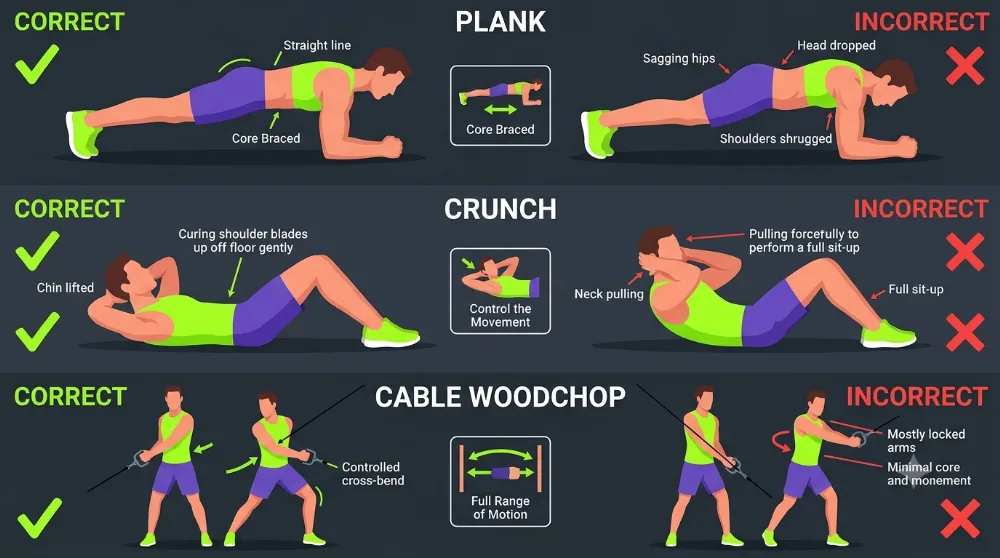
Key cues: Straight line — imagine a broomstick along your spine. Core braced — as if preparing to be punched. Glutes engaged — squeeze your glutes to protect your lower back. No sagging — hips should not drop toward the floor.
Side Plank (for obliques):
- Lie on your side, propped up on your forearm, elbow under shoulder.
- Stack your feet, lift your hips until your body forms a straight line.
- Hold, keeping your core braced and hips lifted.
- Repeat on the other side.
Crunch (and V Crunch)
Standard Crunch:
- Set up — lie on your back, knees bent, feet flat on the floor.
- Position — hands behind your head (don't pull on your neck) or crossed over your chest.
- Curl — lift your shoulder blades off the floor, curling your ribcage toward your pelvis.
- Squeeze — pause at the top, squeezing your abdominals.
- Lower — control the descent back to the starting position (2-3 seconds).
- Repeat — keep tension throughout; don't use momentum.
Key cues: Chin off chest — keep a fist-sized gap between chin and chest. Curl, don't sit up — only your shoulder blades lift. No pulling on neck — hands are for support, not leverage.
V Crunch (for lower abs):
- Lie on your back, legs straight, arms extended overhead.
- Simultaneously lift your upper body and legs, forming a "V" shape.
- Squeeze at the top, lower under control.
Cable Woodchop (High-to-Low & Low-to-High)
High-to-Low Woodchop:
- Set up — attach a rope or handle to a cable pulley at high position.
- Position — stand perpendicular to the cable, feet shoulder-width apart, arms extended.
- Rotate — pull the handle diagonally downward across your body, rotating your torso.
- Squeeze — pause at the bottom, feeling your obliques contract.
- Return — control the return to the start position (2-3 seconds).
- Repeat — complete all reps on one side before switching.
Low-to-High Woodchop (for variety):
- Attach the cable at a low position.
- Pull diagonally upward across your body.
- This variation targets the obliques from a different angle.
Key cues: Rotate from your core — not just your arms. Keep a slight bend in your knees — allows for rotation. Control the movement — don't let the weight swing you. Squeeze at the bottom — feel the oblique contraction.
Recommended Sets, Reps and Load
| Goal | Exercise | Sets | Reps/Duration | Load | Notes |
|---|---|---|---|---|---|
| Rectus abdominis / six-pack | Crunch | 3-4 | 12-20 reps | Bodyweight | Slow tempo (2-3 sec eccentric) |
| Core stability / spinal health | Plank | 3 | 30-60 sec | Bodyweight | Focus on form over duration |
| Oblique development | Side Plank | 3/side | 30-45 sec | Bodyweight | Superior for oblique activation |
| Rotational power | Cable Woodchop | 3-4/side | 10-15 reps | Moderate | Control the movement |
| Lower abs / overall core | V Crunch | 3 | 10-15 reps | Bodyweight | Good for rectus abdominis |
| Complete core development | All three (periodised) | 3 each | Varied | Varied | Targets all core functions |
Who Should Use Which Option
| Profile | Recommended | Rationale |
|---|---|---|
| Six-pack development | Crunches (primary) + Planks (accessory) | Crunches = higher RA activation |
| Posture / back health | Plank (primary) | Targets multifidus + erector spinae |
| Oblique definition | Side Plank (primary) | Superior oblique activation |
| Athletic / rotational sports | Cable Woodchop (primary) | Builds rotational power |
| General fitness | All three (rotate) | Balanced core development |
| Beginners | Plank + Crunch | Learn stability and flexion |
| Low back pain | Plank (with caution) | Strengthens spinal stabilisers |
Comparison Table: Plank vs Crunch vs Cable Woodchop
| Option | Best For | Muscle Emphasis | Functional Carryover | Safety Note | Practical Cue |
|---|---|---|---|---|---|
| Plank | Spinal stability, endurance, posture | Multifidus, erector spinae, transversus abdominis | Posture, back health, injury prevention | Low risk; avoid sagging | "Straight line, brace core, squeeze glutes" |
| Side Plank | Oblique development, lateral stability | External oblique (significantly greater than crunch) | Side-to-side stability, injury prevention | Low risk; keep hips lifted | "Stack feet, lift hips, straight line" |
| Crunch | Six-pack hypertrophy | Rectus abdominis (higher activation than plank) | Aesthetic (six-pack) | Low risk; avoid neck strain | "Chin up, curl, don't pull neck" |
| V Crunch | Upper + lower rectus abdominis | Rectus abdominis (upper and lower) | Aesthetic, core strength | Moderate; lower back strain if uncontrolled | "Lift legs and torso together" |
| Cable Woodchop | Rotational power, functional strength | External/internal oblique, transversus abdominis | Sports performance (golf, tennis, baseball) | Low-moderate; use controlled weight | "Rotate from core, not arms" |
Common Mistakes Table
| Mistake | Why It Is a Problem | Fix |
|---|---|---|
| Sagging hips (plank) | Increases lower back stress; reduces core activation | Brace core, squeeze glutes, keep straight line |
| Holding breath (plank) | Increases blood pressure; reduces stability | Breathe steadily throughout |
| Pulling on neck (crunch) | Cervical spine stress; neck pain | Hands behind head for support only |
| Using momentum (crunch) | Reduces muscle tension; limits growth | Control both phases (2-3 sec eccentric) |
| Rushing reps (all) | Reduces time under tension | Slow tempo for all exercises |
| Swinging weight (woodchop) | Uses momentum, not core; reduces effectiveness | Control the movement; don't let weight swing you |
| Only doing one exercise | Misses other core functions | Use all three for complete development |
| Not progressing | Plateaus in core strength | Add weight or increase difficulty |
Sample Workout Integration
Workout 1: Core Stability + Endurance
- Plank — 3 sets of 45-60 seconds (bodyweight) — Focus on form
- Side Plank — 3 sets per side of 30-45 seconds (bodyweight) — Oblique focus
- Crunch — 3 sets of 15-20 reps (bodyweight) — Slow tempo
- Bird-Dog — 3 sets per side of 10 reps (bodyweight) — Spinal stability
Workout 2: Hypertrophy + Six-Pack Focus
- Crunch — 4 sets of 15-20 reps (bodyweight) — High reps
- V Crunch — 3 sets of 12-15 reps (bodyweight) — Lower abs
- Cable Woodchop — 3 sets per side of 10-12 reps (moderate load) — Rotational
- Leg Raises — 3 sets of 12-15 reps (bodyweight) — Lower abs
Workout 3: Functional + Athletic Core
- Cable Woodchop — 4 sets per side of 10-12 reps (moderate load) — Rotational power
- Plank (weighted) — 3 sets of 30-45 seconds (moderate load) — Add plate on back
- Side Plank (weighted) — 3 sets per side of 30 seconds (moderate load) — Add plate on hip
- Med Ball Rotational Throws — 3 sets per side of 8-10 reps (light load) — Explosive rotation
Recommended Weekly Volume
| Training Status | Sets per Week | Recommendation |
|---|---|---|
| Beginner | 6-9 sets | 2 sessions/week, 2-3 exercises |
| Intermediate | 10-15 sets | 2-3 sessions/week |
| Advanced | 15-20 sets | 3-4 sessions/week, periodised |
Warning / Safety Section: When to Stop or Modify
Stop the exercise immediately if you experience sharp, stabbing pain in the lower back, neck or spine; pain that worsens during the movement (not just muscle burn); joint locking, catching or giving way; or pain that persists after your workout.
- Lower back pain: avoid crunches that involve spinal flexion; use planks for stability work.
- Neck pain: never pull on your neck during crunches; keep hands behind head for support only.
- Shoulder pain: planks may aggravate shoulders; use elbow planks or reduce duration.
- Wrist pain: use forearm planks instead of hand planks.
- New to core training: start with planks and basic crunches before progressing to woodchops.
- Key safety principles: maintain a neutral spine (especially during planks), control the movement (don't use momentum), breathe steadily (don't hold your breath), progress gradually (increase duration/reps before adding weight), and listen to your body — pain is information, not something to push through. Warm up properly with light cardio and dynamic stretches before core work.
Takeaway
The research is clear: planks, crunches and cable woodchops each serve a different purpose — and the best approach is to use all three.
Crunches produce significantly higher rectus abdominis activation than planks (p < 0.01). They are the superior choice for six-pack development and hypertrophy.
Planks are best for spinal stabilisation and effectively target the multifidus and erector spinae. Side planks are superior for oblique and lumbar paraspinal recruitment.
Cable woodchops are the go-to exercise for rotational core strength and functional performance — making them essential for athletes in rotational sports.
Body position matters — supine and prone positions target the rectus abdominis; side positions target the obliques and lower back.
The best approach for most lifters: Periodise your training. Use crunches for six-pack development, planks for spinal stability and endurance, and cable woodchops for rotational power and functional core strength. Train your core 2-4 times per week and progressively overload over time.
Complete Reference List
- Comparison of Two Common Core Training Exercises to a Functional Activity in Trunk Flexors. J Strength Cond Res — Crunch produced significantly higher RA recruitment than plank (p < 0.01).
- Electromyographical Comparison of the Abdominal Crunch to Planks Performed With and Without a Suspension Trainer. 2017. ScholarWorks
- Muscle Activation Among Supine, Prone, and Side Position Exercises With and Without a Swiss Ball. 2016. PMC
- Effects of Whole Body Vibration Exercise on Lumbar-Abdominal Muscles Activation for Patients With Chronic Low Back Pain. 2020. PubMed
- Influence of Trunk Rotator Strength on Rotational Medicine Ball Throwing Performance. 2023. PubMed
- Are anthropometric, flexibility, muscular strength, and endurance variables related to clubhead velocity in low- and high-handicap golfers? PubMed
- An Electromyographic Analysis of Three Abdominal Core Muscles: Comparing The Crunch To The Plank. 1997. J Strength Cond Res
- EMG activation of abdominal muscles in the crunch exercise performed with different external loads. 2009. PubMed