The science-backed answer
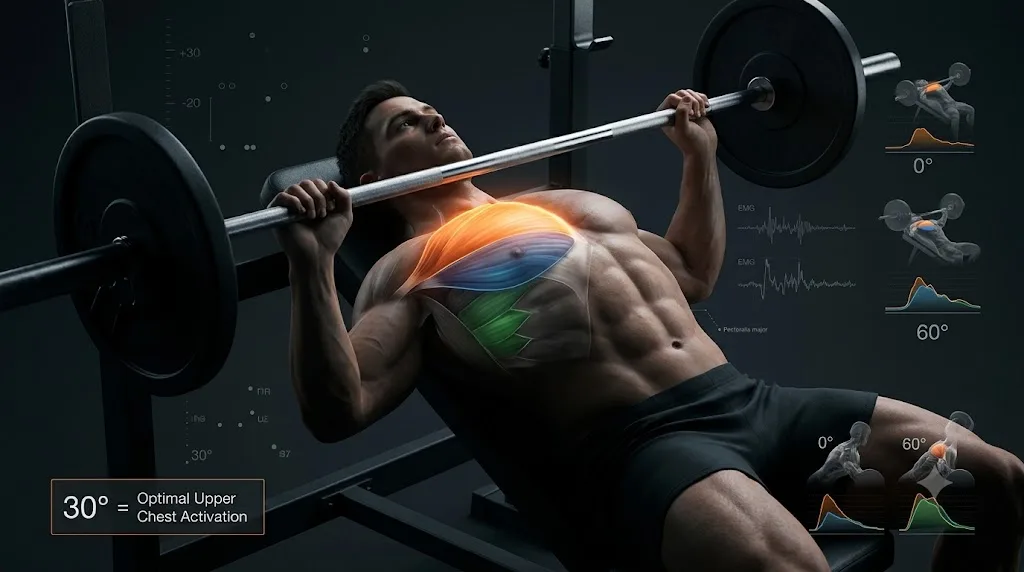
The incline bench press is the go-to exercise for targeting the upper chest, also called the clavicular head of the pectoralis major. But the bench angle matters. A 2020 study by Rodríguez-Ridao and colleagues found that maximal EMG activity for the upper pectoralis occurred at a bench inclination of 30°.
The same research found that inclinations greater than 45° produced significantly higher anterior deltoid activation and reduced the muscular performance of the pectoralis major. In simple terms: when the bench gets too steep, the movement becomes more shoulder press than chest press.
Quick answer: what is the best incline bench angle?
For most lifters, the best incline bench press angle for upper chest growth is 30°. A range of 30–45° can work, but going above 45° usually shifts too much emphasis to the shoulders.
30° incline
Best default angle for upper chest activation and overall chest-focused pressing.
15–20° incline
Useful for lifters who feel too much shoulder involvement at higher angles.
45° incline
Still useful, but it involves more anterior deltoid and may feel shoulder-dominant.
Introduction
The incline bench press is one of the most popular chest exercises in the gym. It is commonly used to build the upper chest, the area near the collarbone that gives the pecs a fuller and more rounded look.
But many lifters guess the angle. Some set the bench barely above flat. Others press at a steep 60° angle and wonder why they feel the movement mostly in their shoulders.
The problem is simple: bench angle changes which muscles do the work. Too flat, and the movement becomes closer to a flat bench press. Too steep, and the anterior deltoids take over. This guide breaks down what the research says about the best incline bench angle for upper chest activation, shoulder involvement and practical training.
Anatomy: what changes with incline bench angle?
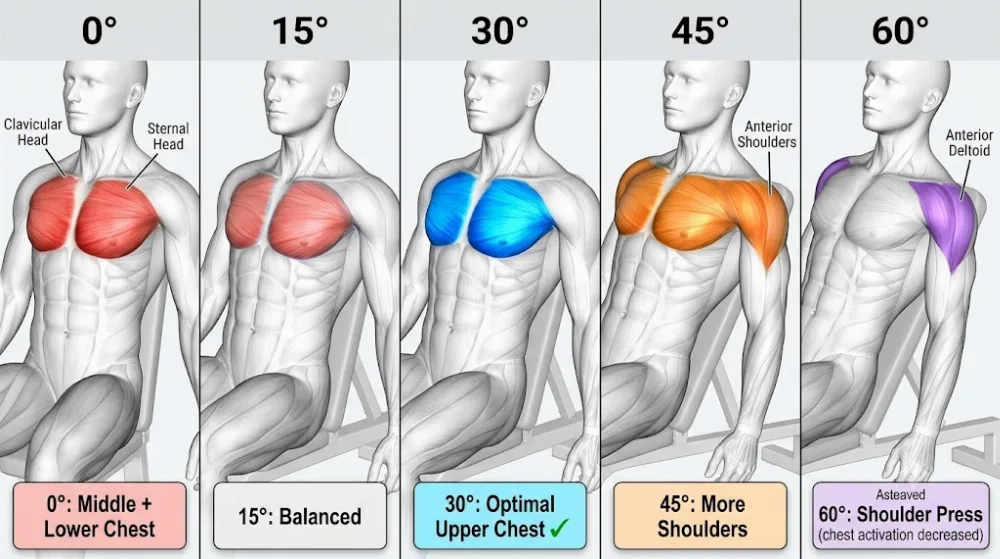
The pectoralis major has different regions that contribute differently depending on pressing angle. The incline bench press mainly targets the clavicular head, but only when the angle is chosen correctly.
| Chest portion | Location | Primary function | Best targeted by |
|---|---|---|---|
| Clavicular head | Upper chest near the collarbone | Shoulder flexion | Incline press around 30° |
| Sternal head | Middle chest near the sternum | Shoulder adduction | Flat press around 0° |
| Costal head | Lower chest near the ribs | Shoulder extension | Decline pressing patterns |
How bench angle changes the movement
As the bench angle increases, the movement shifts from a horizontal press toward a vertical press. That means the upper chest may work more at moderate inclines, but the shoulders increasingly dominate at steeper inclines.
| Feature | 0° flat | 15° | 30° | 45° | 60°+ |
|---|---|---|---|---|---|
| Upper chest activation | Low | Moderate | Maximum | High | Moderate |
| Middle chest activation | Maximum | High | Moderate | Low | Low |
| Lower chest activation | Maximum | Moderate | Low | Low | Very low |
| Anterior deltoid activation | Low | Moderate | Moderate | High | Maximum |
| Shoulder stress | Low | Low | Moderate | High | Very high |
The science: what the research reveals
2020 five-angle EMG study
Rodríguez-Ridao and colleagues compared bench press angles of 0°, 15°, 30°, 45° and 60°. The highest upper pectoralis activation occurred at 30°, while the anterior deltoid was highest at 60°.
Practical takeaway: 30° is the strongest evidence-based default for upper chest focus. Above 45°, the shoulders take over more.
Incline vs decline bench research
Glass and Armstrong compared incline and decline pressing. They found greater lower pectoral activation during decline pressing, while upper pectoral activation did not differ significantly between incline and decline.
Practical takeaway: incline pressing is still useful, but it is a specialised tool, not automatically superior for total chest development.
Bench angle and activation timing
Lauver and colleagues studied barbell bench press at 0°, 30°, 45° and -15°. The research suggested that 30° and 45° can produce greater activation during certain phases of the press.
Practical takeaway: 30–45° is a useful range, but individual comfort and shoulder mechanics still matter.
30–45° range recommendation
Trebs and colleagues reported that incline angles between 30° and 45° activate the clavicular head effectively.
Practical takeaway: stay in the 30–45° range for upper chest work, with 30° as the best starting point.
Incline bench angle comparison
| Angle | Best for | Muscle emphasis | Shoulder involvement | Safety note | Practical cue |
|---|---|---|---|---|---|
| 0° flat | Middle and lower chest, overall pressing strength | Middle and lower pectoralis | Low | Lower shoulder stress | Standard bench press |
| 15° | Shoulder-friendly upper chest work | Upper and middle pectoralis | Low to moderate | Often easiest on shoulders | Slight incline, gentle on shoulders |
| 30° | Optimal upper chest focus | Upper pectoralis | Moderate | Best balance | Use 30° for upper chest focus |
| 45° | Upper chest plus shoulders | Upper pectoralis and anterior deltoid | High | More shoulder stress | Useful, but more delt-heavy |
| 60°+ | Shoulder press emphasis | Anterior deltoid, less chest | Very high | Avoid for chest-focused work | Too steep for chest development |
How to set up the incline bench press correctly
Set the right angle
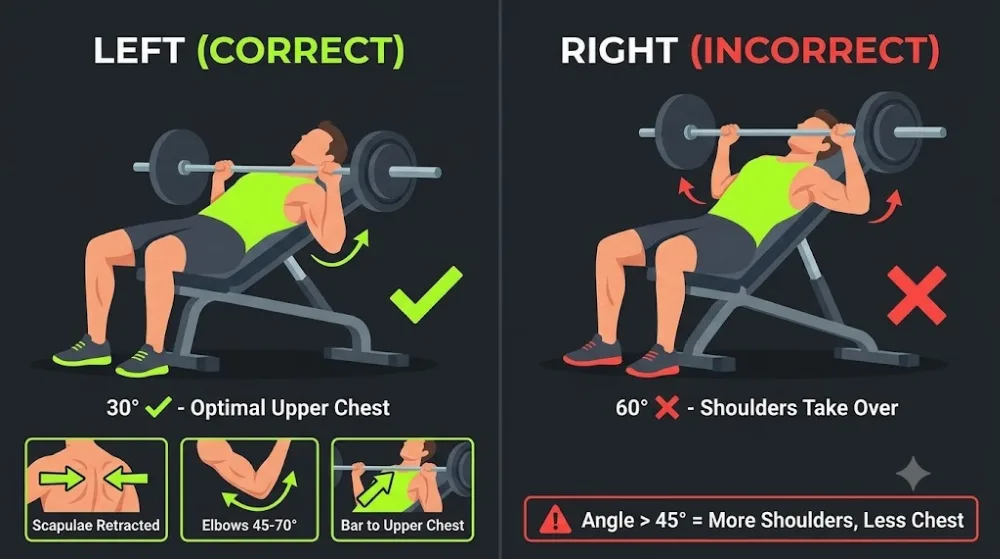
- Start at 30° for upper chest focus.
- If your shoulders dominate, lower the bench to 15–20°.
- Do not exceed 45° if your goal is chest development.
- Keep your back position consistent so you do not change the effective angle.
Incline bench press form
- Lie on a bench angled at 30°.
- Plant your feet firmly on the floor.
- Retract and depress your shoulder blades.
- Use a grip slightly wider than shoulder width.
- Lower the bar to the upper chest under control.
- Press up and slightly back while maintaining tension.
Shoulder-friendly adjustment
- Lower the bench to 15–20° if the movement feels too shoulder-heavy.
- Keep elbows around 45–70° from the torso.
- Use dumbbells if a barbell irritates your shoulders or elbows.
- Reduce load until the chest, not the joints, is doing the work.
Recommended sets, reps and load
| Goal | Angle | Sets | Reps | Load | Notes |
|---|---|---|---|---|---|
| Upper chest hypertrophy | 30° | 3–4 | 8–12 | 65–80% 1RM | Optimal for upper pec activation |
| Upper chest plus shoulders | 45° | 3–4 | 8–10 | 65–75% 1RM | More shoulder involvement |
| Strength | 30° | 3–5 | 5–8 | 80–85% 1RM | Good balance of chest and triceps |
| Shoulder-friendly pressing | 15–20° | 3–4 | 10–12 | 65–75% 1RM | Less shoulder stress |
| Variety and periodisation | Rotate 15–45° | 3–4 | 8–12 | 65–80% 1RM | Different stimulus over time |
Who should use which incline angle?
| Lifter profile | Recommended angle | Reason |
|---|---|---|
| Upper chest focus | 30° | Maximal EMG activity for the upper pectoralis. |
| Shoulder sensitivity | 15–20° | Usually less anterior deltoid involvement. |
| Strength athlete | 30° | Good balance of chest and triceps contribution. |
| Bodybuilder | 30–45° rotation | Allows variety while staying chest-focused. |
| Beginner | 30° | Most natural and effective starting point. |
| Shoulder-dominant lifter | 15–20° | Reduces shoulder compensation. |
Common incline bench press mistakes
| Mistake | Why it is a problem | Fix |
|---|---|---|
| Bench angle too steep | Shifts the load to the shoulders and reduces chest involvement. | Set the bench to 30° and avoid going above 45°. |
| Angle too flat | Does not strongly target the upper chest. | Increase toward 30° for upper chest work. |
| Excessive lower-back arch | Changes the effective angle and reduces upper chest focus. | Keep your back stable and ribs controlled. |
| Elbows flared too wide | Can increase shoulder impingement risk. | Keep elbows roughly 45–70° from the torso. |
| Not retracting scapulae | Reduces chest tension and increases shoulder stress. | Pull shoulder blades together and down before pressing. |
| Bouncing the bar | Uses momentum instead of muscle tension. | Lower under control for 2–3 seconds. |
| Partial range of motion | Limits useful stretch and contraction. | Use a controlled full range that your shoulders tolerate. |
Sample workouts using incline bench angles
Workout 1: upper chest focus
- Incline barbell press at 30° — 4 sets of 8–10 reps
- Incline dumbbell press at 30° — 3 sets of 10–12 reps
- Low-to-high cable crossover — 3 sets of 12–15 reps
- Face pulls — 3 sets of 15 reps
Workout 2: full chest development
- Flat barbell bench press — 4 sets of 8–10 reps
- Incline dumbbell press at 30° — 3 sets of 10–12 reps
- Decline dumbbell press — 3 sets of 10–12 reps
- Cable crossovers — 3 sets of 12–15 reps
Workout 3: shoulder-friendly chest day
- Incline dumbbell press at 15–20° — 4 sets of 10–12 reps
- Flat dumbbell press — 3 sets of 10–12 reps
- Pec deck flyes — 3 sets of 12–15 reps
- Band pull-aparts — 3 sets of 15 reps
Safety: when to stop or modify
Stop the exercise immediately if you feel sharp shoulder, elbow or wrist pain, pain that worsens during the movement, joint locking, catching, giving way or pain that persists after training.
- Shoulder impingement: lower the angle to 15–20° and keep elbows around 45° from the torso.
- Elbow tendinopathy: use dumbbells instead of a barbell for a more natural movement path.
- Lower back pain: keep your feet flat and avoid excessive arching.
- Beginners: start with dumbbells and lighter loads before moving heavy.
Takeaway
The research is clear: 30° is the best default incline bench angle for upper chest activation. It produces strong upper pectoralis involvement while keeping the press chest-focused.
Flat bench remains better for the middle and lower chest. A 45° incline can still work, but it brings in more shoulder involvement. Above 45°, the anterior deltoids usually take over and chest contribution drops.
For most lifters, use 30° for your main upper chest work. If your shoulders dominate, reduce the angle to 15–20°. Rotate between 15° and 45° for variety, but avoid 60°+ if your goal is chest development.
Complete reference list
- Rodríguez-Ridao D, Antequera-Vique JA, Martín-Fuentes I, Muyor JM. Effect of Five Bench Inclinations on the Electromyographic Activity of the Pectoralis Major, Anterior Deltoid, and Triceps Brachii during the Bench Press Exercise. Int J Environ Res Public Health. 2020;17(19):7339. PubMed ID: 33049982.
- Lauver JD, Cayot TE, Scheuermann BW. Influence of bench angle on upper extremity muscular activation during bench press exercise. Eur J Sport Sci. 2016;16(3):309-316. PubMed ID: 25799093.
- Trebs AA, Brandenburg JP, Pitney WA. An electromyography analysis of three muscles surrounding the shoulder joint during the performance of a chest press exercise at several angles. J Strength Cond Res. 2010;24(7):1928-1934.
- Glass S, Armstrong T. Electromyographical Activity of the Pectoralis Muscle During Incline and Decline Bench Presses. J Strength Cond Res. 1997;11(3):163-167.
- Motor Unit Recruitment of the Pectoral Muscle During Incline and Decline Bench Press. Medicine & Science in Sports & Exercise.