Here's what the science shows
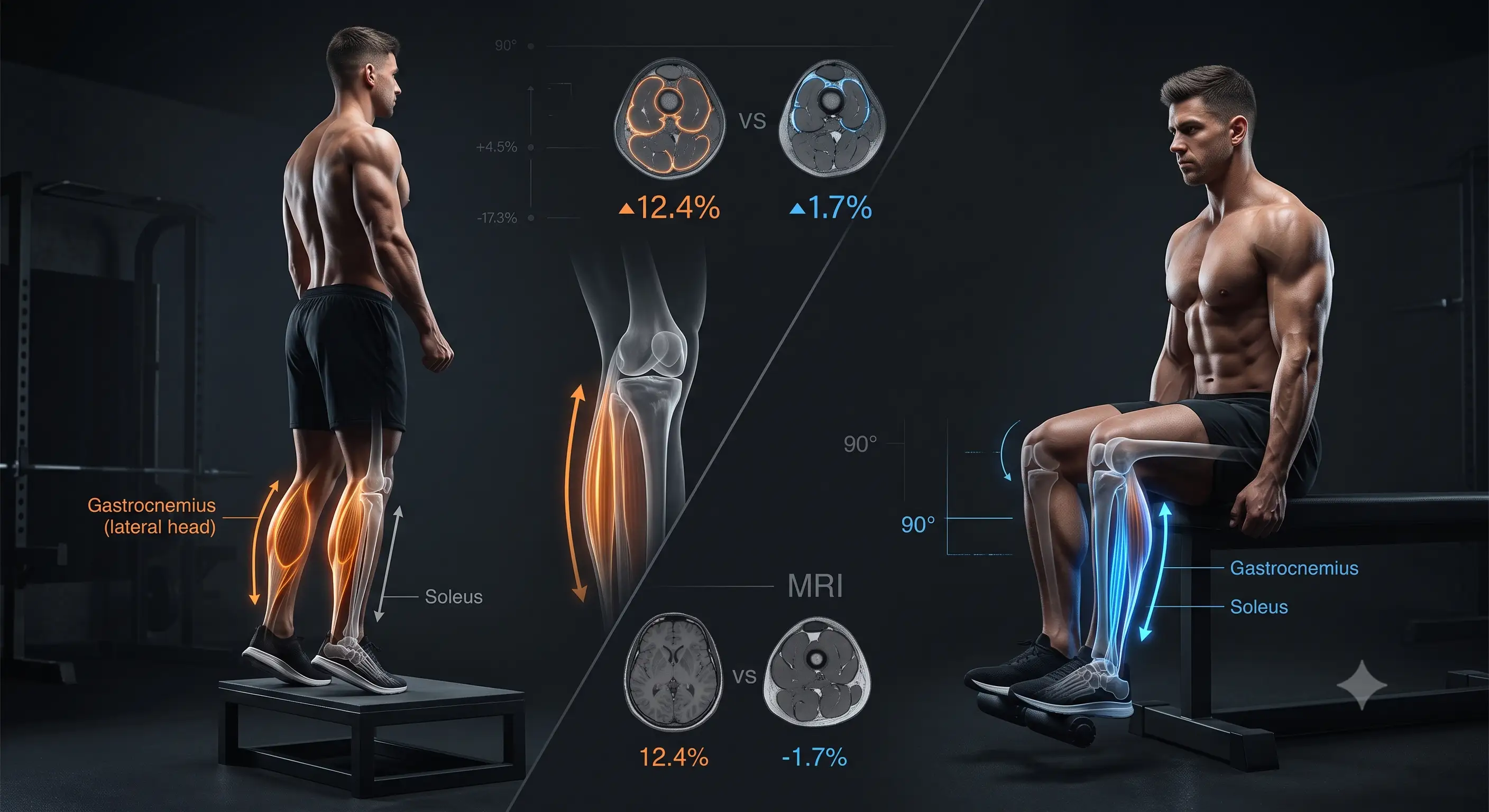
The triceps surae (calf muscles) are notoriously difficult to grow. But a landmark 2023 study found that standing calf raises produced 12.4% lateral gastrocnemius growth and 9.2% medial gastrocnemius growth over 12 weeks, compared to just 1.7% and 0.6% for seated calf raises. The soleus, however, grew similarly in both positions (2.1% vs 2.9%). Why? The gastrocnemius crosses the knee joint – it's stretched and placed under greater tension when the knee is straight (standing). The soleus only crosses the ankle – it's activated regardless of knee angle. The takeaway: standing calf raises for gastrocnemius development; seated calf raises for soleus emphasis. Use both for complete calf development.
Short answer
Standing and seated calf raises target different muscles due to knee position. The gastrocnemius crosses the knee joint, so it is stretched and maximally activated during standing calf raises (knee straight). The soleus only crosses the ankle, so it is activated equally in both positions, making seated calf raises ideal for isolating it. A landmark 2023 study showed standing calf raises produced up to 15x more gastrocnemius growth than seated. The best approach: use both – standing for overall calf size and gastrocnemius peak, seated for soleus thickness and depth.


Research source disclaimer. All research cited in this article is sourced from peer-reviewed studies indexed in PubMed, NIH/NCBI-linked sources, or reputable journals where available. Links to the original studies are provided throughout.
Introduction
The calf muscles – often called the "triceps surae" – are one of the most stubborn muscle groups in the human body. Walk into any gym and you'll see lifters with impressive upper bodies and relatively underdeveloped calves.
But here's the thing: calves are not impossible to grow. You're just training them wrong.
The key to unlocking calf growth lies in understanding a simple piece of anatomy: the gastrocnemius crosses the knee joint, while the soleus does not. This means the position of your knee during calf raises changes which muscle does the work.
So which is better – standing or seated calf raises? The answer isn't as simple as "one is superior." The research tells a clear story: standing calf raises are far more effective for gastrocnemius growth, while seated calf raises target the soleus. The best approach? Use both.
This guide breaks down what the peer-reviewed research actually says about standing versus seated calf raises – for muscle activation, hypertrophy and practical application.
Anatomy / Biomechanics: The Triceps Surae
The Calf Muscles
| Muscle | Origin | Insertion | Crosses Knee? | Primary Function |
|---|---|---|---|---|
| Gastrocnemius (lateral head) | Lateral femoral condyle | Calcaneus (via Achilles tendon) | Yes | Ankle plantarflexion; knee flexion assistance |
| Gastrocnemius (medial head) | Medial femoral condyle | Calcaneus (via Achilles tendon) | Yes | Ankle plantarflexion; knee flexion assistance |
| Soleus | Tibia and fibula (posterior) | Calcaneus (via Achilles tendon) | No | Ankle plantarflexion (postural and endurance) |
Why Knee Position Matters
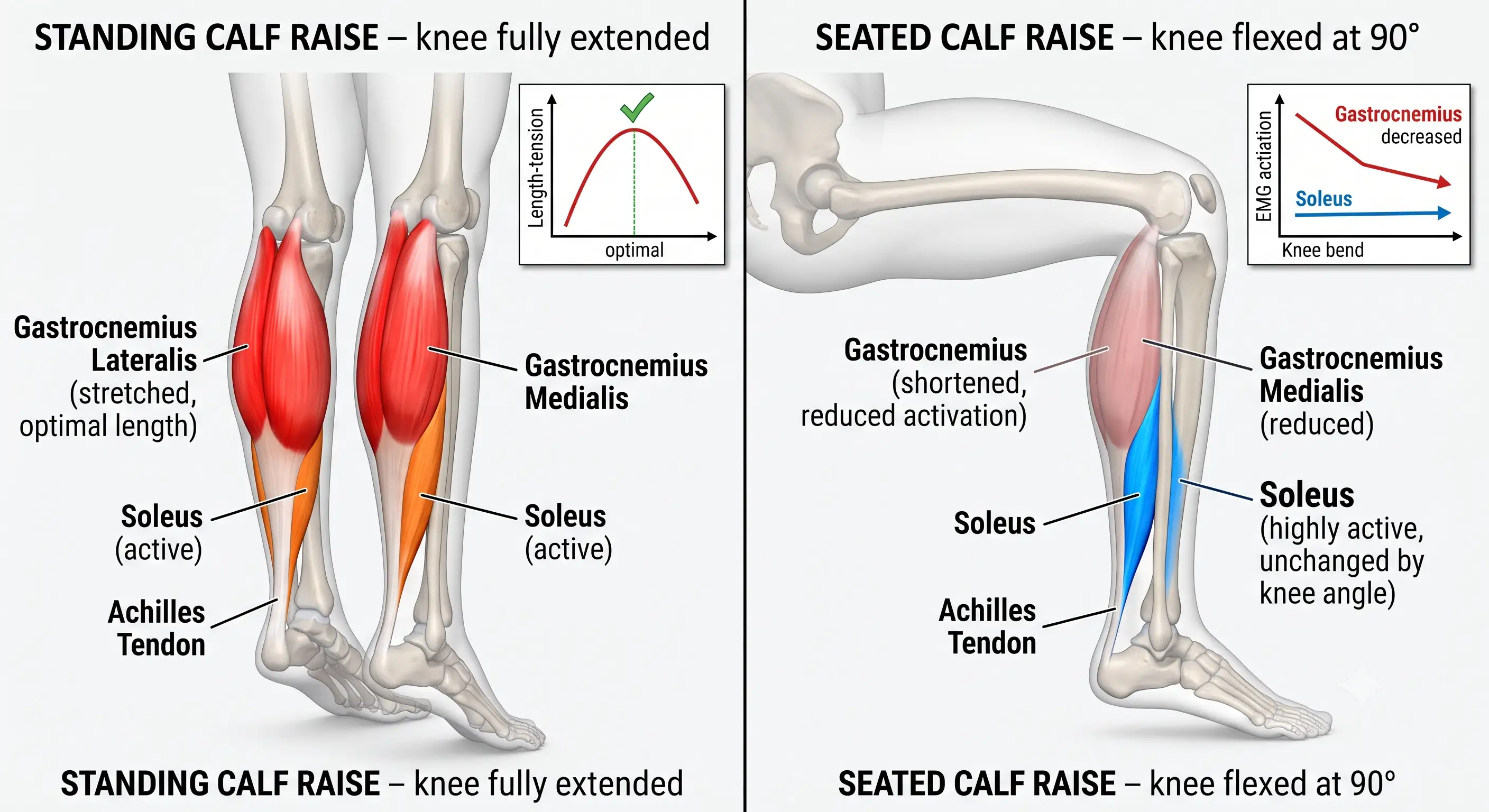
The gastrocnemius is a bi-articular muscle – it crosses both the knee and ankle joints. When you bend your knee (as in a seated calf raise), the gastrocnemius is shortened and placed in a mechanically disadvantaged position. This reduces its ability to generate force and limits the hypertrophic stimulus.
The soleus is a mono-articular muscle – it only crosses the ankle joint. Its activation is unaffected by knee angle. This means the soleus works just as hard whether your knee is straight or bent.
Key Biomechanical Differences
| Feature | Standing Calf Raise | Seated Calf Raise |
|---|---|---|
| Knee position | Extended (straight) | Flexed (~90°) |
| Gastrocnemius length | Lengthened (stretched) | Shortened |
| Gastrocnemius activation | High – optimal length-tension relationship | Reduced – mechanically disadvantaged |
| Soleus activation | High | High – unaffected by knee angle |
| Load capacity | Higher (can use more weight) | Lower (limited by knee position) |
| Primary target | Gastrocnemius (overall calf size) | Soleus (calf thickness/depth) |
The Science: What the Research Reveals
Landmark hypertrophy study: Standing calf raises produced 12.4% lateral gastroc growth vs 1.7% for seated. Soleus grew similarly in both.
Bending the knee reduces gastrocnemius activation without increasing soleus activation. You simply get less total stimulus.
Multi- and single-joint resistance exercises promote similar plantar flexor activation. Choice can be based on preference.
Gastrocnemius EMG activity decreases at greater knee flexion angles. Soleus shows no change across joint positions.
Source 1: The Landmark Hypertrophy Study – Standing vs Seated Calf Raises
Study: Kinoshita M, Maeo S, Kobayashi Y, et al. Triceps surae muscle hypertrophy is greater after standing versus seated calf-raise training. Front Physiol. 2023;14:1272106.
PMC ID: PMC10753835
https://pmc.ncbi.nlm.nih.gov/articles/PMC10753835/
What it found: Fourteen untrained adults conducted calf-raise training with one leg in a standing/knee-extended position and the other leg in a seated/knee-flexed position at 70% of one-repetition maximum. Each leg performed 10 repetitions/set, 5 sets/session, 2 sessions/week for 12 weeks. MRI scans measured muscle volume before and after.
| Muscle | Standing Condition | Seated Condition | Difference |
|---|---|---|---|
| Lateral Gastrocnemius | +12.4% | +1.7% | Standing 7x more growth |
| Medial Gastrocnemius | +9.2% | +0.6% | Standing 15x more growth |
| Soleus | +2.1% | +2.9% | No significant difference |
| Whole Triceps Surae | +5.6% | +2.1% | Standing significantly greater |
"Standing calf-raise was by far more effective, therefore recommended, than seated calf-raise for inducing muscle hypertrophy of the gastrocnemius and consequently the whole triceps surae".
Key takeaway: Standing calf raises are dramatically more effective for gastrocnemius growth (up to 15x more). The soleus grows similarly in both positions.
Source 2: Knee Position Affects Gastrocnemius Activation
Study: Knee position affects medial gastrocnemius and soleus activation during dynamic plantarflexion: no evidence for an inter-muscle compensation in healthy young adults. 2024.
URL: PMC
What it found: This study examined how knee position affects muscle activation during dynamic plantarflexion (calf raise movements). "Knee position affects medial gastrocnemius and soleus activation during dynamic plantarflexion, with plantarflexion torque being smaller in the knee-flexed versus knee-extended position. However ... and reduces plantarflexion strength, with decreased medial gastrocnemius activity but no compensatory increase in soleus activation".
Key takeaway: Bending the knee reduces gastrocnemius activation without increasing soleus activation. You don't "make up" for the loss – you simply get less total stimulus.
Source 3: EMG Comparison – Multi-Joint vs Single-Joint Exercises
Study: Gentil P, et al. Multi- and Single-Joint Resistance Exercises Promote Similar Plantar Flexor Activation in Resistance Trained Men. Int J Environ Res Public Health. 2020;17(24):9487.
PubMed ID: 33352879
https://pubmed.ncbi.nlm.nih.gov/33352879/
What it found: Twenty-two trained men performed leg press and calf raise exercises using a 10-repetition maximum load. EMG activity was measured for the soleus, medial and lateral gastrocnemius.
| Muscle | Leg Press (%MVIC) | Calf Raise (%MVIC) | Significance |
|---|---|---|---|
| Lateral Gastrocnemius | 49.20% | 50.70% | p = 0.230 |
| Medial Gastrocnemius | 51.31% | 52.19% | p = 0.668 |
| Soleus | 50.76% | 51.34% | p = 0.535 |
"There were no significant differences between exercises for any muscle (lateral gastrocnemius (p = 0.230), medial gastrocnemius (p = 0.668), and soleus (p = 0.535))".
Key takeaway: Calf raises (both standing and seated variations) effectively activate the triceps surae. The choice between exercises can be based on personal preference and practical aspects without negative impact on muscle activation.
Source 4: Gastrocnemius Activity Decreases with Knee Flexion
Study: Arampatzis A, et al. (2006) – referenced in multiple sources.
What it found: Electromyographic (EMG) activity in the gastrocnemius decreases at greater knee flexion angles (more knee bend). The soleus, however, shows no change in activity across differing knee flexion angles.
Key takeaway: This biomechanical principle explains why standing (straight knee) calf raises are superior for gastrocnemius activation – the muscle is in its optimal length-tension relationship.
Source 5: Eccentric Calf Exercise and Knee Position
Study: Electromyographic analysis of an eccentric calf muscle exercise in persons with and without Achilles tendinopathy. Phys Ther Sport. 2012.
URL: PubMed
What it found: This study compared EMG activity of the gastrocnemius and soleus muscles during eccentric calf exercises in different knee joint positions. "The gastrocnemius muscle was significantly more active in the extended knee condition and soleus muscle activity was unchanged across joint positions".
Key takeaway: For eccentric training (lowering phase), the gastrocnemius is more active with a straight knee – making standing calf raises more effective for both concentric and eccentric work.
Source 6: Training Volume and Calf Hypertrophy
Study: Bigger Calves from Doing Higher Resistance Training Volume? Int J Sports Med. 2024;45(10):739-747.
What it found: Sixty-one untrained young women performed a calf training program for 6 weeks, 3 days per week, with differences in resistance training volume. "Although all groups experienced calf muscle hypertrophy, our results suggest that the higher dose range may optimize triceps surae muscle size gains".
Key takeaway: Volume matters for calf growth. Higher training volume (more sets per week) may optimise triceps surae hypertrophy.
Practical Application
Step-by-Step Instructions
Standing Calf Raise
- Set up – stand on a calf raise machine or a raised platform (step/block) with the balls of your feet on the edge.
- Position – keep your knees straight (extended) but not locked out.
- Lower – drop your heels as far down as possible – feel the stretch in your gastrocnemius.
- Drive – push through the balls of your feet to raise your heels as high as possible.
- Squeeze – hold the top position for 1-2 seconds.
- Control – lower under control (2-3 seconds).
- Repeat – maintain tension throughout.
Seated Calf Raise
- Set up – sit on a seated calf raise machine with the pad across your thighs.
- Position – keep your knees flexed at approximately 90°.
- Lower – drop your heels as far down as possible – feel the stretch in your soleus.
- Drive – push through the balls of your feet to raise your heels.
- Squeeze – hold the top position for 1-2 seconds.
- Control – lower under control (2-3 seconds).
- Repeat – maintain tension throughout.
Recommended Sets, Reps and Load
| Goal | Exercise | Sets | Reps | Load | Notes |
|---|---|---|---|---|---|
| Gastrocnemius growth | Standing | 4-5 | 8-12 | 70-80% 1RM | Straight knee; full range |
| Soleus development | Seated | 3-4 | 10-15 | 65-75% 1RM | 90° knee; slow tempo |
| Complete calf development | Both | 3-4 each | 10-15 | 65-80% 1RM | Periodise your training |
| Strength | Standing | 4-5 | 5-8 | 80-90% 1RM | Heavier loads |
| Rehab / tendon health | Seated | 3 | 15-20 | Light | Higher reps; lower load |
Who Should Use Which Option?
| Profile | Recommended | Rationale |
|---|---|---|
| Overall calf size | Standing (primary) + Seated (accessory) | Standing = 12.4% LG growth vs 1.7% seated |
| Gastrocnemius emphasis | Standing | Gastrocnemius is lengthened with straight knee |
| Soleus emphasis | Seated | Soleus activation is unaffected by knee angle |
| Achilles tendinopathy | Seated (initially) | Reduced gastrocnemius tension; progress to standing |
| Calf stubbornness | Both (high volume) | Higher dose range may optimise growth |
| Beginner | Both (light) | Learn the movement pattern; build tendon resilience |
Comparison Table: Standing vs Seated Calf Raises
| Option | Best For | Muscle Emphasis | Joint / Safety Note | Practical Cue |
|---|---|---|---|---|
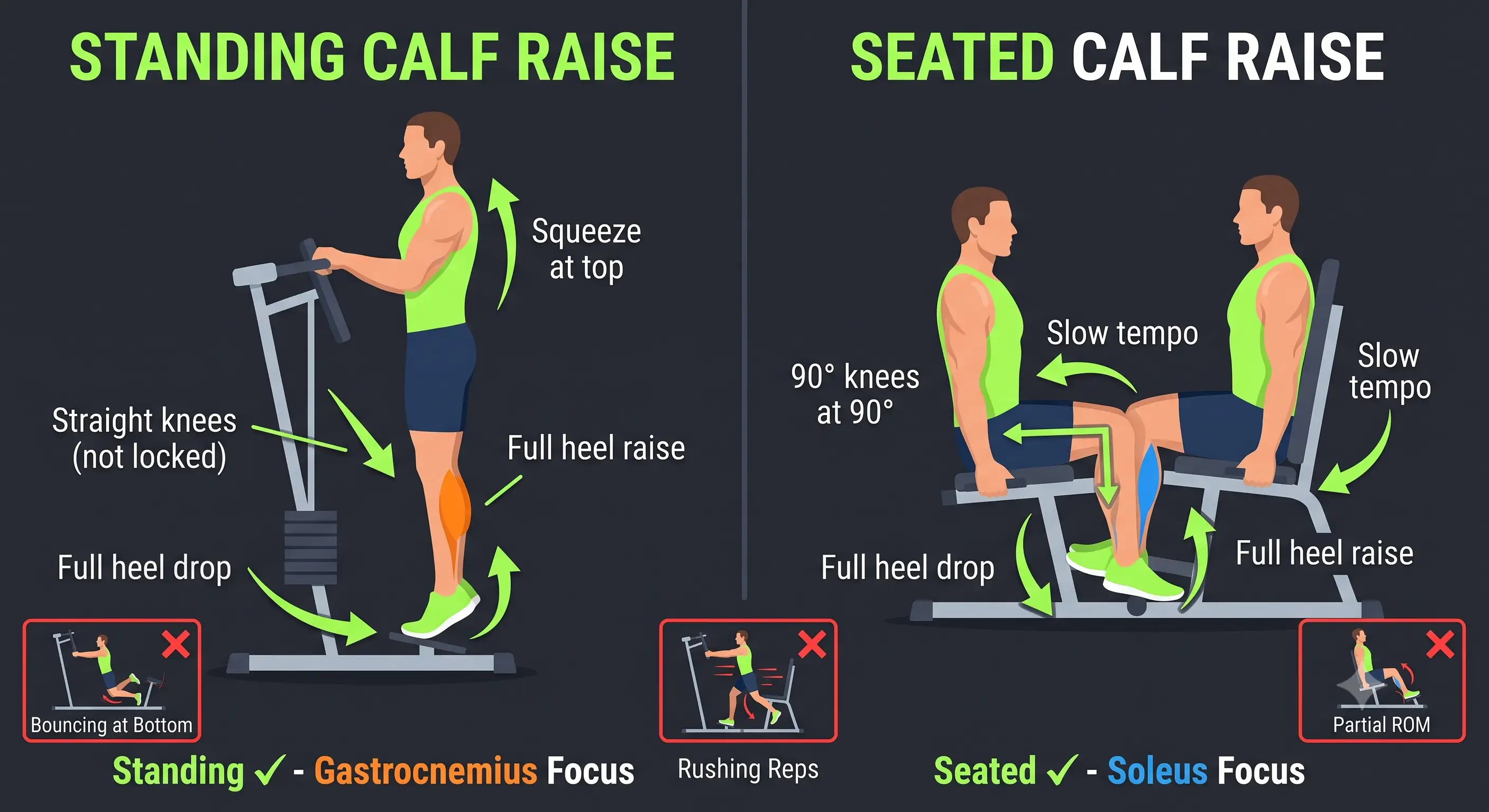
| Standing Calf Raise | Gastrocnemius growth, overall calf size, strength | Lateral + Medial Gastrocnemius (12.4% / 9.2% growth) | Higher Achilles load; full stretch | "Straight knees, full range, squeeze at top" |
| Seated Calf Raise | Soleus development, tendon rehab, calf thickness | Soleus (2.9% growth; similar to standing) | Lower Achilles load; knee-friendly | "90° knees, slow tempo, feel the burn" |
| Both (periodised) | Complete calf development | Full triceps surae | Balanced stress across both heads | "Train both for complete development" |
Common Mistakes Table
| Mistake | Why It Is a Problem | Fix |
|---|---|---|
| Bouncing at the bottom | Uses tendon elasticity instead of muscle; reduces tension | Pause briefly at the bottom; control the stretch |
| Not achieving full range of motion | Reduces muscle damage stimulus; limits growth | Drop heels as far as possible; raise as high as possible |
| Using too much weight | Compromises form; reduces range of motion | Reduce load; focus on full ROM and control |
| Rushing the reps | Reduces time under tension; limits hypertrophy | Slow tempo: 2-3 sec up, 2-3 sec down |
| Locking knees (standing) | Transfers load to joints; reduces muscle tension | Keep a slight bend in the knees |
| Bending knees too much (standing) | Reduces gastrocnemius activation | Keep knees straight (extended) |
| Not going deep enough (seated) | Reduces soleus stretch; limits growth | Drop heels as far as possible |
| Neglecting one variation | Misses half the calf muscles | Use both standing AND seated |
Sample Workout Integration
Workout 1: Calf Focus – Complete Development
| Exercise | Sets | Reps | Load | Notes |
|---|---|---|---|---|
| Standing Calf Raise | 4 | 10-12 | 75% 1RM | Full ROM; squeeze at top |
| Seated Calf Raise | 4 | 12-15 | 70% 1RM | Slow tempo; 90° knee |
| Leg Press | 3 | 10 | Moderate | Compound lower body |
| Tibialis Anterior Raise | 3 | 15 | Light | Balance the lower leg |
Workout 2: Gastrocnemius Focus
| Exercise | Sets | Reps | Load | Notes |
|---|---|---|---|---|
| Standing Calf Raise | 5 | 8-10 | 80% 1RM | Heavy; full stretch |
| Standing Calf Raise (single-leg) | 3 | 10-12/leg | Moderate | Unilateral focus |
| Seated Calf Raise | 3 | 12 | Moderate | Accessory soleus work |
| Squat | 3 | 8 | 80% 1RM | Compound lower body |
Workout 3: Soleus / Rehab Focus
| Exercise | Sets | Reps | Load | Notes |
|---|---|---|---|---|
| Seated Calf Raise | 4 | 15-20 | Light | High reps; slow tempo |
| Standing Calf Raise (light) | 3 | 12-15 | Light | Progress gradually |
| Eccentric Standing Calf Raise | 3 | 10 | Bodyweight | 5-sec lowering phase |
| Tibialis Anterior Raise | 3 | 15 | Light | Balance the lower leg |
Safety warning
Stop immediately if you experience:
- Sharp, stabbing pain in the calf, Achilles tendon or knee
- Pain that worsens during the movement (not just muscle burn)
- Joint locking, catching or giving way
- Pain that persists after your workout
Modify if:
- You have Achilles tendinopathy – start with seated calf raises (reduced gastrocnemius tension) and gradually progress to standing
- You have knee pain – seated calf raises may be more comfortable; avoid locking out knees in standing
- You have calf tightness – reduce range of motion; stretch after training
- You're new to calf training – start with bodyweight or very light loads and master the form first
Key safety principles:
- Full range of motion – drop heels as far as possible; raise as high as possible
- Control the eccentric – lower under control (2-3 seconds)
- Don't bounce – avoid using tendon elasticity; use muscle tension
- Progress gradually – increase load by 2.5–5 kg per session
- Listen to your body – pain is information, not something to push through
- Warm up properly – include dynamic stretches and light warm-up sets
- Consider your footwear – flat, stable shoes are best for calf raises
Takeaway
The research is clear: standing and seated calf raises are not interchangeable – they target different muscles.
- Standing calf raises (straight knee) produce dramatically greater gastrocnemius hypertrophy – 12.4% lateral and 9.2% medial growth over 12 weeks, compared to just 1.7% and 0.6% for seated. The gastrocnemius is stretched and placed under optimal tension when the knee is straight.
- Seated calf raises (bent knee) produce similar soleus growth (2.1-2.9%) to standing. The soleus is unaffected by knee angle, making seated calf raises an effective way to target this muscle without the added gastrocnemius bias.
The soleus is the workhorse of the calf – it's active during standing, walking and postural control. The gastrocnemius is the show muscle – it gives the calf its peak and shape.
The best approach for most lifters is to use both. Use standing calf raises as your primary calf builder (3-5 sets, 8-12 reps, heavy). Use seated calf raises as an accessory (3-4 sets, 12-15 reps, moderate). This gives you complete triceps surae development and keeps your training varied and effective.
Complete reference list
- Kinoshita M, Maeo S, Kobayashi Y, et al. Triceps surae muscle hypertrophy is greater after standing versus seated calf-raise training. Front Physiol. 2023;14:1272106.
- Gentil P, et al. Multi- and Single-Joint Resistance Exercises Promote Similar Plantar Flexor Activation in Resistance Trained Men. Int J Environ Res Public Health. 2020;17(24):9487.
- Knee position affects medial gastrocnemius and soleus activation during dynamic plantarflexion: no evidence for an inter-muscle compensation in healthy young adults. 2024.
- Arampatzis A, et al. Influence of gastrocnemius muscle length on triceps surae torque development and electromyographic activity in man. 2006.
- Electromyographic analysis of an eccentric calf muscle exercise in persons with and without Achilles tendinopathy. Phys Ther Sport. 2012.
- Bigger Calves from Doing Higher Resistance Training Volume? Int J Sports Med. 2024;45(10):739-747.