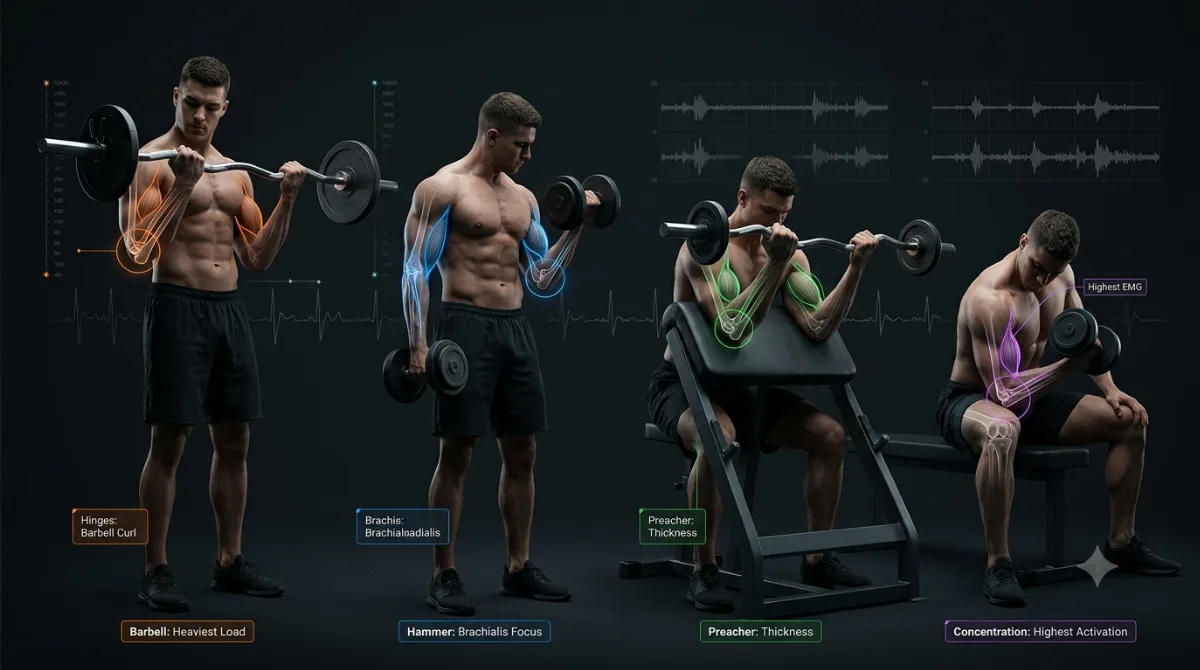
Here's what the science shows
The concentration curl elicits the highest biceps brachii activation of any curl variation, according to ACE-commissioned research. The EZ-bar curl enhances both biceps brachii and brachioradialis EMG activity compared to the straight dumbbell curl. The barbell curl allows significantly heavier loads, translating to greater mechanical tension. The hammer curl specifically targets the brachialis and brachioradialis, muscles vital for overall arm size. The preacher curl offers high peak EMG during the concentric phase but less total range of motion. The takeaway: use a variety of curl variations – concentration curls for peak biceps activation, barbell curls for heavy loading, hammer curls for brachialis development, and preacher curls for isolated thickness.
Quick answer: which curl variation is best for you?
Each curl variation serves a different purpose. Barbell curls are best for heavy loading and overall mass. Dumbbell curls are ideal for muscle symmetry and balanced development. Hammer curls are the go-to for brachialis and forearm thickness. Preacher curls excel at isolated short‑head work and biceps thickness.
Barbell Curl
Best for heavy loading, overall mass and mechanical tension. Allows the greatest load capacity and produces higher biceps brachii activation than dumbbell curls.
Dumbbell Curl
Best for muscle symmetry and balanced development across both biceps heads. Each arm works independently, reducing the chance of imbalances.
Hammer Curl
Best for brachialis and brachioradialis development – the muscles that add significant thickness to your arms. Neutral grip eliminates supination for targeted growth.
Preacher Curl
Best for biceps thickness and short‑head isolation. The supported position offers high peak EMG during the concentric phase, ideal for adding mass to the lower biceps.
Introduction
The biceps curl is arguably the most iconic exercise in the gym. Walk into any weight room and you'll see people curling – but with a crucial difference: barbell, dumbbell, hammer or preacher curl?
Each variation claims to be the best for building bigger arms. But the research tells a clear story: different curls target different muscles and serve different purposes.
The biceps brachii has two heads – the long head and the short head – that work together for elbow flexion and forearm supination. But beneath the biceps lies the brachialis, a powerful elbow flexor that pushes the biceps up for a fuller look. And the brachioradialis runs along the forearm, adding to overall arm thickness.
This guide breaks down what the peer-reviewed research says about barbell, dumbbell, hammer and preacher curls – for muscle activation, hypertrophy and practical application.
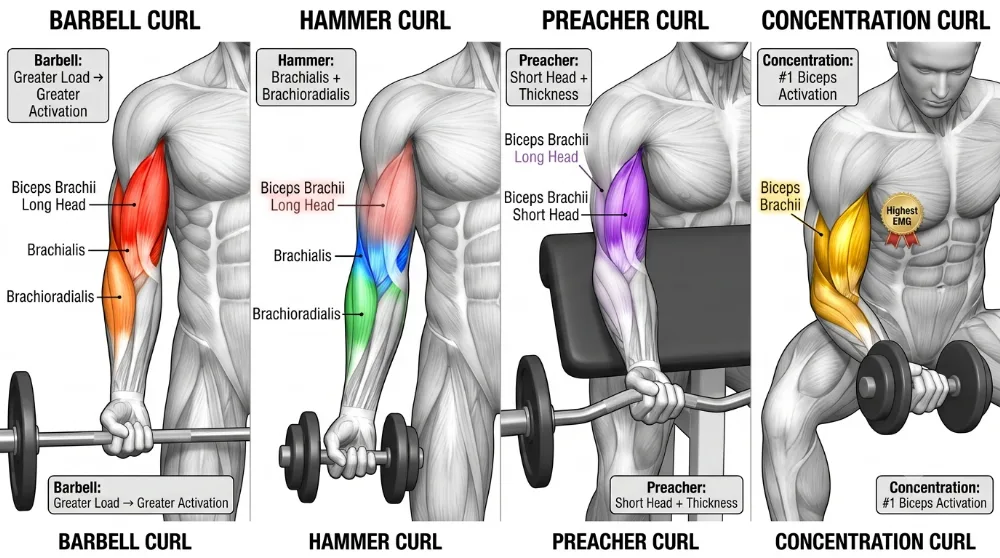
Anatomy / Biomechanics: The Muscles of the Arm
The Primary Muscles
| Muscle | Location | Primary Function | Best Targeted By |
|---|---|---|---|
| Biceps Brachii (Long Head) | Outer portion of the biceps | Elbow flexion, forearm supination, shoulder flexion | Incline curls, concentration curls |
| Biceps Brachii (Short Head) | Inner portion of the biceps | Elbow flexion, forearm supination | Preacher curls, wide-grip barbell curls |
| Brachialis | Deep muscle beneath the biceps | Primary elbow flexor (stronger than biceps) | Hammer curls, reverse curls |
| Brachioradialis | Forearm muscle, runs from upper arm to wrist | Elbow flexion, forearm stabilisation | Hammer curls |
How Grip and Position Change the Movement
| Feature | Barbell Curl | Dumbbell Curl | Hammer Curl | Preacher Curl |
|---|---|---|---|---|
| Grip | Supinated (palms up) | Supinated | Neutral (palms facing) | Supinated |
| Range of motion | Limited by bar | Full (unilateral) | Full | Reduced (elbow supported) |
| Biceps brachii | High activation | High activation | Lower activation | High peak EMG |
| Brachialis | Moderate | Moderate | Highest | Moderate |
| Brachioradialis | Low-Moderate | Low-Moderate | Highest | Low |
| Load capacity | Highest | Moderate | Moderate | Lower |
| Shoulder involvement | Minimal | Minimal | Minimal | Minimal (supported) |
The key insight: each variation creates a different stimulus – choose based on your goal and individual anatomy.
The Science: What the Research Reveals
Source 1: The Best Biceps Exercise – Concentration Curl Wins
Study: ACE-commissioned research, University of Wisconsin-La Crosse. ACE Fitness
What it found: Sixteen healthy men and women performed eight popular biceps exercises. EMG electrodes measured activation of the biceps brachii, brachioradialis and anterior deltoid.
- Rank 1: Concentration Curl – Highest biceps activation
- Rank 2: Cable Curl
- Rank 3: Chin-Up
- Lowest: Preacher Curl among those tested
Key takeaway: For maximal biceps brachii activation, the concentration curl is the clear winner. With your upper arm braced against your inner thigh, there's no room for swinging or momentum – your biceps do all the work.
Source 2: Barbell vs Dumbbell – Barbell Allows Heavier Loads
Study: Oliveira et al. (2019). Cited in BOXROX analysis. PubMed Search
What it found: Researchers compared barbell curls and dumbbell curls using EMG.
- Biceps brachii activation: Greater in barbell curl vs dumbbell curl
- Reason: Barbell allows for greater load → higher mechanical tension
- Balanced activation: Dumbbell curls provide more even activation across both biceps heads
Key takeaway: The barbell curl is superior for heavy loading and overall biceps activation. The dumbbell curl is superior for muscle symmetry and balanced development.
Source 3: EZ-Bar vs Dumbbell – EZ-Bar Enhances Activation
Study: Marcolin G, Panizzolo FA, Petrone N, et al. Differences in electromyographic activity of biceps brachii and brachioradialis while performing three variants of curl. PeerJ. 2018;6:e5165. PubMed ID: 30013836
What it found: Twelve participants performed one set of ten repetitions at 65% of 1RM for three curl variants: dumbbell curl (DC), straight barbell curl (BC), and EZ-bar curl (EZ).
- BB activation: Higher in EZ vs DC (P < 0.05)
- BR activation: Higher in EZ vs DC (P < 0.01)
- Concentric phase (BR): Higher in EZ vs DC (P < 0.001) and BC vs DC (P < 0.05)
- Eccentric phase (BB & BR): Higher in EZ vs DC (P < 0.01)
Key takeaway: The EZ-bar curl enhances activation of both the biceps brachii and brachioradialis compared to the dumbbell curl. The difference between straight and EZ barbell is small – choose based on wrist comfort.
Source 4: Hammer Curl – Brachialis and Brachioradialis Focus
Study: Multiple EMG analyses.
What it found: Research comparing traditional, hammer and reverse curls found:
- Biceps brachii activation: Highest during traditional curl
- Brachialis activation: Significantly greater during reverse curl vs hammer and traditional
- Brachioradialis recruitment: Hammer curl specifically targets this muscle
Key takeaway: The hammer curl is the go-to exercise for brachialis and brachioradialis development – muscles that add significant thickness to your arms.
Source 5: Standing vs Preacher Curl – Torque Differences
Study: Mookerjee S, Smoliga J, Roman C. EMG And Torque Differences During Supported And Unsupported Isokinetic Bicep Curl Exercise. Med Sci Sports Exerc. 2008;40(5):S260. DOI: 10.1249/01.mss.0000322424.93119.f5
What it found: Ten male subjects performed standing curls and preacher curls at three velocities.
- EMG activity: No significant differences in biceps or brachioradialis EMG between standing and preacher curls
- Isometric torque: Greater in standing curl (88.51Nm vs 79.69Nm, p<0.05)
- Torque at 150°/sec: Greater in standing curl (48.54Nm vs 37.29Nm)
- Torque at 240°/sec: Greater in standing curl (41.81Nm vs 31.80Nm)
Key takeaway: The preacher curl does not produce greater EMG activity than the standing curl, but it may offer a different stimulus through its supported position and focus on the biceps at the stretched position.
Source 6: Incline Curl for the Long Head
Study: Pinto et al. (2013) and Oliveira et al. (2009). PubMed Search
What it found: The concentration curl elicited the highest peak biceps brachii activation, followed closely by the incline dumbbell curl and the standard barbell curl. The long head of the biceps (which contributes to the biceps' peak) is more engaged in exercises where the arms are behind the torso, such as incline dumbbell curls.
Key takeaway: For long head development and biceps peak, include incline dumbbell curls in your routine.
Step-by-Step Instructions: How to Do Each Curl Variation Correctly
Barbell Curl
- Set up – stand with feet shoulder-width apart, barbell in hands, palms facing up.
- Grip – hands shoulder-width apart (or slightly wider for short head emphasis).
- Position – keep elbows tucked at your sides, shoulders down and back.
- Curl – bend at the elbows, curling the bar toward your shoulders.
- Squeeze – pause and squeeze your biceps at the top.
- Lower – control the descent (2-3 seconds) until arms are fully extended.
- Repeat – maintain tension throughout; don't swing.
Dumbbell Curl
- Set up – stand or sit with dumbbells in each hand, palms facing up.
- Curl – bend at the elbows, curling both dumbbells toward your shoulders.
- Squeeze – pause at the top, squeezing your biceps.
- Lower – control the descent (2-3 seconds) to full extension.
- Repeat – you can alternate arms or curl both together.
Hammer Curl
- Set up – stand with dumbbells in each hand, palms facing each other (neutral grip).
- Curl – bend at the elbows, curling the dumbbells toward your shoulders.
- Squeeze – pause at the top, feeling the brachialis contract.
- Lower – control the descent (2-3 seconds).
- Repeat – maintain the neutral grip throughout.
Preacher Curl
- Set up – sit at the preacher bench, arms resting on the pad, barbell or dumbbell in hands.
- Position – extend your arms fully, palms facing up.
- Curl – bend at the elbows, curling the weight toward your shoulders.
- Squeeze – pause at the top.
- Lower – control the descent (2-3 seconds) to full extension.
- Repeat – keep your upper arms fixed against the pad.
Concentration Curl
- Set up – sit on the edge of a bench with legs spread.
- Position – hold a dumbbell in one hand, place the elbow of that arm on your inner thigh.
- Curl – curl the dumbbell toward your shoulder, keeping your upper arm braced.
- Squeeze – pause at the top for 1-2 seconds.
- Lower – control the descent (2-3 seconds).
- Repeat – complete all reps on one arm before switching.
Recommended Sets, Reps and Load
| Goal | Exercise | Sets | Reps | Load | Notes |
|---|---|---|---|---|---|
| Maximal biceps activation | Concentration Curl | 3-4 | 10-15 | Moderate | Highest EMG activation |
| Heavy loading / strength | Barbell Curl | 3-5 | 6-10 | 75-85% 1RM | Greatest load capacity |
| Brachialis development | Hammer Curl | 3-4 | 10-15 | Moderate | Neutral grip targets brachialis |
| Biceps peak / long head | Incline Dumbbell Curl | 3-4 | 10-12 | Moderate | Arms behind torso |
| Biceps thickness / short head | Preacher Curl | 3-4 | 10-12 | Moderate | Supported position |
| Balanced development | EZ-Bar Curl | 3-4 | 8-12 | 70-80% 1RM | Enhances BB + BR activation |
Who Should Use Which Option
| Profile | Recommended | Rationale |
|---|---|---|
| Maximising biceps growth | Concentration Curl + Barbell Curl | Highest activation + heaviest load |
| Brachialis focus | Hammer Curl | Neutral grip targets deep arm muscle |
| Biceps peak / long head | Incline Dumbbell Curl | Arms behind torso |
| Biceps thickness / short head | Preacher Curl | Supported position |
| Wrist comfort / forearm | EZ-Bar Curl | Enhances activation, comfortable grip |
| Muscle symmetry | Dumbbell Curl | Each arm works independently |
| Complete arm development | All variations (periodised) | Targets biceps, brachialis and brachioradialis |
Comparison Table: Biceps Curl Variations
| Option | Best For | Muscle Emphasis | Load Capacity | Joint Comfort | Practical Cue |
|---|---|---|---|---|---|
| Barbell Curl | Heavy loading, overall mass | Biceps brachii (greater activation vs dumbbell) | Highest | Moderate | "Elbows tucked, shoulders down, control the eccentric" |
| Dumbbell Curl | Muscle symmetry, balanced development | Biceps brachii (even across both heads) | Moderate | High | "Each arm independent, full range of motion" |
| EZ-Bar Curl | Wrist comfort, enhanced activation | BB + BR (enhanced vs dumbbell) | High | Highest | "EZ bar = less wrist stress, more activation" |
| Hammer Curl | Brachialis + forearm development | Brachialis, brachioradialis | Moderate | High | "Neutral grip, feel the brachialis work" |
| Preacher Curl | Biceps thickness, short head, isolation | Short head biceps (peak EMG in concentric phase) | Lower | Moderate | "Upper arms fixed, squeeze at the top" |
| Concentration Curl | Highest biceps activation | Biceps brachii (clear winner for EMG) | Lowest | High | "Elbow braced, no momentum, squeeze hard" |
| Incline Dumbbell Curl | Biceps peak, long head | Long head biceps (arms behind torso) | Moderate | High | "Arms back, stretch the long head" |
Common Mistakes Table
| Mistake | Why It Is a Problem | Fix |
|---|---|---|
| Using momentum / swinging | Reduces biceps tension; increases injury risk | Control the eccentric (2-3 sec); brace your arm for concentration curls |
| Not achieving full range of motion | Reduces muscle damage stimulus; limits growth | Full extension at bottom; full contraction at top |
| Too much weight | Compromises form; reduces time under tension | Reduce load; focus on control and squeeze |
| Elbows drifting forward | Reduces biceps activation; shifts to shoulders | Keep elbows tucked at your sides |
| Not squeezing at the top | Reduces peak contraction stimulus | Pause and squeeze for 1-2 seconds |
| Only training biceps once per week | Suboptimal for hypertrophy | Train biceps 2-3x per week |
| Neglecting brachialis training | Limits overall arm size | Include hammer curls or reverse curls |
| Rushing the eccentric phase | Reduces mechanical tension | Lower under control for 2-3 seconds |
Sample Workout Integration
Workout 1: Biceps + Back Day (Strength Focus)
- Barbell Curl — 4 sets of 6-8 reps at 80% 1RM (heavy loading)
- Hammer Curl — 3 sets of 10-12 reps (moderate load) (brachialis development)
- Concentration Curl — 3 sets of 12-15 reps (light load) (highest biceps activation)
- Pull-Ups — 3 sets of 8-10 reps (bodyweight) (compound back + biceps)
Workout 2: Arm Hypertrophy Focus
- EZ-Bar Curl — 4 sets of 10-12 reps at 70% 1RM (enhanced BB + BR activation)
- Incline Dumbbell Curl — 3 sets of 10-12 reps (moderate load) (long head / biceps peak)
- Preacher Curl — 3 sets of 10-12 reps (moderate load) (short head / thickness)
- Hammer Curl (finisher) — 3 sets of 12-15 reps (light load) (brachialis burnout)
Workout 3: Complete Arm Development (Push Day Finisher)
- Concentration Curl — 3 sets of 12-15 reps (light load) (between pressing sets)
- Dumbbell Curl — 3 sets of 10-12 reps (moderate load) (unilateral balance)
- Hammer Curl — 3 sets of 12-15 reps (light load) (brachialis + forearm)
Recommended Weekly Volume
| Training Status | Sets per Week | Recommendation |
|---|---|---|
| Beginner | 6-9 sets | 2 sessions/week, 3 exercises |
| Intermediate | 10-15 sets | 2-3 sessions/week |
| Advanced | 15-20 sets | 3 sessions/week, periodised |
Warning / Safety Section: When to Stop or Modify
Stop the exercise immediately if you experience sharp, stabbing pain in the elbow, wrist or shoulder; pain that worsens during the movement (not just muscle burn); joint locking, catching or giving way; or pain that persists after your workout.
- Wrist pain: use EZ-bar instead of straight barbell; avoid excessive wrist extension.
- Elbow tendinopathy: use neutral grip (hammer curls) or lighter loads with higher reps.
- Shoulder pain: concentration curls reduce shoulder involvement.
- New to curling: start with dumbbell curls or EZ-bar curls to learn the movement pattern.
- Key safety principles: control the eccentric (2-3 seconds), don't ego lift, use full range of motion, keep elbows stationary, listen to your body, progress gradually (1.25-2.5 kg per session), and warm up properly with light sets before heavy work.
Takeaway
The research is clear: different curl variations serve different purposes – and the best approach is to use a variety.
Concentration curls produce the highest biceps brachii activation of any curl variation and are ideal for maximal biceps engagement.
Barbell curls allow the heaviest loads and produce greater biceps activation than dumbbell curls, making them ideal for overall mass and strength.
EZ-bar curls enhance activation of both the biceps brachii and brachioradialis and are more wrist-friendly than straight bars.
Hammer curls specifically target the brachialis and brachioradialis – muscles that add significant thickness to your arms.
Preacher curls offer high peak EMG during the concentric phase and are ideal for biceps thickness and short head development.
Incline dumbbell curls place the arms behind the torso, engaging the long head of the biceps for peak development.
The best approach for most lifters: Include a mix of curl variations in your training. Use barbell or EZ-bar curls for heavy compound work, hammer curls for brachialis development, and concentration or incline curls for targeted biceps activation. Train your biceps 2-3 times per week and progressively overload over time.
Complete Reference List
- Marcolin G, Panizzolo FA, Petrone N, et al. Differences in electromyographic activity of biceps brachii and brachioradialis while performing three variants of curl. PeerJ. 2018;6:e5165. PubMed ID: 30013836
- Oliveira et al., 2019. Barbell curl vs dumbbell curl EMG comparison (cited in BOXROX analysis). PubMed Search
- Pinto et al., 2013. Concentration curl elicits highest peak biceps brachii activation (cited in BOXROX). PubMed Search
- Mookerjee S, Smoliga J, Roman C. EMG And Torque Differences During Supported And Unsupported Isokinetic Bicep Curl Exercise. Med Sci Sports Exerc. 2008;40(5):S260. DOI: 10.1249/01.mss.0000322424.93119.f5
- ACE-commissioned research on biceps exercises (concentration curl ranked highest). ACE Fitness
- T3 analysis of biceps exercise research. T3 Active