Here's what the science shows
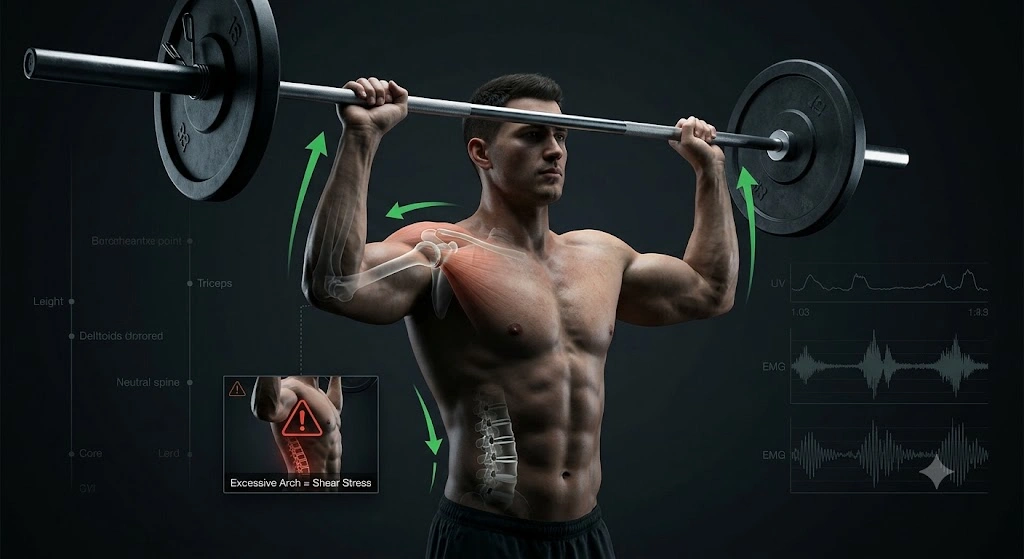
The overhead press is one of the most effective exercises for building shoulder strength and mass. Research shows that dumbbells produce significantly greater anterior deltoid activation (63.3%) compared to kettlebells (57.9%) during the overhead press. Standing overhead press activates core muscles — including the rectus abdominis and erector spinae — significantly more than the seated variation. For lower back safety, excessive lumbar extension (arching) during the press is the primary cause of low back pain — and research confirms that for participants with normal trunk stability and ideal shoulder ROM, overhead pressing is a safe exercise for both the shoulder and spine. The takeaway: choose your implement and position based on your goals — dumbbells for deltoid activation, standing for core engagement, and always prioritise a braced, neutral spine over ego.
Short answer
The overhead press is highly effective for building shoulder strength and mass when performed correctly. Research shows dumbbells produce 63.3% anterior deltoid activation compared to 57.9% for kettlebells. Standing variations activate core muscles (rectus abdominis and erector spinae) significantly more than seated, while seated allows heavier loading. For lower back safety, the key is maintaining a braced, neutral spine and avoiding excessive lumbar extension. The overhead press is safe for both shoulders and spine when you have adequate mobility and trunk stability. Best approach: use dumbbells for deltoid activation, standing for core engagement, and always prioritise technique over weight.


Research source disclaimer. All research cited in this article is sourced from peer-reviewed studies indexed in PubMed, NIH/NCBI-linked sources, or reputable journals where available. Links to the original studies are provided throughout.
Introduction
The overhead press is one of the oldest and most effective exercises in strength training. It builds powerful shoulders, develops the triceps, and challenges your core stability like few other movements can.
But it's also one of the most debated exercises in the gym. Should you use a barbell or dumbbells? Stand or sit? Press in front of your head or behind it? And perhaps most importantly — is the overhead press safe for your lower back?
These aren't just theoretical questions. The answers determine whether you build muscle effectively or end up with shoulder pain and a sore lower back.
This guide breaks down what the peer-reviewed research actually says about overhead press technique — for shoulder activation, muscle growth, core engagement and lower back safety.
Anatomy / Biomechanics: What Happens During the Overhead Press
The Primary Muscles
| Muscle | Role in the Overhead Press |
|---|---|
| Anterior Deltoid | Primary shoulder flexor — does the heaviest lifting |
| Medial (Lateral) Deltoid | Assists with shoulder abduction; heavily involved in behind-the-neck variations |
| Posterior Deltoid | Shoulder stabiliser; acts as a key stabiliser during proper pressing |
| Triceps Brachii | Elbow extension — straightening the arms at the top |
| Upper Trapezius | Scapular stabilisation and upward rotation |
| Serratus Anterior | Scapular upward rotation and stabilisation |
| Lower Trapezius | Scapular depression and stabilisation |
| Core (Rectus Abdominis, Obliques, Erector Spinae) | Spinal stabilisation — prevents excessive lumbar extension |
Key Biomechanical Considerations
| Factor | Effect |
|---|---|
| Barbell | More stable implement; allows heavier loading; excites muscles more than machines |
| Dumbbell | Greater stabiliser demand; significantly higher anterior deltoid activation than kettlebell |
| Standing | Greater core muscle activation (rectus abdominis, erector spinae); requires more stability |
| Seated | Allows heavier loads to be lifted; reduces lower body contribution |
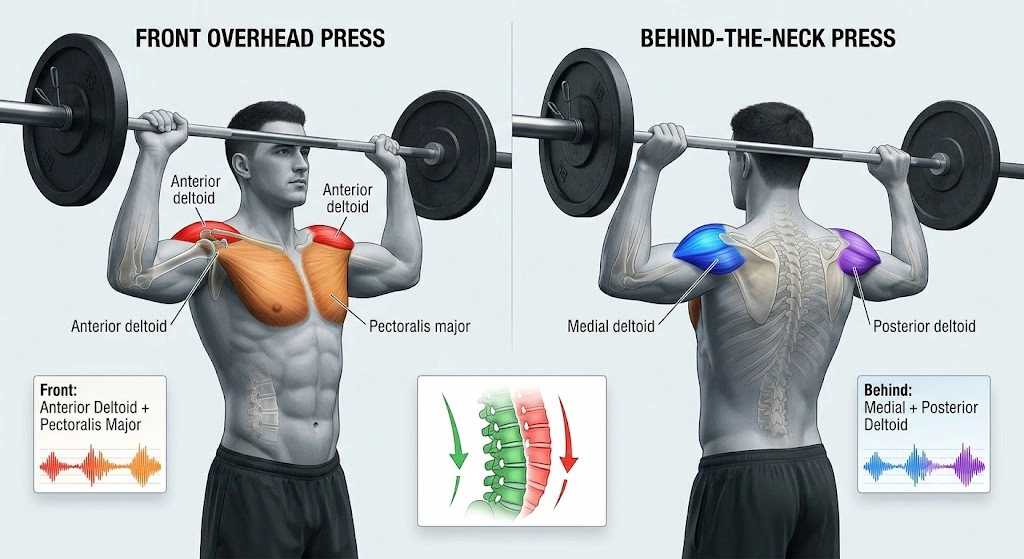
| Front Press | Favours anterior deltoid and pectoralis major |
| Behind-the-Neck | Enhances medial and posterior deltoid excitation |
The Science: What the Research Reveals
Dumbbell overhead press produced 63.3% anterior deltoid activation vs 57.9% for kettlebell. More stable implement = greater force production.
Dumbbell superior for medial deltoid and lower trapezius. Bottom-up kettlebell uniquely effective for serratus anterior activation.
Standing press activates core (rectus abdominis, erector spinae) significantly more than seated. Seated allows heavier loads.
Barbell overhead press excites muscles more than machine. Triceps, erector spinae, and lower trapezius show higher activity with barbell.
Source 1: Dumbbell vs Kettlebell — Dumbbell Wins for Anterior Deltoid
Study: Dicus JR, et al. Stability of Resistance Training Implement alters EMG Activity during the Overhead Press. Int J Exerc Sci. 2018;11(1):708-716.
PubMed ID: 29997723
https://pubmed.ncbi.nlm.nih.gov/29997723/
What it found: Twenty-one subjects performed overhead presses with dumbbells and kettlebells. EMG analysis revealed:
| Implement | Anterior Deltoid Activity (%MVIC) |
|---|---|
| Dumbbell | 63.3 ± 13.3% |
| Kettlebell | 57.9 ± 15.0% |
"EMG activity was augmented in the anterior deltoid when using the more stable implement, the dumbbell."
Key takeaway: For maximising anterior deltoid activation, the dumbbell overhead press is significantly more effective than the kettlebell. The difference in stability — with the dumbbell's centre of mass aligned with the glenohumeral joint — allows for greater force production.
Source 2: Dumbbell vs Kettlebell vs Bottom-Up Kettlebell — Scapular Stabilisers
Study: Busch A, Sarver X, et al. Electromyographic analysis of shoulder-complex muscles performing overhead presses with dumbbell, kettlebell, and bottom-up kettlebell. J Bodyw Mov Ther. 2023.
PubMed ID: 38432822
https://pubmed.ncbi.nlm.nih.gov/38432822/
What it found: Twenty-eight collegiate baseball players performed overhead presses with dumbbells (DB), kettlebells (KB), and bottom-up kettlebells (KBU) at equal loads (11.34kg).
| Muscle | DB | KB | KBU | Winner |
|---|---|---|---|---|
| Medial Deltoid | Highest | Intermediate | Lowest | DB |
| Serratus Anterior | Moderate | Lowest | Highest | KBU |
| Lower Trapezius | Highest | Lowest | Intermediate | DB |
"The KBU press only elicited greater EMG activity in the SA. The DB elicited greater EMG activity in both the MD and LT."
Key takeaway: The dumbbell is superior for medial deltoid and lower trapezius activation. The bottom-up kettlebell is uniquely effective for serratus anterior — a key scapular stabiliser often weak in overhead athletes.
Source 3: Standing vs Seated — Standing Activates Core More
Study: McGill SM, et al. (2010) — referenced in Journal of Strength and Conditioning Research.
What it found: A study published in the Journal of Strength and Conditioning Research found that the standing press resulted in significantly greater activation of the core muscles, particularly the rectus abdominis and erector spinae, compared to the seated variation.
Additional finding: A 2024 study comparing standing, seated and lying-seated shoulder press found that seated and lying-seated positions permit participants to lift heavier loads compared to standing.
Key takeaway: Standing = more core activation and stability demand. Seated = ability to lift heavier due to reduced stability requirements. Choose based on your priority: core engagement (standing) or maximal load (seated).
Source 4: Front Press vs Behind-the-Neck — Different Deltoid Emphasis
Study: Padovan R, Toninelli N, Longo S, et al. High-Density Surface Electromyography Excitation in Front vs. Back Overhead Press Prime Movers. J Hum Kinet.
What it found: Using high-density surface EMG, researchers compared overhead press with the barbell passing in front (front-OHP) or behind the neck (back-OHP).
| Variation | Primary Emphasis |
|---|---|
| Front Overhead Press | Favours anterior deltoid and pectoralis major |
| Behind-the-Neck Press | Enhances medial and posterior deltoid excitation |
Key takeaway: Front press for anterior deltoid and upper chest; behind-the-neck for medial and posterior deltoid development. Both are effective — choose based on your target muscles.
Source 5: Shoulder and Spine Safety — Overhead Press Is Safe With Proper Form
Study: Overhead shoulder press – In-front of the head or behind the head? Asian J Sports Med. 2014.
URL: ScienceDirect
What it found: Thirty-three participants performed overhead pressing in-front and behind the head. Shoulder ROM and spine posture were quantified using 3D biomechanical measures.
"For participants with normal trunk stability and ideal shoulder ROM, overhead pressing is a safe exercise (for the shoulder and spine) when performed either in-front of or behind the head."
Additional finding: The in-front technique commenced in lordotic position, whilst behind-the-head technique commenced in kyphotic position. Males were able to maintain flat or normal lumbar lordosis, whereas females tended to kyphotic.
Key takeaway: Overhead pressing is safe for both the shoulder and spine when you have adequate mobility and trunk stability. If you lack either, address those limitations before heavy pressing.
Source 6: Barbell vs Machine — Barbell Excites Muscles More
Study: Coratella G, Tornatore G, Longo S, Esposito F, Cè E. Front vs Back and Barbell vs Machine Overhead Press: An Electromyographic Analysis and Implications For Resistance Training. Front Physiol. 2022;13:825880.
PubMed ID: 35936912
https://pubmed.ncbi.nlm.nih.gov/35936912/
What it found: This study compared muscle excitation between barbell and machine overhead press variations.
"Overhead press performed using barbell excites muscles more than using machine to stabilize the trajectory of the external load."
Additional finding: During standing overhead press, the triceps brachii long head, erector spinae, and lower trapezius exhibited significantly higher activity in the barbell condition compared to machine.
Key takeaway: Barbell overhead press is superior to machine for overall muscle activation, particularly for the triceps, spinal erectors and lower trapezius. Machines may be useful for stability or rehab, but barbells provide a greater stimulus.
Source 7: Lower Back Safety — Excessive Extension Is the Problem
Research synthesis: Multiple studies and biomechanical analyses have identified the primary mechanism of lower back injury during overhead pressing.
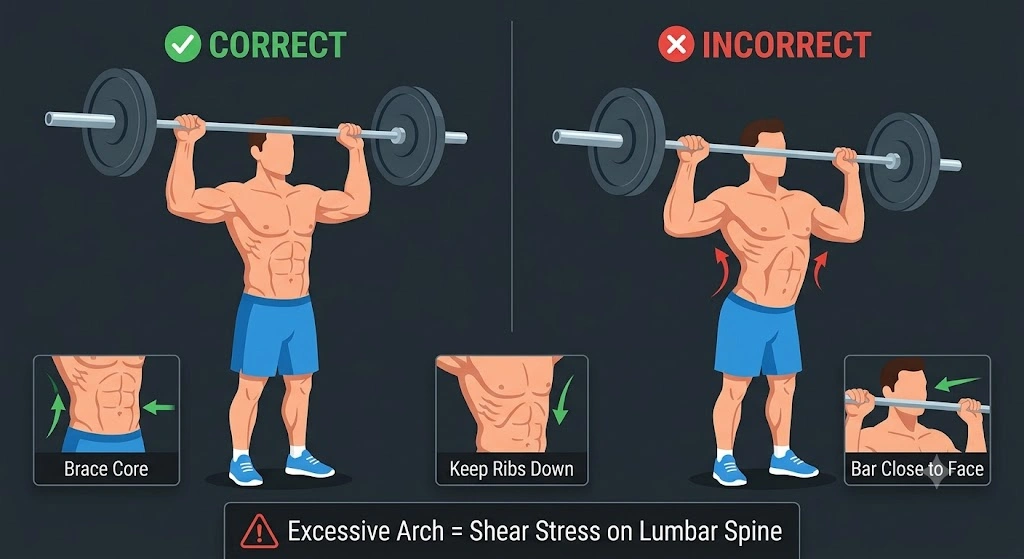
"The number one cause of lower back pain from overhead presses is an excessive extension (arching) of the lower back during the press."
Biomechanical mechanism: When you press overhead with excessive lumbar extension, the lumbar spine moves into hyperextension, creating shear stress on the intervertebral discs. As one analysis explains: "Overhead presses put your lumbar spine into excessive lordosis [and] cause vertebral bodies to angle and create shear stress forward/downward."
Key takeaway: The overhead press itself is not dangerous for the lower back — poor technique (excessive arching) is the problem. Maintaining a braced, neutral spine throughout the movement is the single most important factor for lower back safety.
Practical Application
Step-by-Step Instructions
Standing Barbell Overhead Press
- Set up — stand with feet shoulder-width apart, barbell resting on your front delts and upper chest.
- Grip — hands just outside shoulder width, wrists straight.
- Brace — take a deep breath into your belly, brace your core as if preparing to be punched.
- Press — drive the bar straight up, keeping it close to your face.
- Head position — push your head slightly forward as the bar passes your forehead.
- Lock out — extend your arms fully, with the bar over your mid-foot.
- Lower — control the descent back to your shoulders (2-3 seconds).
- Maintain — keep your ribs down and core braced throughout — do not arch your lower back.
Seated Dumbbell Overhead Press
- Set up — sit on a bench with back support, dumbbells at shoulder height.
- Grip — palms facing forward, dumbbells just outside your shoulders.
- Brace — engage your core against the backrest.
- Press — drive the dumbbells straight up, bringing them together at the top (but not touching).
- Lower — control the descent back to shoulder height (2-3 seconds).
- Repeat — maintain tension throughout.
Recommended Sets, Reps and Load
| Goal | Exercise | Sets | Reps | Load | Notes |
|---|---|---|---|---|---|
| Shoulder Hypertrophy | Dumbbell OHP | 3-4 | 8-12 | 65-80% 1RM | Seated or standing |
| Anterior Deltoid Focus | Barbell OHP (front) | 3-4 | 8-10 | 70-80% 1RM | Standing for core |
| Medial/Posterior Deltoid | Behind-the-neck | 3 | 8-12 | 60-70% 1RM | Only if you have the mobility |
| Core + Shoulder | Standing Barbell OHP | 3-4 | 5-8 | 75-85% 1RM | Heavy; focus on brace |
| Stability/Rehab | Dumbbell OHP | 3 | 12-15 | Light | Seated; controlled tempo |
Who Should Use Which Option?
| Profile | Recommended | Rationale |
|---|---|---|
| Maximising Deltoid Activation | Dumbbell OHP | 63.3% MVIC anterior deltoid activation |
| Core Engagement | Standing Barbell OHP | Greater rectus abdominis and erector spinae activation |
| Heavy Loading | Seated Barbell OHP | Seated position allows heavier loads |
| Medial/Posterior Deltoid | Behind-the-neck Press | Enhanced medial and posterior deltoid excitation |
| Serratus Anterior Focus | Bottom-up Kettlebell Press | Highest SA activation among implements |
| Lower Back Sensitivity | Seated OHP (with back support) | Reduces lumbar demands |
| Beginner | Seated Dumbbell OHP | More stable; easier to learn |
Comparison Table: Overhead Press Variations
| Option | Best For | Muscle Emphasis | Joint / Safety Note | Practical Cue |
|---|---|---|---|---|
| Standing Barbell | Overall strength, core engagement, anterior deltoid | Anterior deltoid, triceps, core (rectus abdominis, erector spinae) | Requires strong core brace to prevent lumbar extension | "Brace hard, ribs down, bar close to face" |
| Standing Dumbbell | Deltoid activation, stability, unilateral development | Anterior deltoid (63.3% MVIC), medial deltoid, lower trapezius | More shoulder stability required | "Press up and slightly together" |
| Seated Barbell | Heavy loading, reduced core demand | Anterior deltoid, triceps | Allows heavier loads; less core engagement | "Back against support, drive through heels" |
| Seated Dumbbell | Hypertrophy, beginners, shoulder health | Anterior + medial deltoid, serratus anterior | Most stable; lowest injury risk | "Control the descent, full ROM" |
| Behind-the-Neck | Medial and posterior deltoid | Medial deltoid, posterior deltoid | Requires adequate shoulder mobility | "Only if you have the mobility" |
Common Mistakes Table
| Mistake | Why It Is a Problem | Fix |
|---|---|---|
| Excessive lumbar arching | Creates shear stress on lumbar spine; primary cause of lower back pain | Brace core; keep ribs down; squeeze glutes |
| Bar path too far forward | Increases moment arm on shoulders; reduces efficiency | Keep bar close to face; press in a straight line |
| Flaring elbows | Increases shoulder impingement risk | Keep elbows slightly forward, not directly out to sides |
| Not controlling the eccentric | Reduces muscle damage stimulus; limits growth | Lower under control (2-3 seconds) |
| Locking out aggressively | Transfers load to joints; reduces muscle tension | Lock out smoothly; don't "bounce" into lockout |
| Using too much weight | Compromises form; increases injury risk | Reduce load; focus on technique |
| Behind-the-neck without mobility | High injury risk for shoulders and cervical spine | Only perform if you have adequate shoulder ROM |
Sample Workout Integration
Workout 1: Shoulder Hypertrophy Focus
| Exercise | Sets | Reps | Load | Notes |
|---|---|---|---|---|
| Standing Dumbbell OHP | 4 | 10-12 | 70% 1RM | Focus on deltoid activation |
| Seated Dumbbell Lateral Raise | 3 | 12-15 | Moderate | Medial deltoid |
| Face Pulls | 3 | 15 | Light | Rear delt + rotator cuff |
| Behind-the-neck Press | 3 | 10 | Light | Only if mobility allows |
Workout 2: Strength + Core Focus
| Exercise | Sets | Reps | Load | Notes |
|---|---|---|---|---|
| Standing Barbell OHP | 5 | 5 | 80-85% 1RM | Heavy; brace core hard |
| Pull-ups | 3 | 8-10 | Bodyweight | Upper back balance |
| Seated Dumbbell OHP | 3 | 10 | Moderate | Volume work |
| Plank | 3 | 60s | Bodyweight | Core stability |
Workout 3: Shoulder Health + Stability
| Exercise | Sets | Reps | Load | Notes |
|---|---|---|---|---|
| Seated Dumbbell OHP | 3 | 12-15 | Light | Controlled tempo |
| Bottom-up Kettlebell Press | 3 | 10/arm | Light | Serratus anterior focus |
| Band Pull-Aparts | 3 | 15 | Light | Rotator cuff health |
| YTWL Raises | 3 | 10 each | Light | Scapular stabilisers |
Safety warning
Stop immediately if you experience:
- Sharp, stabbing pain in the shoulder, neck or lower back
- Pain that worsens during the movement (not just muscle burn)
- Joint locking, catching or giving way
- Pain that persists after your workout
Modify if:
- You have lower back pain — switch to seated overhead press with back support; focus on maintaining a neutral spine
- You have shoulder impingement — avoid behind-the-neck pressing; use dumbbells instead of barbells for a more natural movement path
- You lack shoulder mobility — do not perform behind-the-neck presses; work on mobility first
- You're new to overhead pressing — start with seated dumbbell presses and master the form first
Key safety principles:
- Brace your core — this is the single most important factor for lower back safety
- Keep ribs down — prevents excessive lumbar extension
- Control the eccentric — lower under control (2-3 seconds)
- Don't ego lift — overhead pressing with poor form is not productive
- Know your mobility — if you can't get into the position, don't force it
- Progress gradually — increase load by 1.25-2.5 kg per session
- Listen to your body — pain is information, not something to push through
Takeaway
The research is clear: the overhead press is one of the most effective exercises for building shoulder strength and mass — but how you perform it matters.
- Dumbbells produce significantly greater anterior deltoid activation (63.3%) than kettlebells (57.9%). They're the superior choice for maximising deltoid growth.
- Standing overhead press activates the core muscles (rectus abdominis and erector spinae) significantly more than seated. Choose standing for core engagement and functional strength.
- Seated overhead press allows you to lift heavier loads. Choose seated for maximal loading and hypertrophy.
- Front press favours the anterior deltoid and pectoralis major; behind-the-neck favours the medial and posterior deltoid. Choose based on your target muscles.
For lower back safety, the overhead press is safe when performed with proper technique. The key is maintaining a braced, neutral spine and avoiding excessive lumbar extension.
The best approach for most lifters is to periodise your training. Use standing dumbbell presses for deltoid activation and core engagement; use seated barbell presses for heavy loading; and if you have adequate mobility, incorporate behind-the-neck variations for medial and posterior deltoid development. Always prioritise technique over ego, and your shoulders — and lower back — will thank you.
Complete reference list
- Dicus JR, et al. Stability of Resistance Training Implement alters EMG Activity during the Overhead Press. Int J Exerc Sci. 2018;11(1):708-716.
- Busch A, Sarver X, et al. Electromyographic analysis of shoulder-complex muscles performing overhead presses with dumbbell, kettlebell, and bottom-up kettlebell. J Bodyw Mov Ther. 2023.
- Coratella G, Tornatore G, Longo S, Esposito F, Cè E. Front vs Back and Barbell vs Machine Overhead Press: An Electromyographic Analysis and Implications For Resistance Training. Front Physiol. 2022;13:825880.
- Overhead shoulder press – In-front of the head or behind the head? Asian J Sports Med. 2014.
- Malek NFA, et al. Comparison of electromyographic activation and weight lifted between standing, seated and lying-seated shoulder press among trained men. AIP Conf Proc. 2024;2750(1):050009.
- McGill SM, et al. (2010). Standing press results in significantly greater activation of core muscles (rectus abdominis and erector spinae) compared to seated. J Strength Cond Res.
- Padovan R, et al. High-Density Surface Electromyography Excitation in Front vs. Back Overhead Press Prime Movers. J Hum Kinet.