Short answer
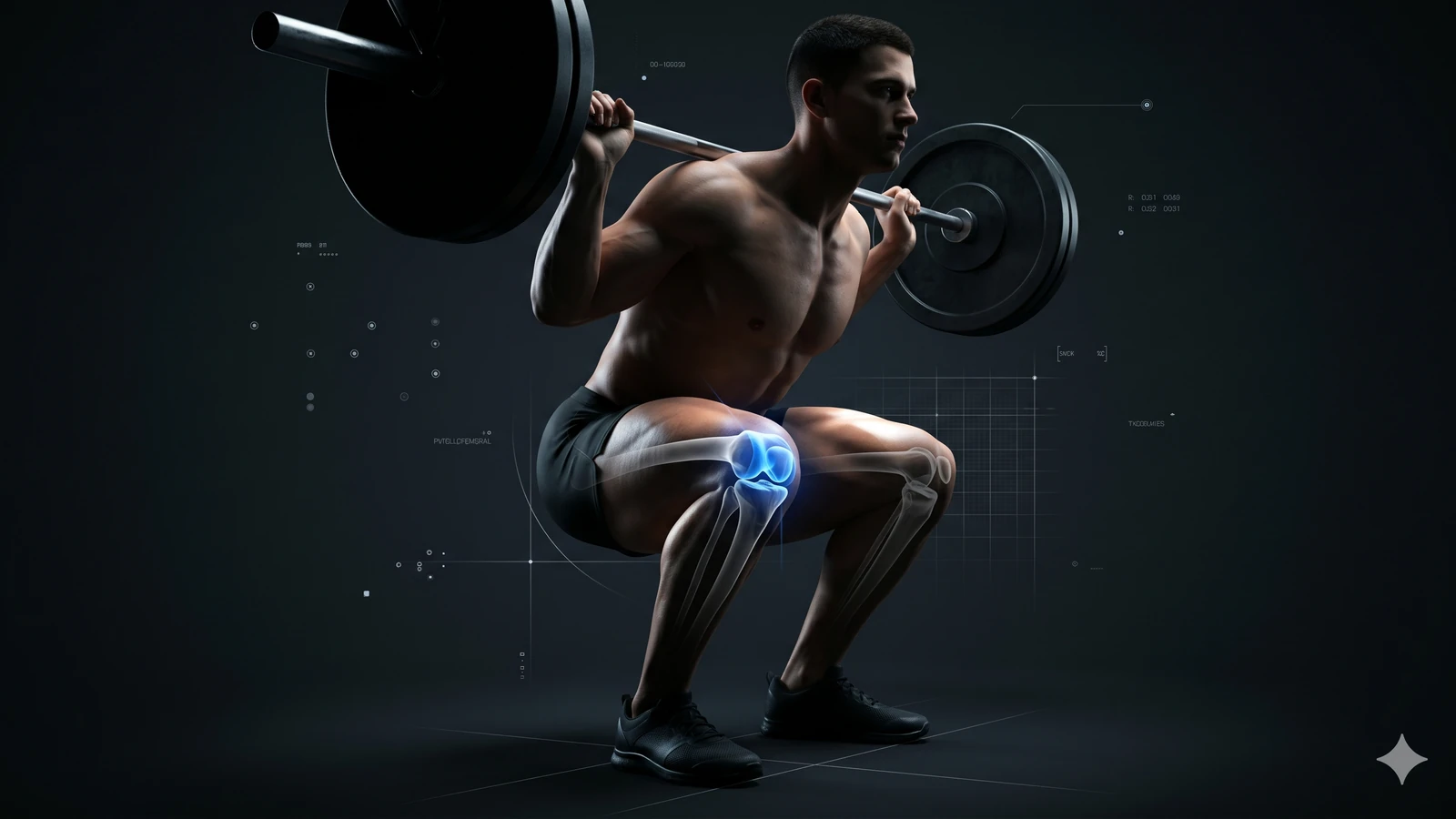
Parallel squats and deep squats both build lower-body strength and muscle. Deep squats can increase glute, adductor and quadriceps demand, but may also increase patellofemoral joint stress depending on load and technique. Parallel squats are a safer starting point for many lifters, while deep squats are useful when mobility, control and knee tolerance are already in place.


Research source disclaimer. Research cited in this article is sourced from peer-reviewed studies indexed in PubMed, NIH/NCBI-linked sources, or reputable journals where available.
Introduction
The squat is one of the most fundamental exercises in strength training. But a question divides gym floors and coaching circles: how low should you go?
Some lifters say deep squats destroy your knees. Others say anything above parallel is a waste of time. The science is more useful than both extremes. Depth changes muscle contribution and joint loading, but the right choice depends on your goal, mobility, injury history and technique.
Anatomy and biomechanics: what happens when you squat
| Muscle | Role in the squat |
|---|---|
| Quadriceps | Knee extension, especially as you drive out of the bottom position. |
| Gluteus maximus | Hip extension, with higher demand as the squat gets deeper. |
| Hamstrings | Hip extension assistance and knee-flexion stabilisation. |
| Adductors | Hip stabilisation and hip-extension assistance, especially at depth. |
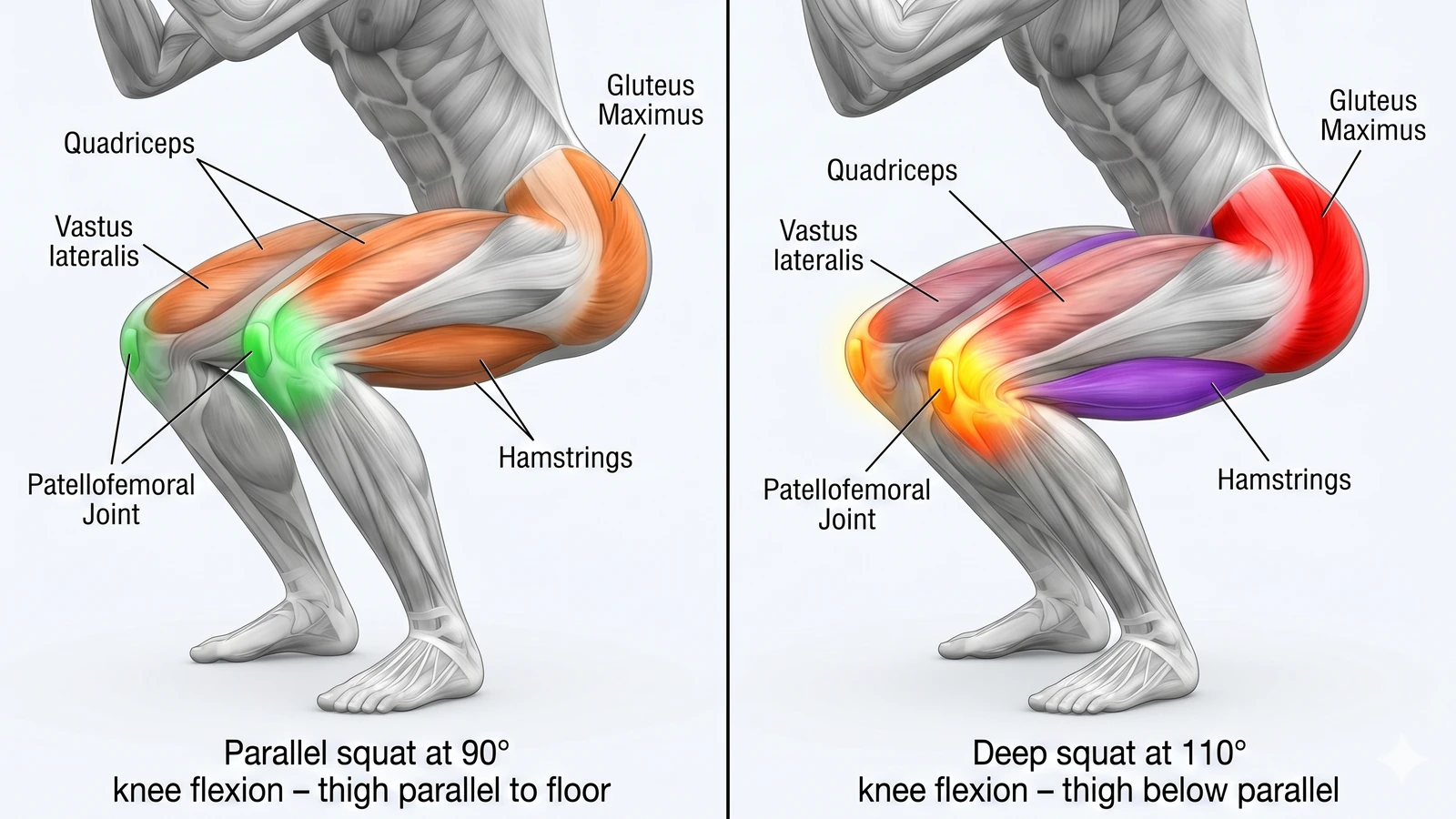
A parallel squat usually means the hip crease reaches roughly knee height. A deep squat means the hip crease moves below the knee. As depth increases, knee flexion increases, and the knee experiences both compressive and shear forces. Load, control and anatomy decide whether those forces are productive or irritating.
The science: what the research reveals
Back squat depth increased gluteus maximus activation, while relative quadriceps and hamstring contribution did not differ significantly across depths.
Deeper squats produced greater vastus lateralis and gluteus maximus activity in group-exercise participants.
Full squat training produced greater gluteus maximus and adductor volume increases than half squats over 10 weeks.
Below-parallel squats increased patellofemoral reaction force and stress compared with shallower depths, with load also mattering.
In collegiate women athletes, patellofemoral joint kinetics did not vary significantly across 70, 90 and 110 degrees of knee flexion.
Knee extensor effort increased with greater depth, while hip extensor effort increased with both depth and load.
Practical application
| Goal | Depth | Sets | Reps | Load | Tempo |
|---|---|---|---|---|---|
| Strength | Either | 3-5 | 3-6 | 80-90% 1RM | 2-0-1 |
| Hypertrophy | Either | 3-4 | 8-12 | 65-80% 1RM | 3-0-1 |
| Glute focus | Deep | 3-4 | 8-12 | 60-75% 1RM | 3-0-1 |
| Beginner or knee-sensitive | Parallel | 3 | 10-15 | Light | 3-0-1 |
Who should use which option?
| Profile | Recommended depth | Why |
|---|---|---|
| Healthy beginner | Parallel | Builds foundational strength with simpler control demands. |
| Powerlifter | Competition-legal parallel | Specific to meet standards and heavier loading. |
| Bodybuilder | Deep if tolerated | More glute and adductor development potential. |
| Sports athlete | Mixed | Builds strength through multiple ranges. |
| Knee pain history | Parallel first | Manage patellofemoral stress and progress gradually. |
Common mistakes
| Mistake | Why it is a problem | Fix |
|---|---|---|
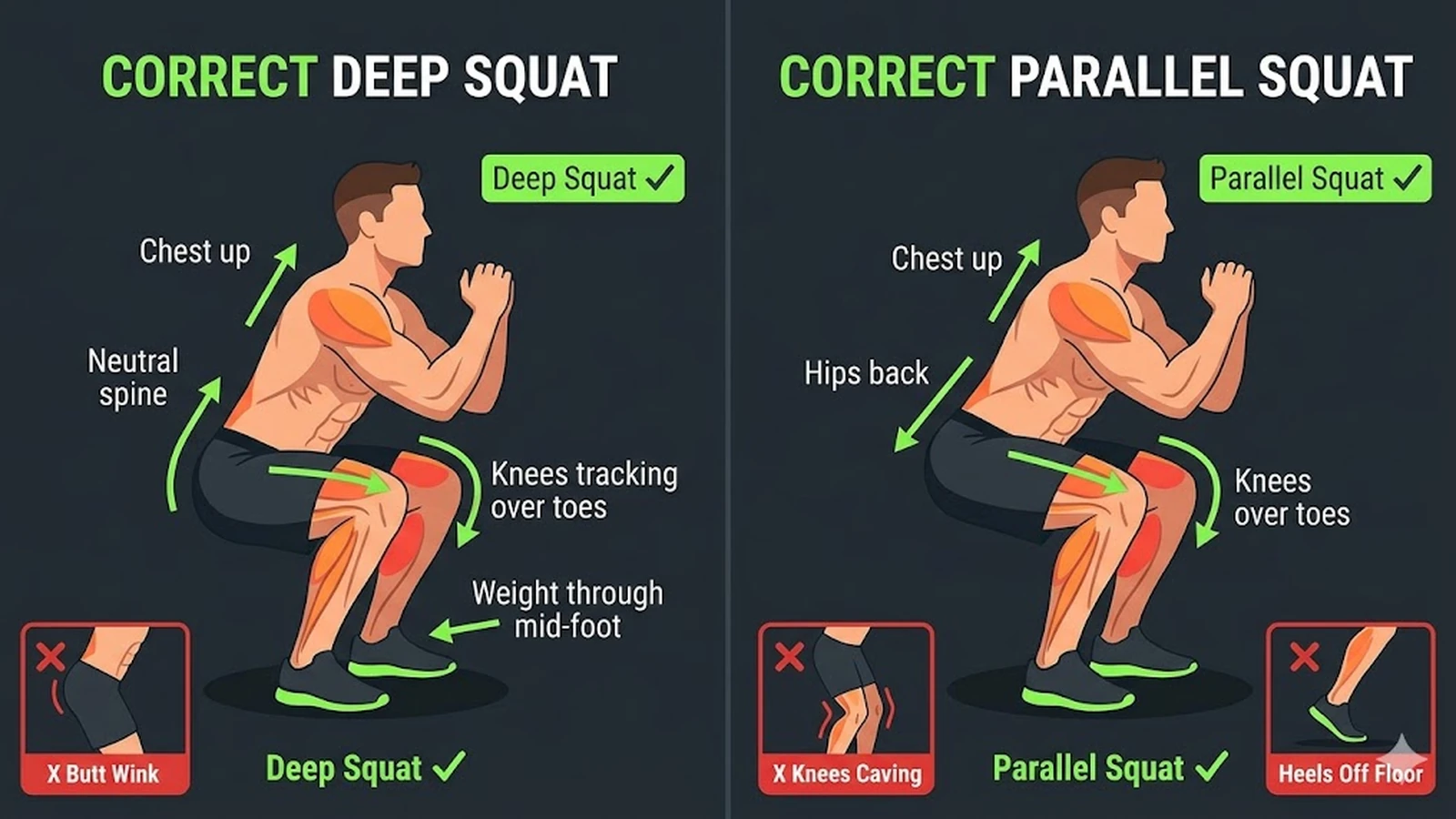
| Heels coming off the floor | Shifts load forward and can increase knee stress. | Improve ankle mobility or use weightlifting shoes. |
| Knees caving inward | Increases stress on passive structures. | Drive knees over toes and lower the load. |
| Butt wink | Loss of lumbar position at the bottom. | Stop at the depth where your spine stays neutral. |
| Bouncing out of the bottom | Uses momentum and may irritate joints. | Control the reversal or add a short pause. |
Sample workout integration
- Strength focus: parallel back squat 5 x 5, Romanian deadlift 3 x 8, leg press 3 x 10, calf raise 3 x 12.
- Hypertrophy focus: deep back squat 4 x 8-10, dumbbell lunges 3 x 10 per leg, leg curls 3 x 12, hip thrusts 3 x 12.
- Mixed focus: deep squats 3 x 6, heavier parallel squats 3 x 6, Bulgarian split squats 3 x 8 per leg, Nordic curls 3 x 6-8.
When to stop or modify
Stop immediately for sharp knee, hip or lower-back pain, joint locking, catching, giving way, or pain that persists after training. If you have patellofemoral pain, reduce depth to parallel, lower load, and progress gradually. If you have a prior knee injury, get guidance before adding heavy deep squats.
Takeaway
Parallel and deep squats both belong in evidence-based training. Parallel squats are a reliable starting point and fit heavier strength work. Deep squats can offer greater glute and adductor development and appear safe for healthy knees when technique and loading are controlled.
The best depth is the one that lets you train consistently, with good form, without pain. Progress depth before load, and periodise your squat depth over time.
Sources and references
- Caterisano A, et al. Back squat depth and EMG activity. PubMed PMID: 12173958
- O'Neill KE, et al. Squat depth and load on lower body muscle activity. PubMed PMID: 33660588
- Kubo K, et al. Squat depth and lower-limb muscle volumes. PubMed PMID: 31230110
- Zavala L, et al. Patellofemoral kinetics at different squat depths. PubMed PMID: 32781938
- Salem GJ, et al. Patellofemoral kinetics during squatting. PubMed PMID: 11390050
- Bryanton MA, et al. Squat depth and relative muscular effort. PubMed PMID: 22797000
- Frontiers in Physiology 2024 scoping review on deep squats and knee structures