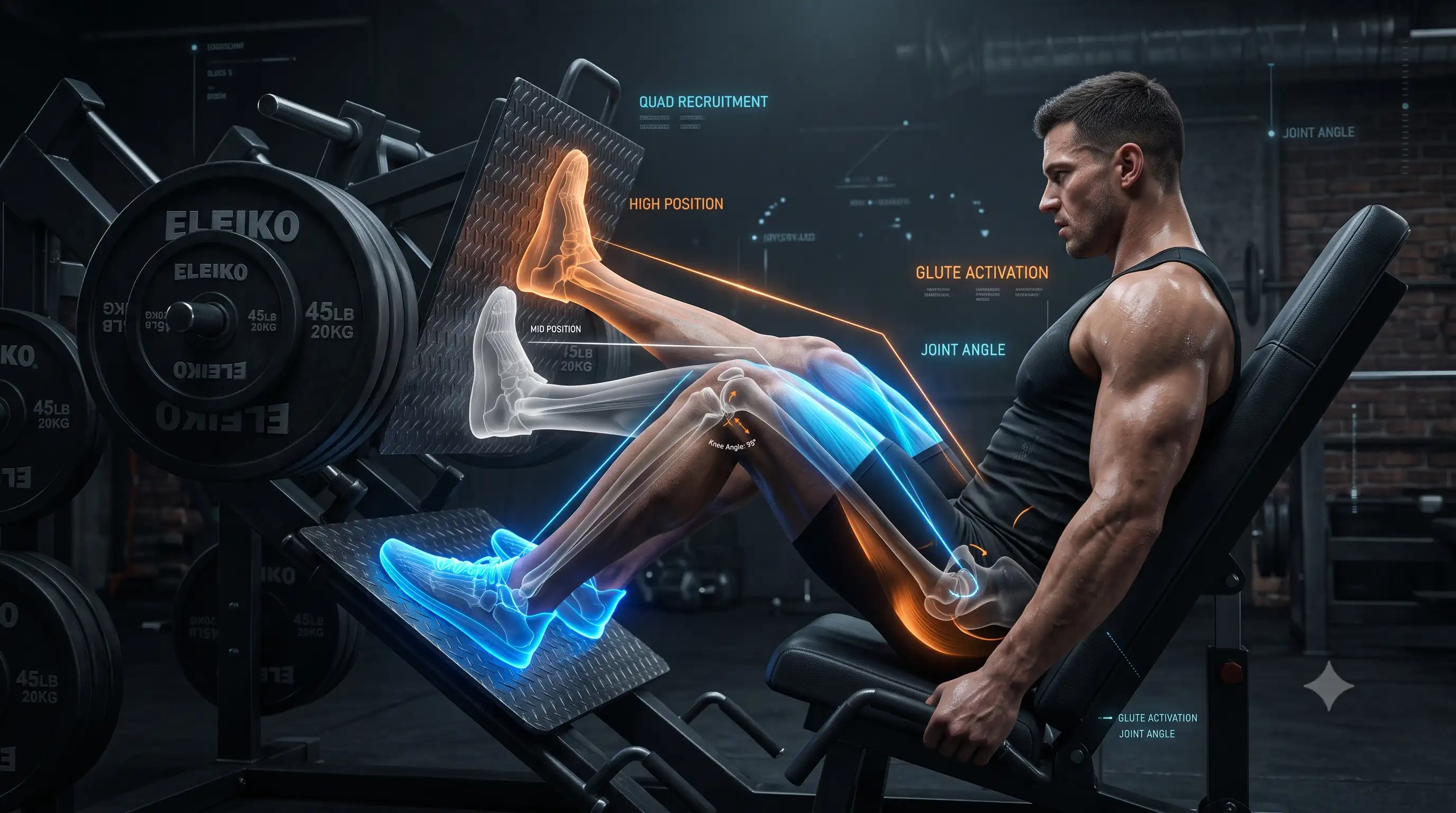
Here's what the science shows
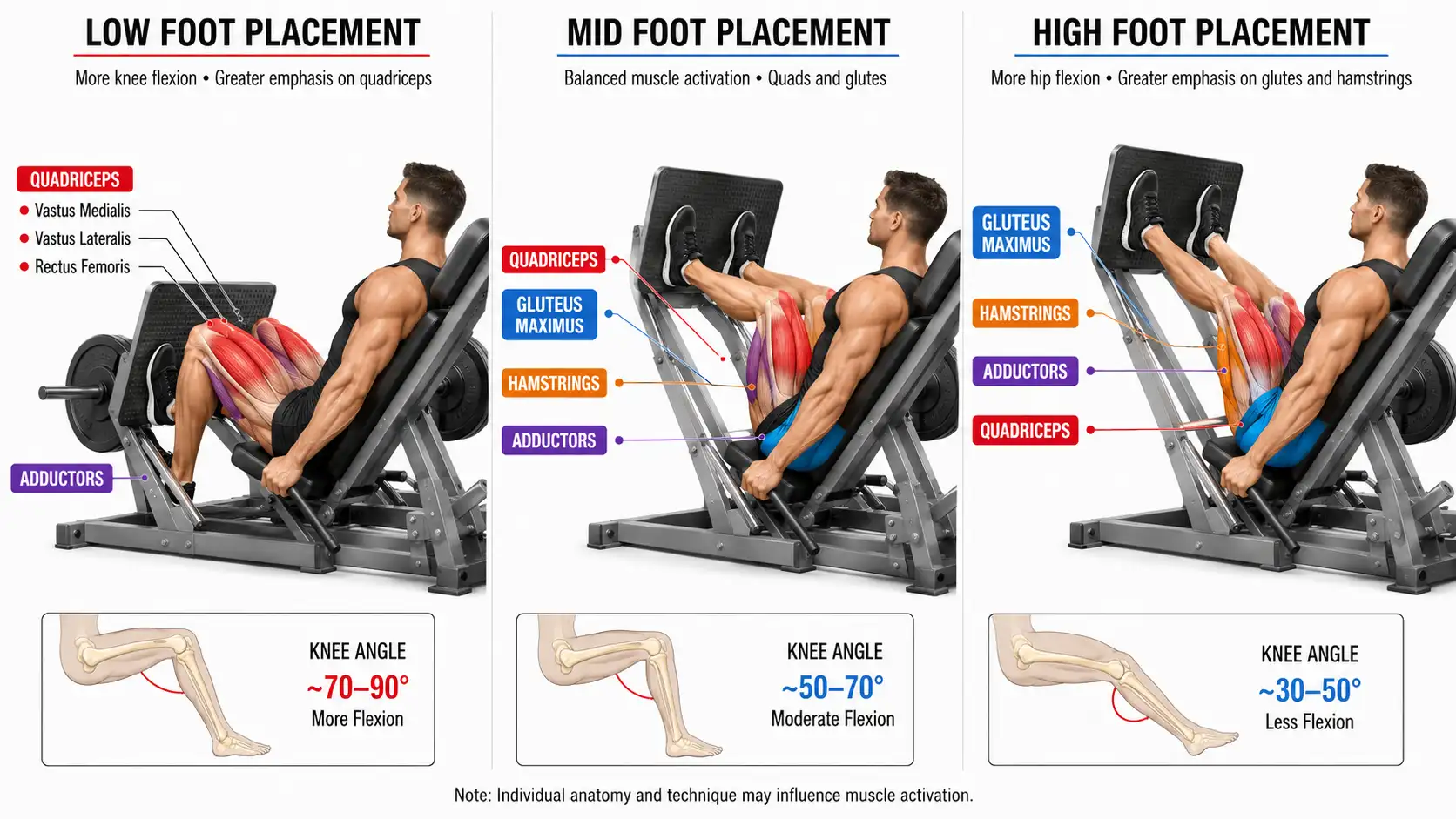
Foot placement on the leg press changes which muscles do the work. A high foot placement shifts emphasis to the glutes and hamstrings, while a low foot placement targets the quadriceps more directly. A wider stance increases hamstring activation, while a narrower stance may emphasise the quads. Critically, foot angle (toes straight vs turned out) does not significantly affect muscle activity or knee forces – so choose what feels comfortable. The leg press also generates significantly lower knee forces than the squat, making it a safer option for those with knee concerns. The takeaway: adjust your foot placement based on your training goals, but keep your feet flat and stable – knee safety comes first.
Short answer
Foot placement on the leg press dictates which muscles work hardest. Placing your feet low on the platform maximises quadriceps activation due to increased knee flexion. Placing your feet high shifts the focus to the glutes and hamstrings by increasing hip extension. A wide stance further engages the hamstrings and adductors, while a narrow stance targets the quads. Research shows that foot angle (toes in vs out) has no significant effect on muscle activation or knee stress, so prioritise comfort. Finally, the leg press generates significantly lower knee forces than the squat, making it an excellent, knee-friendly alternative for building lower body strength.


Research source disclaimer. All research cited in this article is sourced from peer-reviewed studies indexed in PubMed, NIH/NCBI-linked sources, or reputable journals where available. Links to the original studies are provided throughout.
Introduction
The leg press is one of the most popular machines in any gym. It's accessible, safe and effective for building lower body strength. But here's a question that many lifters overlook: where should you place your feet?
Move your feet up, down, wider or narrower – and you change which muscles do the work. The same machine, the same weight, the same number of reps – but a completely different stimulus.
This isn't gym lore. It's biomechanics. Your foot position changes the angles at your hip and knee, which changes the demands on your quadriceps, glutes, hamstrings and even your knee joints.
This guide breaks down what the peer-reviewed research actually says about leg press foot placement – for muscle activation, joint safety and practical application.
Anatomy / Biomechanics: What Changes When You Move Your Feet?
The Primary Muscles
| Muscle | Role in Leg Press |
|---|---|
| Quadriceps (vastus medialis, vastus lateralis, rectus femoris) | Knee extension – straightening the knee to push the platform away |
| Gluteus maximus | Hip extension – driving the hips forward as the platform is pushed |
| Hamstrings (biceps femoris, semitendinosus) | Hip extension assistance; knee stabilisation |
| Adductors (inner thigh) | Hip stabilisation; more active with wider stances |
| Gastrocnemius (calf) | Ankle stabilisation; assists in pushing |
Research consistently shows that the quadriceps muscles elicit the greatest muscle activation during the leg press, particularly the vastus medialis and vastus lateralis, followed closely by the rectus femoris.
How Foot Placement Changes the Movement
| Foot Placement | Effect on Hip Angle | Effect on Knee Angle | Primary Muscle Emphasis |
|---|---|---|---|
| High (top of plate) | More hip flexion | Less knee flexion | Glutes + Hamstrings |
| Low (bottom of plate) | Less hip flexion | More knee flexion | Quadriceps |
| Wide (outside shoulders) | More hip abduction | Similar knee angle | Adductors + Hamstrings |
| Narrow (hip-width) | Less hip abduction | Similar knee angle | Quadriceps |
| Toes turned out | External hip rotation | Similar knee angle | Adductors (slight) |
The key insight: changing foot position changes the orientation of the femur, which in turn affects the demands on the hip and knee joints.
The Science: What the Research Reveals
Landmark study on knee biomechanics. Found that foot angle doesn't affect muscle activity, but wide stances increase hamstring activation. Leg press generates lower knee forces than squats.
Systematic review confirming that high foot placement elicits significantly greater gluteus maximus and hamstring muscle activity compared to standard placements.
Muscular activation in males tends to be greater during wide stance than standard stance, whereas no such effect of stance was observed in females at higher loads.
No ACL forces were produced for any leg press variation. Tibiofemoral and patellofemoral forces were significantly lower than in the back squat.
Source 1: The Landmark Study – Foot Placement and Knee Forces
Study: Escamilla RF, Fleisig GS, Zheng N, et al. Effects of technique variations on knee biomechanics during the squat and leg press. Med Sci Sports Exerc. 2001;33(9):1552-1566.
PubMed ID: 11528356
https://pubmed.ncbi.nlm.nih.gov/11528356/
What it found: Ten experienced male lifters performed the squat, a high foot placement leg press (LPH), and a low foot placement leg press (LPL) employing a wide stance (WS), narrow stance (NS), and two foot angle positions (feet straight and feet turned out 30°).
| Finding | Detail |
|---|---|
| Foot angle | No differences were found in muscle activity or knee forces between foot angle variations. |
| Hamstring activation | The WS-LPH (wide stance, high feet) generated greater hamstrings activity than the NS-LPH. |
| Squat vs Leg Press | The squat generated greater quadriceps and hamstrings activity than both LPH and LPL. |
| Knee forces | Tibiofemoral compressive forces, PCL tensile forces, and patellofemoral compressive forces were generally greater in the squat than the LPH and LPL. |
| No ACL forces | No ACL forces were produced for any exercise variation. |
| Stance width effect | For all exercises, the WS generated greater PCL tensile forces than the NS. The NS produced greater TF and PF compressive forces than the WS during the LPH and LPL. |
Key takeaway: Foot angle doesn't matter much for muscle activation or knee forces. Foot height and stance width matter more. The leg press generates significantly lower knee forces than the squat, making it a knee-friendly alternative.
Source 2: Systematic Review – High Foot Placement for Glutes and Hamstrings
Study: Martín-Fuentes I, Oliva-Lozano JM, Muyor JM. Evaluation of the Lower Limb Muscles' Electromyographic Activity during the Leg Press Exercise and Its Variants: A Systematic Review. Int J Environ Res Public Health. 2020;17(13):4626.
PubMed ID: 32605065
https://pubmed.ncbi.nlm.nih.gov/32605065/
What it found: This systematic review compared different leg press variations and their effects on muscle activation. "The leg press with high foot placement elicited greater gluteus maximus and greater hamstring muscle activity compared to the 45° inclined leg press exercise."
Key takeaway: If your goal is glute and hamstring development, place your feet higher on the platform. This increases hip extension demands and shifts emphasis to the posterior chain.
Source 3: Foot Height – High vs Low Placement
Study: Multiple EMG studies (synthesised in systematic reviews).
| Foot Placement | Muscle Emphasis | Mechanism |
|---|---|---|
| High placement | Greater gluteus maximus and hamstring activity | More hip flexion; greater stretch on hip extensors |
| Low placement | Higher quadriceps activation | More knee flexion; greater knee extension demands |
Key takeaway: High = glutes/hamstrings. Low = quads. This is the most practical and well-supported finding in leg press research.
Source 4: Stance Width – Wide vs Narrow
Study: Escamilla et al. (2001) – detailed above.
| Stance Width | Effect |
|---|---|
| Wide stance | Greater hamstrings activity (especially with high foot placement); Greater PCL tensile forces |
| Narrow stance | Greater tibiofemoral and patellofemoral compressive forces during leg press |
Key takeaway: A wider stance emphasises the hamstrings and adductors more, while a narrower stance may place slightly more compressive force on the knee joint.
Source 5: Sex Differences in Stance Width Response
Study: Sex differences in muscle activation during inclined leg press exercise: Effects of stance width, load, and contraction phase.
What it found: Muscular activation in males tends to be greater during wide stance than standard stance, whereas no such effect of stance was observed in females. The change from standard to wide stance significantly increased activation of vastus medialis muscles only in males at higher loads.
Key takeaway: Individual responses to stance width may vary. Experiment to find what works for your body.
Source 6: Foot Angle – Does It Matter?
Study: Escamilla et al. (2001) – detailed above.
What it found: No differences were found in muscle activity or knee forces between foot angle variations (feet straight vs feet turned out 30°).
Key takeaway: Foot angle is largely a matter of comfort. Turn your toes out slightly if it feels more natural – it won't significantly change muscle activation or knee stress.
Source 7: Knee Safety – Leg Press vs Squat
Study: Escamilla et al. (2001) – detailed above.
What it found: No ACL forces were produced for any leg press variation. Tibiofemoral and patellofemoral forces were generally greater in the squat than the leg press. All forces increased with knee flexion – meaning deeper ranges of motion create more joint stress.
Key takeaway: The leg press is a knee-friendly alternative to the squat. For those with patellofemoral or PCL concerns, the leg press – especially with limited range of motion (0-50° knee flexion) – is a safer option.
Practical Application
Step-by-Step Instructions
General Setup (All Variations)
- Sit on the leg press machine with your back flat against the pad.
- Place your feet on the platform based on your goal (see below).
- Keep your feet flat – heels and toes should both be in contact with the platform.
- Lower the weight under control until your knees are at approximately 90° (or your chosen depth).
- Push through your entire foot – not just your toes or heels.
- Extend your knees and hips to return to the start position.
- Do not lock out your knees at the top – keep a slight bend.
Foot Placement Options
| Goal | Foot Placement | Stance Width | Foot Angle | Notes |
|---|---|---|---|---|
| Quadriceps focus | Low (bottom of plate) | Shoulder-width | Comfortable | Maximises knee flexion |
| Glute/Hamstring focus | High (top of plate) | Shoulder-width | Comfortable | Increases hip extension |
| Hamstring emphasis | High | Wide (outside shoulders) | Slightly turned out | WS-LPH = greatest hamstring activity |
| Adductor focus | Mid | Wide | Turned out | Targets inner thigh |
| Knee-friendly | Mid-high | Comfortable | Comfortable | Reduces knee stress; limit range to 0-50° |
Recommended Sets, Reps and Load
| Goal | Sets | Reps | Load | Notes |
|---|---|---|---|---|
| Quad hypertrophy | 3-4 | 10-15 | 65-80% 1RM | Low foot placement |
| Glute development | 3-4 | 10-15 | 65-80% 1RM | High foot placement |
| Strength | 3-5 | 5-8 | 80-90% 1RM | Choose your focus |
| Knee rehab / safety | 3 | 12-15 | Light-moderate | Limit range; moderate load |

Who Should Use Which Option?
| Profile | Recommended Placement | Rationale |
|---|---|---|
| Quad-dominant lifter | Low placement | Maximises quadriceps activation |
| Glute-focused training | High placement | Increases glute and hamstring involvement |
| Hamstring emphasis | High + wide stance | WS-LPH = greatest hamstring activity |
| Knee pain / sensitivity | Mid-high placement | Reduces knee stress; limit range |
| Beginner | Mid placement | Balanced activation; safe starting point |
| Long femurs / tight ankles | High placement | Reduces knee travel; more comfortable |
Comparison Table: Leg Press Foot Placements
| Option | Best For | Muscle Emphasis | Joint / Safety Note | Practical Cue |
|---|---|---|---|---|
| Low Placement | Quadriceps development | Vastus medialis, vastus lateralis, rectus femoris | More knee flexion = more knee stress | "Feet low, knees drive forward" |
| High Placement | Glute and hamstring development | Gluteus maximus, biceps femoris | Less knee stress; more hip extension | "Feet high, drive through heels" |
| Wide Stance | Hamstring and adductor emphasis | Biceps femoris, adductors | Greater PCL tensile forces | "Feet wide, knees track over toes" |
| Narrow Stance | Quadriceps emphasis | Vastus medialis, vastus lateralis | Greater PF compressive forces | "Feet hip-width, push evenly" |
| Foot Angle (any) | Comfort and stability | Minimal effect on activation | No significant effect on knee forces | "Point toes naturally" |
Common Mistakes Table
| Mistake | Why It Is a Problem | Fix |
|---|---|---|
| Heels lifting off platform | Reduces hamstring and glute engagement; increases knee shear | Keep feet flat; push through entire foot |
| Locking out knees at top | Transfers load to joints; reduces muscle tension | Keep a slight bend at full extension |
| Using too much weight | Compromises form; increases injury risk | Reduce load; focus on controlled movement |
| Going too deep (knees to chest) | Increases knee forces significantly | Stop at 90° or when hips begin to lift |
| Hips lifting off the pad | Shifts load to lower back; reduces leg drive | Keep hips pressed firmly into the pad |
| Feet too far apart or close | May cause unnecessary joint stress | Adjust stance to shoulder-width or slightly wider |
| Not controlling the eccentric | Reduces muscle damage stimulus; limits growth | Lower under control (2-3 seconds) |
Sample Workout Integration
Workout 1: Quad Focus
| Exercise | Sets | Reps | Load | Notes |
|---|---|---|---|---|
| Leg Press (Low placement) | 4 | 10-12 | 75% 1RM | Quad emphasis |
| Barbell Squat | 3 | 8 | 80% 1RM | Compound quad work |
| Leg Extensions | 3 | 12 | Moderate | Isolation |
| Walking Lunges | 3 | 10/leg | Moderate | Unilateral |
Workout 2: Glute/Hamstring Focus
| Exercise | Sets | Reps | Load | Notes |
|---|---|---|---|---|
| Leg Press (High + Wide placement) | 4 | 10-12 | 70% 1RM | Glute/hamstring emphasis |
| Romanian Deadlift | 3 | 10 | Moderate | Posterior chain |
| Hip Thrusts | 3 | 12 | Moderate | Glute isolation |
| Lying Leg Curls | 3 | 12 | Moderate | Hamstring isolation |
Workout 3: Knee-Friendly / Rehab Focus
| Exercise | Sets | Reps | Load | Notes |
|---|---|---|---|---|
| Leg Press (Mid placement, limited ROM) | 3 | 12-15 | Light | 0-50° range |
| Seated Leg Curls | 3 | 12 | Light | Hamstring support |
| Wall Sits | 3 | 30-60s | Bodyweight | Isometric quad work |
| Step-ups (low box) | 3 | 10/leg | Bodyweight | Controlled movement |
Safety warning
Stop immediately if you experience:
- Sharp, stabbing pain in the knee, hip or lower back
- Pain that worsens during the movement (not just muscle burn)
- Joint locking, catching or giving way
- Pain that persists after your workout
Modify if:
- You have knee pain – use a higher foot placement and limit range of motion to 0-50° knee flexion
- You have lower back pain – keep your hips pressed firmly into the pad; avoid rounding your lower back
- You have patellofemoral pain – the leg press is generally safer than the squat, but use moderate loads and controlled range
- You're new to leg press – start with light loads and master the form first
Key Safety Principles:
- Keep feet flat – heels and toes both on the platform
- Don't lock out – maintain a slight bend at the knees at full extension
- Control the eccentric – lower the weight under control (2-3 seconds)
- Limit depth if needed – all knee forces increase with knee flexion
- Progress gradually – increase load by 2.5–5 kg per session
- Listen to your body – pain is information, not something to push through
Takeaway
Leg press foot placement is a simple but powerful tool to change your training stimulus.
- Low placement = more quadriceps activation – ideal for building the front of your thighs
- High placement = more glute and hamstring activation – ideal for posterior chain development
- Wide stance = more hamstring and adductor involvement
- Narrow stance = more quadriceps emphasis
- Foot angle = largely a matter of comfort – research shows it doesn't significantly affect muscle activation or knee forces
The leg press is also a knee-friendly alternative to the squat, generating significantly lower knee forces. For those with knee concerns, the leg press – especially with higher foot placement and limited range of motion – is a safe and effective option.
The best approach: choose your foot placement based on your goals. Want bigger quads? Go low. Want stronger glutes and hamstrings? Go high and wide. Want knee safety? Go mid-high and limit your range. Experiment, listen to your body, and train with purpose.
Complete reference list
- Escamilla RF, Fleisig GS, Zheng N, et al. Effects of technique variations on knee biomechanics during the squat and leg press. Med Sci Sports Exerc. 2001;33(9):1552-1566.
- Martín-Fuentes I, Oliva-Lozano JM, Muyor JM. Evaluation of the Lower Limb Muscles' Electromyographic Activity during the Leg Press Exercise and Its Variants: A Systematic Review. Int J Environ Res Public Health. 2020;17(13):4626.
- Sex differences in muscle activation during inclined leg press exercise – effects of stance width, load, and contraction phase.
- Effects of Trunk and Foot Positions on Electromyographic Activity and Co-contraction of Selected Lower Extremity Muscles During Leg-Press Resistance Training.