Here's what the science shows
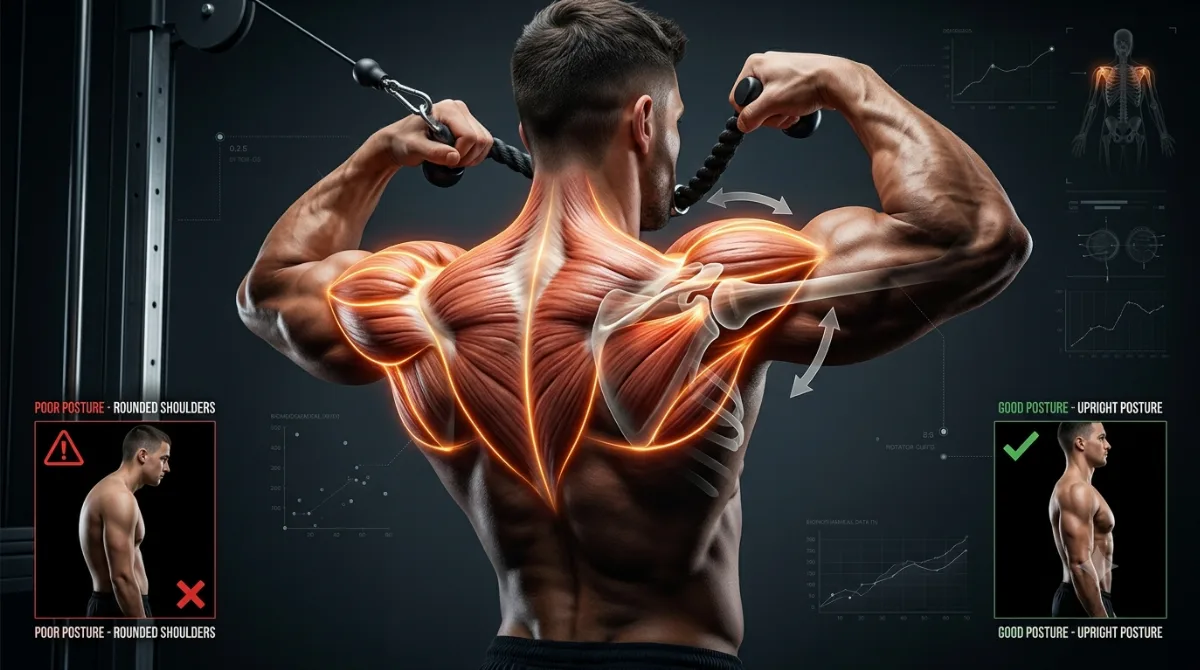
The face pull is a cable-based pulling exercise that primarily targets the posterior deltoids, trapezius, rhomboids, and rotator cuff muscles (infraspinatus and teres minor). Research on shoulder impingement in weight-training populations suggests that strengthening the external rotators may serve as a useful means to mitigate characteristics associated with subacromial impingement syndrome. A systematic review found that for posterior deltoid activation, pull-ups generated the greatest activation, with the standard pull-up and inverted row with a suspension device requiring the highest individual exercise activation. The face pull is considered an important exercise for shoulder health and stability, improving postural muscle development and counteracting rounded shoulder posture. The takeaway: face pulls and rear delt work are essential for shoulder balance, injury prevention and posture correction — especially for lifters who do a lot of pressing.
Quick answer: why face pulls and rear delt training matter
Face pulls and rear delt training are essential for shoulder health, injury prevention and posture correction. They strengthen the often-neglected muscles at the back of the shoulder and upper back — pulling your shoulders back into proper alignment and counteracting the anterior dominance created by pressing movements.
Face Pulls
Best for overall shoulder health, rotator cuff strengthening and posture correction. Targets the posterior deltoids, trapezius, rhomboids, infraspinatus and teres minor with a single movement.
Rear Delt Isolation
Best for targeted hypertrophy of the posterior deltoid. Reverse flyes (dumbbell or machine) and band pull-aparts are excellent complements to face pulls for complete rear shoulder development.
Introduction
If you spend any time in the gym, you've probably seen someone doing face pulls — pulling a rope attachment toward their face with elbows flared out. It looks a bit odd. But here's the thing: it might be the most important exercise you're not doing.
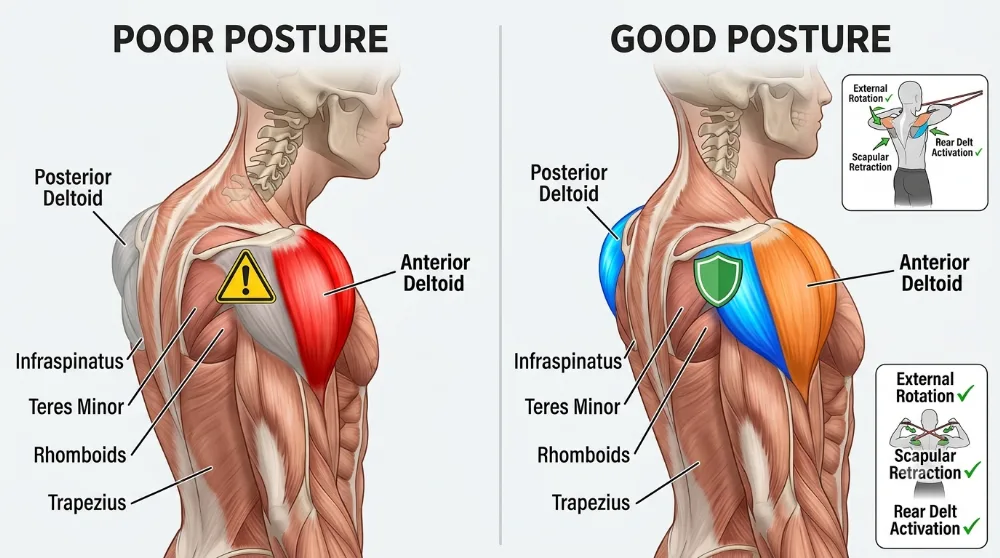
Most gym-goers are obsessed with pressing movements — bench press, overhead press, push-ups. These exercises build the front of your shoulders and chest, but they also create a serious problem: muscle imbalance. The anterior deltoid gets overdeveloped while the posterior deltoid (rear delt) gets neglected.
This imbalance pulls your shoulders forward, rounds your posture, and sets you up for shoulder pain and injury.
Face pulls and rear delt training are the antidote. They strengthen the often-neglected muscles at the back of your shoulders and upper back, pulling your shoulders back into proper alignment.
This guide breaks down what the science says about face pulls and rear delt training — for shoulder health, injury prevention and posture correction.
Anatomy / Biomechanics: Why Rear Delt Training Matters
The Shoulder Muscles
| Muscle | Location | Primary Function | Why It Matters |
|---|---|---|---|
| Posterior Deltoid | Back of the shoulder | Shoulder extension and external rotation | Often neglected; essential for shoulder balance |
| Anterior Deltoid | Front of the shoulder | Shoulder flexion | Overworked in pressing movements |
| Medial Deltoid | Side of the shoulder | Shoulder abduction | Often trained but rarely prioritised |
| Infraspinatus | Rotator cuff (back) | External rotation | Stabilises the shoulder joint |
| Teres Minor | Rotator cuff (back) | External rotation | Works with infraspinatus |
| Rhomboids | Upper back (between shoulder blades) | Scapular retraction | Pulls shoulder blades together |
| Trapezius (middle/lower) | Upper back | Scapular stabilisation | Holds shoulders in proper position |
The Face Pull: What It Targets
The face pull primarily targets the posterior deltoids, trapezius, rhomboids, infraspinatus and teres minor (rotator cuff muscles). It is considered an important exercise for shoulder health and stability.
The Imbalance Problem
Many common gym exercises — bench press, shoulder press, chest flyes — heavily engage the front and side delts. Without balanced rear delt work, this creates:
| Problem | Effect |
|---|---|
| Forward shoulder posture | Rounded shoulders, increased injury risk |
| Muscle imbalance | Weak external rotators, tight internal rotators |
| Increased impingement risk | Pinching of rotator cuff tendons |
| Poor scapular control | Reduced shoulder stability |
Face pulls and rear delt training counteract these issues by strengthening the muscles that pull the shoulders back.
The Science: What the Research Reveals
Source 1: Shoulder Impingement in Weight Training — External Rotation Matters
Study: Characteristics of shoulder impingement in the recreational weight-training population. PubMed
What it found: Research on recreational weight-training participants suggests that weight trainers may be predisposed to subacromial impingement syndrome (SIS). The study found that avoiding performance of lateral deltoid raises and upright rows beyond an angle of 90° and efforts to strengthen the external rotators may serve as a useful means to mitigate characteristics associated with SIS.
Key takeaway: Strengthening the external rotators — which includes the infraspinatus and teres minor (both targeted by face pulls) — is a key strategy for preventing shoulder impingement.
Source 2: Posterior Deltoid Activation — Pull-Ups and Inverted Rows Lead
Study: Activation of the three deltoid muscle portions during common strengthening exercises: A systematic review. ScienceDirect, 2022
What it found: This systematic review examined deltoid activation across common strengthening exercises. For the posterior deltoid, pull-ups generated the greatest activation, with the standard pull-up and the inverted row with a suspension device requiring the highest individual exercise activation.
Key takeaway: Compound pulling exercises (pull-ups, inverted rows) are highly effective for rear delt activation. However, face pulls and rear delt flyes are still valuable for isolating and specifically targeting the posterior deltoid.
Source 3: Posterior Deltoid Activation — Isolation Exercises
Study: Electromyographic comparison of infraspinatus, anterior, and posterior deltoid fibres during belly press exercise and triceps overactivity. PMC, 2025
What it found: This study compared EMG activity of the infraspinatus, anterior deltoid, and posterior deltoid during different exercise conditions.
Key takeaway: Specific exercise selection matters for targeting the posterior deltoid. Isolation exercises like face pulls and reverse flyes are effective for targeted rear delt development.
Source 4: Shoulder Rehabilitation — External Rotation and Scapular Retraction
Study: A Comparison of 2 Exercise Protocols in Athletes With Primary Subacromial Impingement Syndrome: A Randomized Clinical Trial. PubMed, 2024
What it found: An exercise program of 6 to 8 weeks, including strengthening exercises for shoulder external rotators and scapula retractor muscles and stretches for pectoral muscles, can decrease the incidence of shoulder pain.
Key takeaway: External rotation and scapular retraction exercises — exactly what face pulls provide — are clinically proven to reduce shoulder pain and impingement risk.
Source 5: Face Pull — Muscle Activation and Benefits
Research synthesis: The face pull is a weight training exercise that primarily targets the musculature of the upper back and shoulders, namely the posterior deltoids, trapezius, rhomboids, as well as the infraspinatus and teres minor muscles of the rotator cuff.
- Improves posture — Strengthens muscles responsible for maintaining proper posture
- Counteracts rounded shoulders — Pulls shoulders back into alignment
- Improves shoulder stability — Strengthens stabilising muscles
- Reduces injury risk — Balances anterior/posterior shoulder strength
- Supports pressing strength — Stronger rear delts = more stable pressing
Key takeaway: The face pull is a versatile and highly effective exercise for shoulder health, posture and injury prevention.
Practical Application
Step-by-Step Instructions: Face Pull
- Set up — attach a rope handle to a cable pulley set at head height (or slightly above).
- Grip — grasp the rope with both hands, palms facing each other (neutral grip).
- Position — step back so there's tension on the cable, feet shoulder-width apart.
- Pull — pull the rope toward your face, driving your elbows out and back.
- Rotate — as you pull, rotate your hands so your palms face you at the end position.
- Squeeze — pause and squeeze your shoulder blades together at the peak contraction.
- Return — control the return to the start position (2-3 seconds).
- Repeat — maintain tension throughout; don't let the weight stack rest.
Key form cues: Elbows high — aim for elbows at or above shoulder height. Pull to the face — not to the chest. Squeeze the shoulder blades — this is where the magic happens. Don't use momentum — control both the pull and the return.
Other Rear Delt Exercises
| Exercise | Setup | Key Cue |
|---|---|---|
| Bent-Over Reverse Fly | Bend at hips, dumbbells in hands, palms facing each other | "Pull dumbbells apart, squeeze shoulder blades" |
| Machine Reverse Fly | Chest against pad, arms extended back | "Lead with elbows, not hands" |
| Band Pull-Aparts | Band held in front, pull apart horizontally | "Squeeze shoulder blades, hold for 1 second" |
| Cable Rear Delt Fly | Cable at waist height, cross arms, pull back | "Keep arms straight, pull back and together" |
| Seated Cable Face Pull | Same as standing, but seated for stability | "Same cues as standing face pull" |
Recommended Sets, Reps and Load
| Goal | Exercise | Sets | Reps | Load | Notes |
|---|---|---|---|---|---|
| Shoulder health / warm-up | Face Pull | 2-3 | 15-20 | Light | Focus on control and squeeze |
| Rear delt hypertrophy | Face Pull | 3-4 | 10-15 | Moderate | Progressive overload |
| Posture correction | Face Pull + Band Pull-Aparts | 3 | 12-15 | Light | High frequency |
| Strength | Pull-ups (rear delt focus) | 3-4 | 6-10 | Bodyweight + | Compound pulling |
| Variety | Rotate Face Pull, Reverse Fly, Band Pull-Aparts | 3 each | 10-15 | Varied | Different stimulus |
Who Should Prioritise Rear Delt Training
| Profile | Recommended Frequency | Rationale |
|---|---|---|
| Heavy pressers (bench, overhead) | 2-3x per week | Counteracts anterior dominance |
| Office workers / desk jobs | 3-4x per week | Corrects forward shoulder posture |
| Athletes (throwing/sports) | 2-3x per week | Prevents shoulder injuries |
| Bodybuilders | 2x per week | Complete shoulder development |
| Anyone with shoulder pain | Daily (light) | Rehab and prevention |
| Beginners | 2x per week | Builds foundational shoulder health |
Comparison Table: Rear Delt Exercises
| Option | Best For | Muscle Emphasis | Shoulder Health Benefit | Practical Cue |
|---|---|---|---|---|
| Face Pull (Cable) | Overall shoulder health, posture, rotator cuff | Posterior deltoid, trapezius, rhomboids, infraspinatus, teres minor | Highest — external rotation + scapular retraction | "Elbows high, pull to face, squeeze shoulder blades" |
| Bent-Over Reverse Fly (Dumbbell) | Rear delt hypertrophy, isolation | Posterior deltoid (primary) | Moderate — strengthens rear delt | "Bend at hips, pull dumbbells apart" |
| Machine Reverse Fly | Rear delt isolation, beginners | Posterior deltoid (primary) | Moderate — stable movement | "Chest against pad, lead with elbows" |
| Band Pull-Apart | Warm-up, posture, shoulder health | Posterior deltoid, rhomboids, rotator cuff | High — scapular retraction | "Pull band apart, squeeze shoulder blades" |
| Pull-Up / Inverted Row | Overall back + rear delt development | Posterior deltoid (highest activation), lats, traps | Moderate — compound pulling | "Pull chest to bar, squeeze at top" |
| Cable Rear Delt Fly | Constant tension rear delt isolation | Posterior deltoid (primary) | Moderate | "Arms straight, pull back and together" |
Common Mistakes Table
| Mistake | Why It Is a Problem | Fix |
|---|---|---|
| Pulling to the chest (face pull) | Reduces rear delt and rotator cuff activation | Pull to face/forehead level — not the chest |
| Elbows dropping (face pull) | Reduces external rotation; shifts to biceps | Keep elbows high (at or above shoulder height) |
| Using momentum | Reduces muscle tension; increases injury risk | Control both the pull and the return (2-3 sec eccentric) |
| Too much weight | Compromises form; reduces range of motion | Reduce load; focus on control and squeeze |
| Not retracting scapulae | Reduces upper back activation | Squeeze shoulder blades together at the peak |
| Shrugging shoulders | Activates upper traps instead of rear delts | Keep shoulders down and back — don't shrug |
| Limited range of motion | Reduces muscle damage stimulus | Full stretch at start; full contraction at end |
| Neglecting rear delt work entirely | Creates muscle imbalance; increases injury risk | Add 2-3 sets of rear delt work to every workout |
Sample Workout Integration
Workout 1: Shoulder Health Focus
- Band Pull-Aparts (warm-up) — 2 sets of 15 reps (light load) — Activate rear delts and rotator cuff
- Cable Face Pull — 3 sets of 15-20 reps (light-moderate load) — Focus on control and squeeze
- Band External Rotation — 3 sets of 12 reps per side (light load) — Rotator cuff isolation
- YTWL Raises — 3 sets of 10 each (light load) — Scapular stabilisation
Workout 2: Rear Delt Hypertrophy
- Cable Face Pull — 4 sets of 12-15 reps (moderate load) — Primary rear delt builder
- Bent-Over Reverse Fly (Dumbbell) — 3 sets of 12-15 reps (moderate load) — Isolation
- Machine Reverse Fly — 3 sets of 12-15 reps (moderate load) — Stable isolation
- Band Pull-Aparts (finisher) — 3 sets of 15-20 reps (light load) — High-rep burnout
Workout 3: Posture Correction (Full Upper Body)
- Cable Face Pull — 3 sets of 15 reps (light load) — Posture correction
- Pull-Ups — 3 sets of 8-10 reps (bodyweight) — Rear delt + back
- Seated Cable Row — 3 sets of 10-12 reps (moderate load) — Scapular retraction
- Chest Stretch — 2 sets of 30 seconds (bodyweight) — Counteract tight chest
Workout 4: Push Day Finisher (for Pressers)
- Face Pull (superset with pressing) — 3 sets of 15-20 reps (light load) — Between bench press sets
- Band Pull-Aparts — 3 sets of 15 reps (light load) — Post-workout
- External Rotation (band) — 3 sets of 12 reps per side (light load) — Rotator cuff health
Warning / Safety Section: When to Stop or Modify
Stop the exercise immediately if you experience sharp, stabbing pain in the shoulder, neck or upper back; pain that worsens during the movement (not just muscle burn); joint locking, catching or giving way; or pain that persists after your workout.
- Shoulder impingement: face pulls are generally safe, but reduce load and focus on controlled external rotation.
- Rotator cuff issues: use light loads and higher reps; stop if you feel any catching.
- Neck pain: keep your neck neutral; don't crane forward.
- New to face pulls: start with light weight and master the form first.
- Key safety principles: keep elbows high, pull to the face (not the chest or neck), control the eccentric (2-3 seconds), don't ego lift, squeeze at the top, keep shoulders down, progress gradually (small increments), and listen to your body — pain is information, not something to push through.
Takeaway
The research is clear: face pulls and rear delt training are essential for shoulder health, posture and injury prevention.
Face pulls target the posterior deltoids, trapezius, rhomboids and rotator cuff muscles (infraspinatus and teres minor). They are considered an important exercise for shoulder health and stability.
Strengthening the external rotators (which face pulls do) may serve as a useful means to mitigate characteristics associated with subacromial impingement syndrome.
Rear delt training is essential for counteracting anterior muscle dominance from pressing movements and improving posture.
Compound pulling exercises like pull-ups and inverted rows generate the highest posterior deltoid activation, but face pulls and reverse flyes are valuable for specific isolation and shoulder health.
The best approach for most lifters: Include 2-3 sets of face pulls in every workout — especially on pressing days. Add additional rear delt work (reverse flyes, band pull-aparts) 2-3 times per week. Your shoulders — and your posture — will thank you.
Complete Reference List
- Characteristics of shoulder impingement in the recreational weight-training population. PubMed — Strengthening external rotators mitigates SIS risk
- Activation of the three deltoid muscle portions during common strengthening exercises: A systematic review. ScienceDirect, 2022 — Pull-ups generate greatest posterior deltoid activation
- Electromyographic comparison of infraspinatus, anterior, and posterior deltoid fibres during belly press exercise and triceps overactivity. PMC, 2025 — Posterior deltoid activation comparison
- A Comparison of 2 Exercise Protocols in Athletes With Primary Subacromial Impingement Syndrome: A Randomized Clinical Trial. PubMed, 2024 — External rotation + scapular retraction exercises reduce shoulder pain
- Shoulder Impingement: Biomechanical Considerations in Rehabilitation. PubMed
- Rehabilitation Strategies After Shoulder Arthroplasty in Young and Active Patients. PubMed