Here's what the science shows
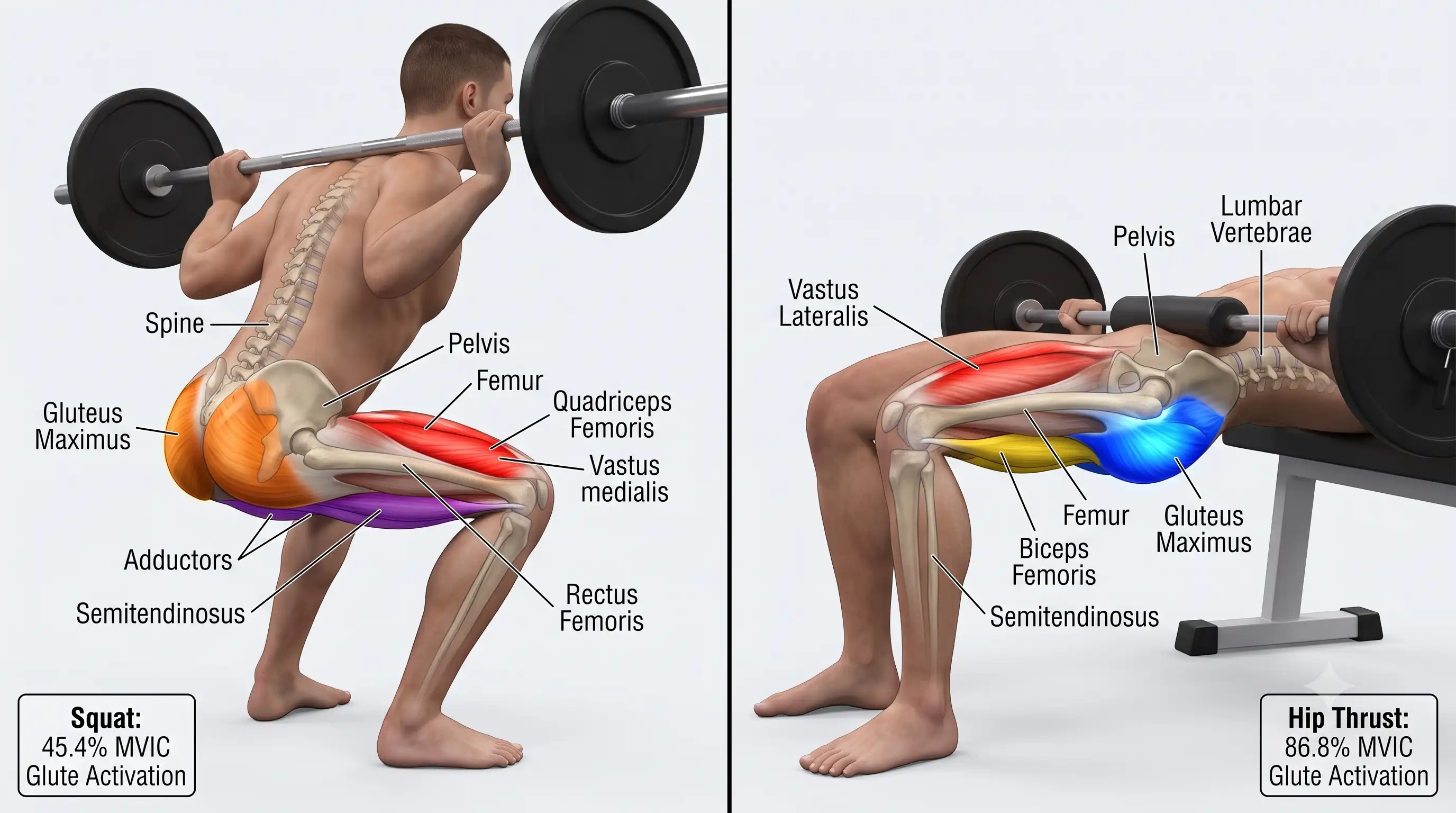
The barbell hip thrust activates the gluteus maximus 69–86% more than the back squat during a single session. But here's the kicker – over 9 weeks of training, both exercises build the same amount of glute muscle. The squat builds more quadriceps and adductor muscle, while the hip thrust builds more hamstring and glute activation. The takeaway: use both – the hip thrust for targeted glute activation, the squat for overall lower body development. Neither is "better"; they're different tools for different goals.
Short answer
Both the hip thrust and squat build glutes effectively, but they do it differently. The hip thrust produces significantly higher gluteus maximus EMG activation in a single session (69–86% more than the squat). However, over long-term training (9+ weeks), both exercises produce similar glute hypertrophy. The squat builds more quadriceps and adductor muscle, making it superior for overall lower body development. The hip thrust is the superior glute activator and has minimal knee loading, making it ideal for glute specialisation. The best approach: use both – periodise your training to get the benefits of each.


Research source disclaimer. All research cited in this article is sourced from peer-reviewed studies indexed in PubMed, NIH/NCBI-linked sources, or reputable journals where available. Links to the original studies are provided throughout.
Introduction
If you've spent any time in the gym or on social media, you've seen the debate: hip thrust vs squat – which one builds glutes better?
The hip thrust exploded in popularity after research showed it activated the glutes more than traditional squats. But the squat is the undisputed king of lower body exercises – it builds quads, glutes, hamstrings and core all at once.
So which one should you choose?
The answer isn't as simple as "one is better than the other." The research tells a more nuanced story – one that depends on your goals, your training history and how you structure your program.
This guide breaks down what the peer-reviewed science actually says about hip thrusts and squats for glute development, muscle activation and practical application.
Anatomy / Biomechanics: What Changes?
The Primary Muscles
| Muscle | Role in Squat | Role in Hip Thrust |
|---|---|---|
| Gluteus Maximus | Hip extension (driving up from the bottom) | Primary mover – hip extension from a flexed position |
| Quadriceps | Knee extension – straightening the knee | Minimal involvement (knee angle is fixed) |
| Hamstrings | Hip extension assistance; knee stabilisation | Significant activation; works with glutes |
| Adductors | Hip stabilisation; active at depth | Minimal involvement |
Key Biomechanical Differences
| Feature | Back Squat | Barbell Hip Thrust |
|---|---|---|
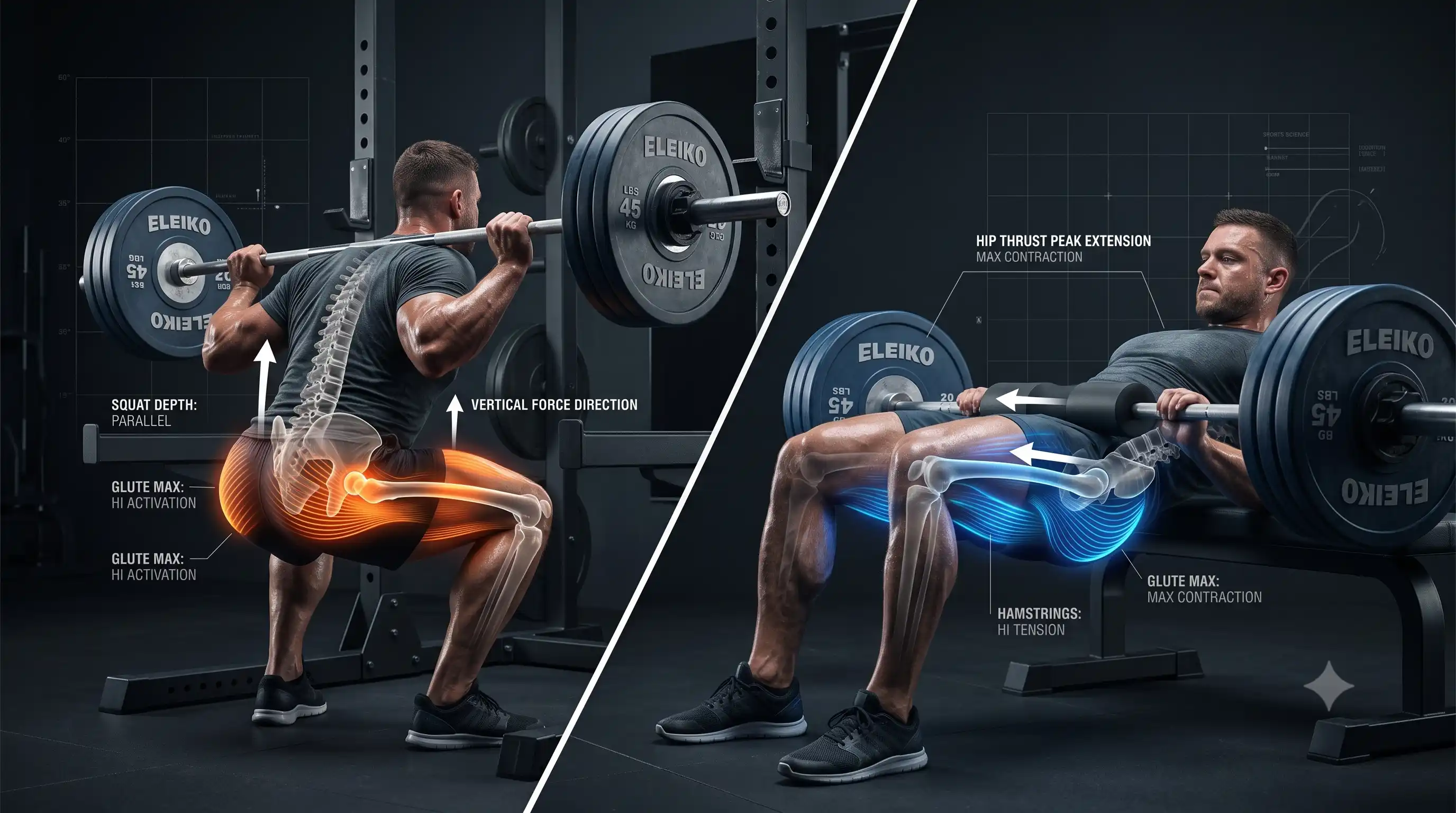
| Movement pattern | Vertical hip and knee extension | Horizontal hip extension |
| Knee flexion | Significant (90–120°) | Minimal (fixed angle) |
| Hip flexion | Significant at bottom | Significant at bottom |
| Torso position | Vertical to slightly forward | Supported on bench, torso moves with hips |
| Primary joint action | Knee + hip extension | Hip extension only |
| Load position | On shoulders (upper back) | Across hips (pelvis) |
The squat is a vertical force exercise – you're pushing the floor away. The hip thrust is a horizontal force exercise – you're driving your hips forward against resistance.
The Science: What the Research Reveals
Hip thrust activated gluteus maximus 86.8% vs squat's 45.4% MVIC – roughly 2x more glute activation in a single session.
9-week training: BOTH exercises built the SAME amount of glute muscle. Squat built more quads & adductors.
12 weeks in well-trained women: Squat produced greater quadriceps (+12.2%) and glute (+9.4%) hypertrophy than hip thrust.
Systematic review: Hip thrust favours greater activation of hip extensor muscles compared to more conventional exercises.
Source 1: EMG Activation – Hip Thrust Activates Glutes More Than Squat
Study: Contreras B, Vigotsky AD, Schoenfeld BJ, Beardsley C, Cronin J. A Comparison of Gluteus Maximus, Biceps Femoris, and Vastus Lateralis Electromyographic Activity in the Back Squat and Barbell Hip Thrust Exercises. J Appl Biomech. 2015;31(6):452-8.
PubMed ID: 26214739
https://pubmed.ncbi.nlm.nih.gov/26214739/
What it found: Thirteen trained women performed estimated 10-repetition maximums in both exercises. The barbell hip thrust elicited:
| Muscle | Hip Thrust (% MVIC) | Squat (% MVIC) | Difference |
|---|---|---|---|
| Upper Gluteus Maximus (mean) | 69.5% | 29.4% | +136% |
| Upper Gluteus Maximus (peak) | 172% | 84.9% | +103% |
| Lower Gluteus Maximus (mean) | 86.8% | 45.4% | +91% |
| Lower Gluteus Maximus (peak) | 216% | 130% | +66% |
| Biceps Femoris (mean) | 40.8% | 14.9% | +174% |
Key takeaway: The hip thrust significantly outperforms the squat for gluteus maximus and biceps femoris activation in a single session.
Source 2: Systematic Review – Hip Thrust Favours Hip Extensors
Study: Krause Neto W, Vieira TL, Gama EF. Barbell Hip Thrust, Muscular Activation and Performance: A Systematic Review. J Sports Sci Med. 2019;18(2):198-206.
PubMed ID: 31191088
https://pubmed.ncbi.nlm.nih.gov/31191088/
What it found: A systematic review of 12 articles concluded that:
- Hip extensor muscles (gluteus maximus and biceps femoris) demonstrate greater activation in the hip thrust compared to the squat
- The muscle excitation sequence is: gluteus maximus → erector spinae → biceps femoris → semitendinosus → vastus lateralis
- The mechanics of the hip thrust favours greater activation of the hip extensor muscles compared to more conventional exercises
Key takeaway: The hip thrust is biomechanically designed to maximise hip extensor activation – exactly what you want for glute development.
Source 3: Long-Term Training – Similar Glute Growth, Different Strengths
Study: Plotkin DL, Rodas MA, Vigotsky AD, et al. Hip thrust and back squat training elicit similar gluteus muscle hypertrophy and transfer similarly to the deadlift. Front Physiol. 2023;14:1279170.
PubMed ID: 37877099
https://pubmed.ncbi.nlm.nih.gov/37877099/
What it found: Untrained participants completed 9 weeks of set-volume equated training (15–17 sessions). MRI measurements showed:
| Outcome | Squat | Hip Thrust | Winner |
|---|---|---|---|
| Gluteal hypertrophy | Similar | Similar | Tie |
| Quadriceps growth | Greater | Less | Squat |
| Adductor growth | Greater | Less | Squat |
| 3RM strength | Favoured squat | Favoured hip thrust | Exercise-specific |
| Deadlift transfer | Similar | Similar | Tie |
"Nine weeks of squat versus hip thrust training elicited similar gluteal hypertrophy, greater thigh hypertrophy in SQ, strength increases that favoured exercise allocation, and similar strength transfers to the deadlift."
Key takeaway: Both exercises build the same amount of glute muscle over time. The squat builds more quadriceps and adductors; the hip thrust builds more exercise-specific strength.
Source 4: Well-Trained Women – Squat May Be More Efficient for Overall Growth
Study: Barbalho M, et al. Back Squat vs. Hip Thrust Resistance-training Programs in Well-trained Women. Int J Sports Med. 2020;41(5):306-310.
PubMed ID: 31975359
https://pubmed.ncbi.nlm.nih.gov/31975359/
What it found: Twenty-two well-trained women completed 12 weeks of training. Both groups increased hip extensor thickness and 1RM. However:
| Measurement | Squat Group | Hip Thrust Group |
|---|---|---|
| Quadriceps thickness | +12.2% | +2.0% |
| Gluteus maximus thickness | +9.4% | +3.7% |
| Squat 1RM | +35.9% | +4.3% |
"BS was more efficient than HT, since it resulted in greater muscle hypertrophy of the quadriceps femoris and gluteus maximus."
Key takeaway: In well-trained women, the squat produced greater overall lower body hypertrophy than the hip thrust. However, the hip thrust still produced significant glute growth.
Source 5: EMG Comparison with Other Exercises
Study: Andersen V, Fimland MS, Mo DA, et al. Electromyographic Comparison of Barbell Deadlift, Hex Bar Deadlift, and Hip Thrust Exercises: A Cross-Over Study. J Strength Cond Res. 2018;32(3):587-593.
PubMed ID: 28151780
https://pubmed.ncbi.nlm.nih.gov/28151780/
What it found: The hip thrust induced greater activation of the gluteus maximus compared with the hex bar deadlift (16%, p=0.025). The barbell deadlift was superior in activating the biceps femoris, whereas the hip thrust provided the highest gluteus maximus activation.
Key takeaway: The hip thrust is one of the best exercises for maximising gluteus maximus activation – outperforming even the deadlift.
Source 6: Activation Across Range of Motion
Study: McCurdy K, Walker J, Kelly C, Polinski M. Hip and Knee Extensor Activation During the Hip Thrust and Rear-Foot-Elevated Split Squat in Trained Females. J Strength Cond Res. 2021;35(5):1201-1207.
PubMed ID: 33900255
https://pubmed.ncbi.nlm.nih.gov/33900255/
What it found: The hip thrust showed highest activation at the top position (hip extended), while the split squat showed highest activation at the bottom position. For the entire repetition, the split squat produced greater vastus lateralis activation (59.4% vs 43.6%).
"The data indicate that the greatest effect for the HT is demonstrated in the top position and at the bottom for the RFESS. Thus, we recommend to implement both exercises in a training program to maximise gluteus maximus and hamstring activation across the full range of motion."
Key takeaway: Hip thrusts are most effective at the top of the movement (full hip extension). For complete glute development, use both exercises.
Practical Application
Step-by-Step Instructions
Barbell Hip Thrust
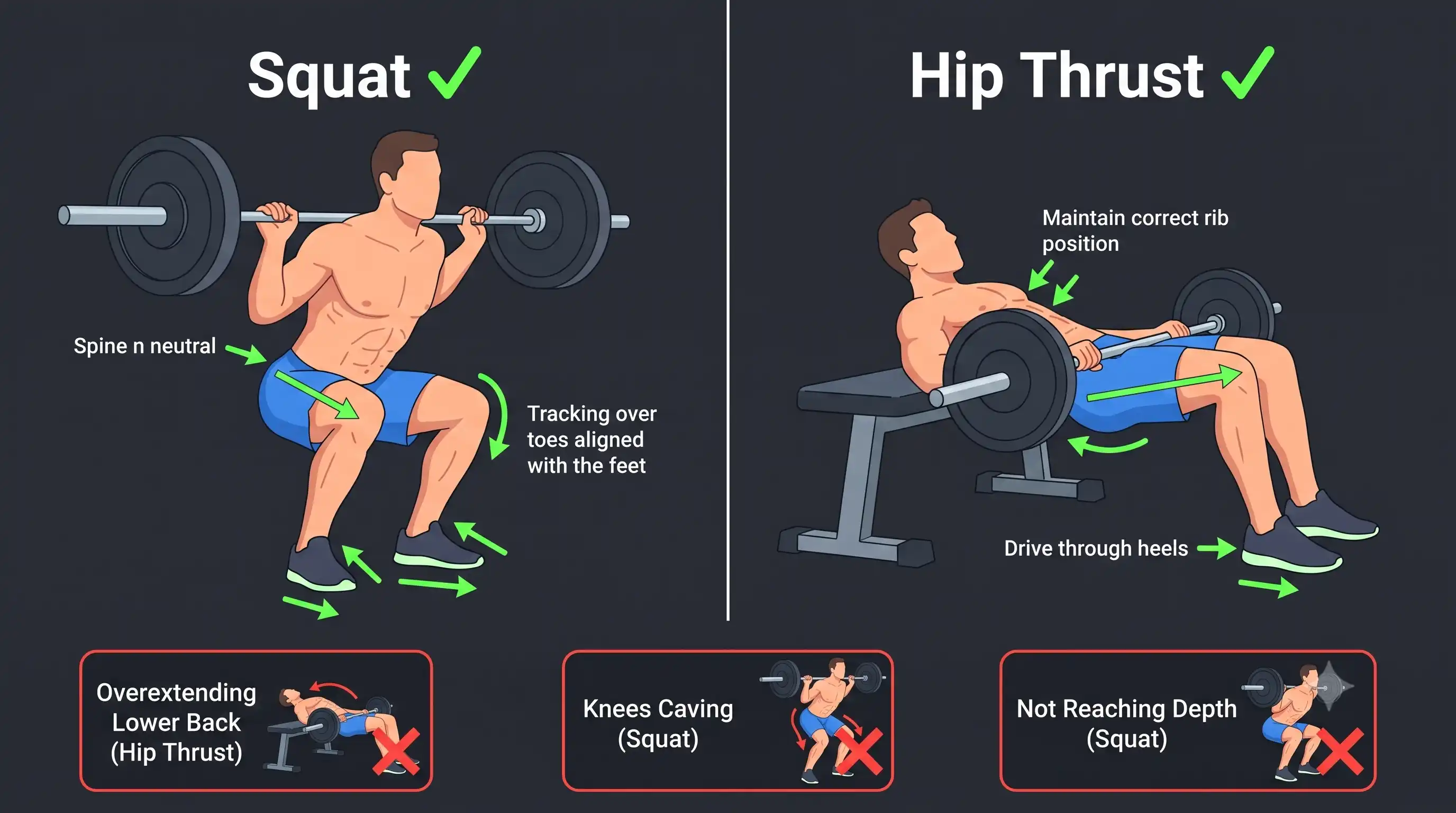
- Set up – sit on the floor with your upper back against a bench, barbell across your hips (use a pad).
- Position – feet shoulder-width apart, knees bent at ~90°, toes pointing forward.
- Drive – push through your heels, drive your hips upward.
- Squeeze – at the top, your torso should be parallel to the floor, knees at 90°, glutes fully contracted.
- Lower – control the descent back to the starting position.
- Repeat – keep tension throughout; don't rest at the bottom.
Barbell Back Squat
- Set up – barbell across your upper back (high bar or low bar position).
- Position – feet shoulder-width apart, toes slightly turned out.
- Descend – push hips back and bend knees simultaneously.
- Depth – go to at least parallel (hip crease level with top of knee).
- Drive – push through mid-foot, drive upward.
- Lock out – stand tall with hips and knees fully extended.
Recommended Sets, Reps and Load
| Goal | Exercise | Sets | Reps | Load | Notes |
|---|---|---|---|---|---|
| Glute hypertrophy | Hip Thrust | 3-4 | 8-15 | 65-80% 1RM | Squeeze at top |
| Overall lower body | Squat | 3-5 | 5-10 | 75-85% 1RM | Full depth |
| Strength | Both | 3-5 | 3-6 | 80-90% 1RM | Alternate exercises |
| Glute focus + quad work | Hip Thrust + Squat | 3 each | 10-12 | Moderate | Superset |
Who Should Use Which Option?
| Profile | Recommended | Rationale |
|---|---|---|
| Glute-focused training | Hip Thrust (primary) + Squat (accessory) | Hip thrust maximises glute activation |
| Overall lower body development | Squat (primary) + Hip Thrust (accessory) | Squat builds quads + adductors + glutes |
| Athlete (sprinting/running) | Both | Hip thrust improves horizontal force production |
| Knee-sensitive | Hip Thrust (primary) | Minimal knee loading; squat may aggravate knees |
| Lower back sensitivity | Hip Thrust (with care) | Squat may aggravate lower back; hip thrust is generally safer |
| Beginner | Squat first, then Hip Thrust | Squat builds foundational strength |
Comparison Table: Hip Thrust vs Squat
| Option | Best For | Muscle Emphasis | Joint / Safety Note | Practical Cue |
|---|---|---|---|---|
| Barbell Hip Thrust | Glute hypertrophy, hamstring development, horizontal force | Gluteus maximus (69-86% higher EMG), biceps femoris | Low knee stress; requires hip padding | "Drive hips up, squeeze at top" |
| Barbell Back Squat | Overall lower body, quadriceps, strength | Glutes + quads + adductors (greater thigh hypertrophy) | Higher knee and lower back stress | "Chest up, hips back, full depth" |
| Both (periodised) | Complete lower body development | Full spectrum of lower body muscles | Balanced stress across joint structures | "Train both for complete development" |
Common Mistakes Table
| Mistake | Why It Is a Problem | Fix |
|---|---|---|
| Hip thrust: overextending lower back | Compresses lumbar spine; reduces glute tension | Squeeze glutes, not lower back; keep ribs down |
| Hip thrust: feet too far forward | Reduces glute activation; increases hamstring dominance | Adjust feet so knees are at 90° at top |
| Hip thrust: using too much weight | Compromises form; reduces range of motion | Reduce load; focus on full hip extension |
| Squat: not reaching depth | Reduces glute activation; limits hypertrophy | Go to at least parallel (hip crease below knee) |
| Squat: knees caving inward | Increases injury risk; reduces glute engagement | Drive knees outward; use light band around knees |
| Squat: heels coming off floor | Shifts load forward; increases knee shear | Improve ankle mobility; use weightlifting shoes |
| Not controlling eccentric | Reduces muscle damage stimulus; limits growth | Lower under control (2-3 seconds) |
Sample Workout Integration
Workout 1: Glute Focus (Hip Thrust Primary)
| Exercise | Sets | Reps | Load | Notes |
|---|---|---|---|---|
| Barbell Hip Thrust | 4 | 10-12 | 75% 1RM | Squeeze at top, 3-sec eccentric |
| Romanian Deadlift | 3 | 10 | Moderate | Hamstring focus |
| Bulgarian Split Squat | 3 | 8/leg | Moderate | Unilateral work |
| Glute Kickbacks | 3 | 15/leg | Light | Finisher |
Workout 2: Overall Lower Body (Squat Primary)
| Exercise | Sets | Reps | Load | Notes |
|---|---|---|---|---|
| Barbell Back Squat | 5 | 5 | 85% 1RM | Full depth |
| Barbell Hip Thrust | 3 | 12 | 70% 1RM | Accessory glute work |
| Leg Press | 3 | 10 | Moderate | Quad emphasis |
| Lying Leg Curls | 3 | 12 | Moderate | Hamstring isolation |
Workout 3: Mixed / Athletic Focus
| Exercise | Sets | Reps | Load | Notes |
|---|---|---|---|---|
| Barbell Squat | 4 | 6 | 80% 1RM | Strength focus |
| Barbell Hip Thrust | 4 | 10 | 70% 1RM | Hypertrophy focus |
| Romanian Deadlift | 3 | 8 | Moderate | Posterior chain |
| Walking Lunges | 3 | 10/leg | Moderate | Unilateral work |
Safety warning
Stop immediately if you experience:
- Sharp, stabbing pain in the lower back, hip or knee
- Pain that worsens during the movement (not just muscle burn)
- Joint locking, catching or giving way
- Pain that persists after your workout
Modify if:
- You have lower back pain – use a hip thrust pad and focus on glute squeeze (not lumbar extension); consider reducing squat depth
- You have knee pain – hip thrusts are generally safer for knees; reduce squat load or depth
- You have hip pain – check your hip thrust foot position; adjust squat stance width
- You're new to these exercises – start with bodyweight or very light loads and master the form first
Key safety principles:
- Form over weight – a heavy hip thrust with lumbar extension is not productive
- Progress gradually – increase load by 2.5–5 kg per session
- Listen to your body – pain is information, not something to push through
- Warm up properly – include dynamic stretches and light warm-up sets
- Use a pad – for hip thrusts, always use a barbell pad or towel to protect your hips
Takeaway
The research is clear: both the hip thrust and the squat build glutes – but they do it differently.
- The hip thrust produces significantly higher gluteus maximus EMG activation in a single session (69-86% more than the squat). It's the superior exercise for targeted glute activation and horizontal force production.
- The squat produces similar glute hypertrophy over time but also builds more quadriceps and adductor muscle. It's the superior exercise for overall lower body development and vertical force production.
- Neither is "better" – they are different tools for different goals. The hip thrust is a glute specialist; the squat is a lower body generalist.
The best approach for most lifters is to use both. Periodise your training – use hip thrusts for targeted glute work and squats for overall lower body development. This gives you complete glute development, balanced muscle growth and keeps your training varied and effective.
Complete reference list
- Contreras B, Vigotsky AD, Schoenfeld BJ, Beardsley C, Cronin J. A Comparison of Gluteus Maximus, Biceps Femoris, and Vastus Lateralis Electromyographic Activity in the Back Squat and Barbell Hip Thrust Exercises. J Appl Biomech. 2015;31(6):452-8.
- Krause Neto W, Vieira TL, Gama EF. Barbell Hip Thrust, Muscular Activation and Performance: A Systematic Review. J Sports Sci Med. 2019;18(2):198-206.
- Plotkin DL, Rodas MA, Vigotsky AD, et al. Hip thrust and back squat training elicit similar gluteus muscle hypertrophy and transfer similarly to the deadlift. Front Physiol. 2023;14:1279170.
- Barbalho M, et al. Back Squat vs. Hip Thrust Resistance-training Programs in Well-trained Women. Int J Sports Med. 2020;41(5):306-310.
- Andersen V, Fimland MS, Mo DA, et al. Electromyographic Comparison of Barbell Deadlift, Hex Bar Deadlift, and Hip Thrust Exercises: A Cross-Over Study. J Strength Cond Res. 2018;32(3):587-593.
- McCurdy K, Walker J, Kelly C, Polinski M. Hip and Knee Extensor Activation During the Hip Thrust and Rear-Foot-Elevated Split Squat in Trained Females. J Strength Cond Res. 2021;35(5):1201-1207.