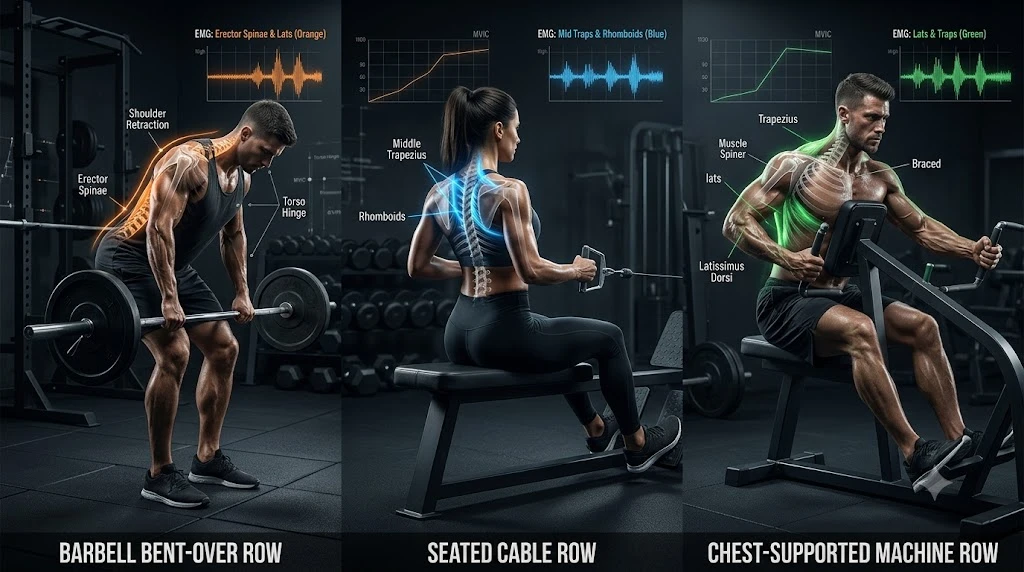
The science-backed answer
Barbell rows, cable rows and machine rows are all effective — but they are not equal tools. Barbell rows create the highest whole-body and spinal erector demand. Cable rows give controlled tension and easier lat or upper-back targeting. Machine rows reduce lower-back fatigue and let you push the back closer to failure. The best choice depends on whether your goal is strength, hypertrophy, lat isolation or lower-back safety.
Short answer
Use barbell rows for raw strength and total back demand. Use cable rows when you want controlled tension and better targeting. Use machine rows when you want high-volume back growth without your lower back becoming the limiting factor.
For most lifters, the best back program does not choose only one. It uses all three at the right time.


Research source note. This guide is based on peer-reviewed exercise science, EMG research and biomechanics studies where available. It is written for practical gym application, not as medical advice.
Why this comparison matters
Rows are supposed to build a bigger, thicker and stronger back. But in the gym, many people treat every row as the same movement with a different handle.
That is the mistake.
A bent-over barbell row is not just a back exercise. It is also a hip-hinge, trunk-stability and lower-back endurance test. A seated cable row is not just an easier barbell row. It changes the force path, stability demand and muscle emphasis. A chest-supported machine row is not a “lazy” row. It can be one of the best ways to train the back hard when your lower back is already tired.
Best for: heavy pulling strength, total back demand, spinal erectors and athletic carryover.
Watch out: lower-back fatigue and form breakdown.
Best for: controlled tension, lat focus, upper-back focus and cleaner reps.
Watch out: turning every rep into a body-swing.
Best for: back hypertrophy, high volume and lower-back support.
Watch out: pulling with arms instead of driving elbows back.
Use barbell rows early when fresh, cable rows for targeted work, and machine rows for safe high-volume finishing sets.
Anatomy: what muscles are actually working?
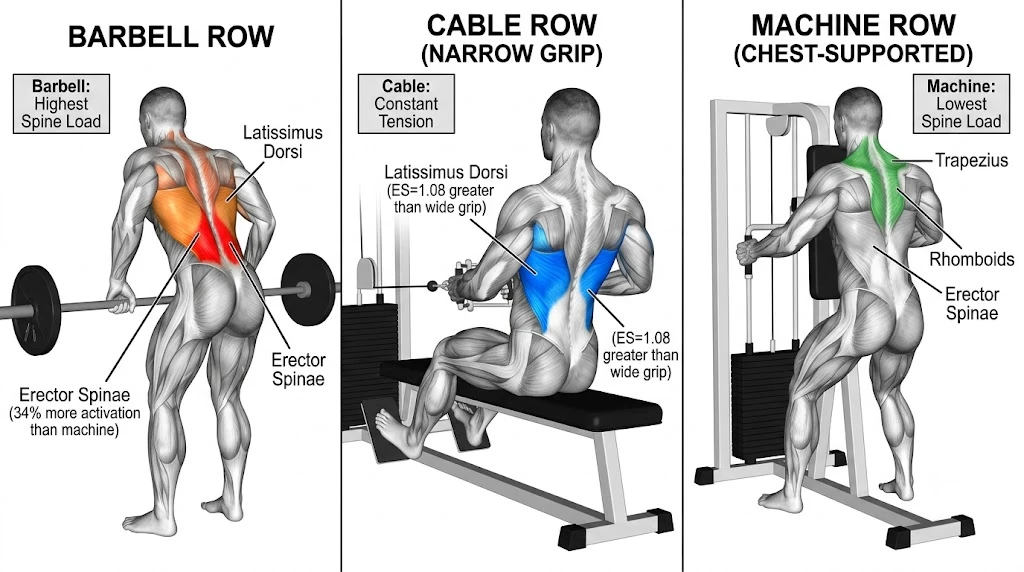
A row is not only a “lat exercise.” Different row variations shift stress across the lats, traps, rhomboids, rear delts, erector spinae and arms.
| Muscle | Main job during rows | Most affected by |
|---|---|---|
| Latissimus dorsi | Pulls the upper arm down and back; creates back width. | Narrower grips, elbows close to body, full stretch. |
| Middle trapezius | Pulls shoulder blades together; creates upper-back thickness. | Wider grips, elbows flared slightly, strong scapular retraction. |
| Rhomboids | Assist scapular retraction and upper-back density. | Controlled squeezing at the end of the row. |
| Posterior deltoid | Assists shoulder extension and pulling the elbow backward. | Wider elbow path and strict control. |
| Erector spinae | Stabilises the spine, especially during bent-over rows. | Unsupported barbell rows and hip-hinge positions. |
| Biceps and forearms | Assist elbow flexion and grip. | Grip style, load and fatigue. |
What the research suggests
The biggest research lesson is simple: the exercise that activates more total muscle is not always the best exercise for every goal.
Barbell rows require the lifter to hold a hip-hinge position while pulling. That increases trunk and erector spinae involvement.
The cable line keeps tension more consistent and lets you adjust grip and elbow path to bias the lats or upper back.
Chest support removes much of the stabilisation requirement, so the target back muscles can become the true limiting factor.
Narrower grips generally bias the lats more. Wider grips often shift more work toward the traps, rhomboids and rear delts.
Barbell row: the strength builder
The barbell row is the most “athletic” of the three. It trains the back, hips, trunk, grip and spinal erectors together.
This is why it feels brutally effective. But it is also why it can become messy. If your lower back is tired, your hamstrings are tight, or your brace is weak, the barbell row quickly turns into a swinging movement.
Heavy compound strength, back density, grip demand and full-body pulling power.
Highest lower-back demand. Not ideal when your lumbar spine is already fatigued.
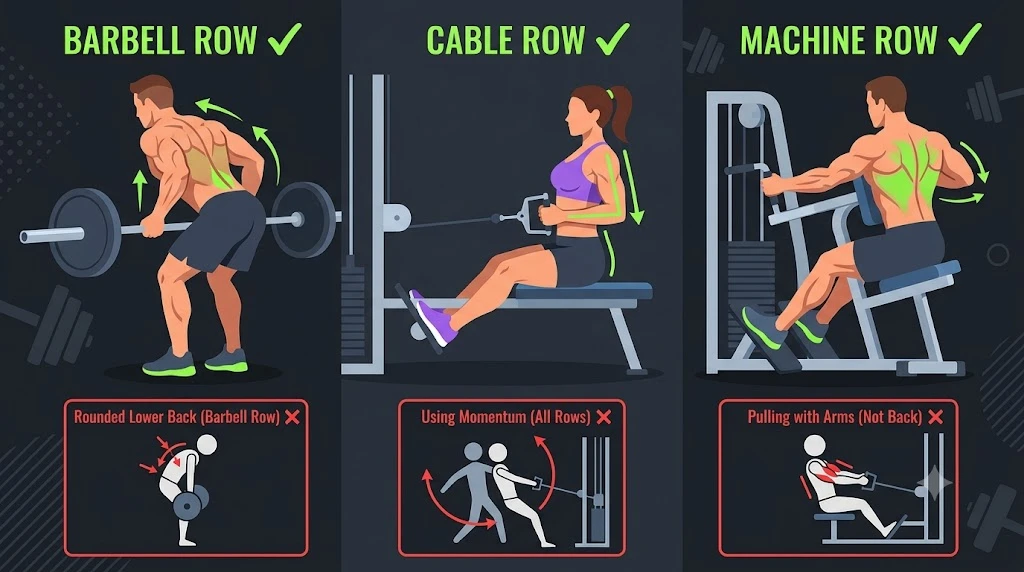
Brace first, hinge hard, keep the torso still, then drive elbows back.
Best barbell row form cues
- Do not chase the heaviest weight first. Chase a repeatable torso angle.
- Keep your spine neutral and ribs locked down.
- Pull the bar toward the lower chest or upper abdomen.
- Pause briefly near the body instead of bouncing reps.
- Stop the set when your torso starts rising rep after rep.
Cable row: the targeting tool
The cable row is usually easier to control than the barbell row. You do not need to hold a heavy hinge position, and you can adjust handles to change the muscle emphasis.
This makes it excellent for lifters who want cleaner reps, better lat focus, or more upper-back volume without turning the set into a lower-back endurance test.
Better for lat focus. Keep elbows closer to the torso and pull toward the lower ribs.
Better for upper back. Let the elbows travel slightly wider and focus on squeezing the shoulder blades.
Useful for fixing side-to-side differences and training anti-rotation control.
Machine row: the hypertrophy weapon
Machine rows are often underrated because they look less “hardcore” than barbell rows. But for muscle growth, support is not a weakness. It can be an advantage.
If the chest is supported, the lower back does not have to stabilise as much. That allows you to push the lats, traps and rhomboids closer to failure with less systemic fatigue.
Simple rule
If your lower back fails before your back muscles, use a machine row. If your target back muscles fail first, the exercise is doing its job.
Head-to-head comparison
This table gives the practical answer most lifters need before choosing an exercise.
| Goal | Best choice | Why |
|---|---|---|
| Overall back strength | Barbell row | Highest full-body demand and heavy loading potential. |
| Lat focus | Narrow-grip cable row | Easy to keep elbows close and pull through the lats. |
| Upper-back thickness | Wide-grip cable row or machine row | Better scapular retraction and controlled squeeze. |
| Lower-back safety | Chest-supported machine row | Reduces lumbar stabilisation demand. |
| High-volume hypertrophy | Machine row | Lets the back fail before the lower back does. |
| Athletic carryover | Barbell row | Trains pulling strength with trunk stiffness and hip-hinge control. |
Recommended sets, reps and loading
| Exercise | Best rep range | Loading style | How hard? |
|---|---|---|---|
| Barbell row | 5–10 reps | Moderate-heavy | Stop 1–3 reps before form breaks. |
| Cable row | 8–15 reps | Moderate | Control the stretch and squeeze. |
| Machine row | 10–20 reps | Moderate to high effort | Can be pushed closer to failure safely. |
| Single-arm row | 10–15 reps per side | Moderate | Keep torso stable and avoid twisting. |
How to program all three
The smartest plan is to use each row where it fits best in the workout.
1. Barbell row — 4 sets of 6–8
2. Wide-grip cable row — 3 sets of 10–12
3. Face pull — 3 sets of 15–20
1. Chest-supported machine row — 4 sets of 10–15
2. Narrow-grip cable row — 3 sets of 10–12
3. Lat pulldown — 3 sets of 10–15
1. Machine row — 4 sets of 12–15
2. Seated cable row — 3 sets of 12
3. Inverted row — 3 sets near failure
Common mistakes that kill back growth
| Mistake | Why it hurts progress | Better fix |
|---|---|---|
| Swinging every rep | Momentum replaces muscle tension. | Lower the weight and pause briefly at the top. |
| Turning rows into curls | Biceps take over before the back is trained hard. | Think “elbows back,” not “hands to body.” |
| Never using support | Lower back becomes the bottleneck too often. | Add machine rows after heavy hinges or deadlifts. |
| Skipping the stretch | You lose useful range and tension. | Let the shoulder blades protract under control. |
| Same grip forever | You keep hitting the same bias. | Rotate narrow, wide and neutral grips across training blocks. |
Safety: when to modify
Modify immediately if a row causes sharp lower-back pain, shoulder pinching, elbow pain, numbness, or pain that worsens set after set.
If your lower back is sensitive, start with chest-supported machine rows, seated cable rows and inverted rows before loading heavy bent-over barbell rows.
- Keep the spine neutral during unsupported rows.
- Brace before pulling heavy loads.
- Do not turn fatigue into sloppy reps.
- Use straps if grip fails before the back on hypertrophy sets.
- Progress load only when technique stays stable.
Final verdict
The barbell row is the best strength row. It builds total back power, trunk stiffness and heavy pulling ability.
The cable row is the best targeting row. It gives cleaner control, constant tension and easy grip variation.
The machine row is the best hypertrophy support row. It lets you train the back hard without the lower back failing first.
The best back program uses all three: barbell rows for strength, cable rows for precision, and machine rows for volume.
References
- Saeterbakken A, Andersen V, Brudeseth A, Lund H, Fimland MS. The Effect of Performing Bi- and Unilateral Row Exercises on Core Muscle Activation.
- Fenwick CMJ, Brown SHM, McGill SM. Comparison of Different Rowing Exercises: Trunk Muscle Activation and Lumbar Spine Motion, Load, and Stiffness.
- Variations in muscle activation levels during traditional latissimus dorsi weight training exercises.
- Padovan R, Cè E, Longo S, et al. High-Density Surface Electromyography excitation in narrow vs wide grip seated row exercise.