Short answer
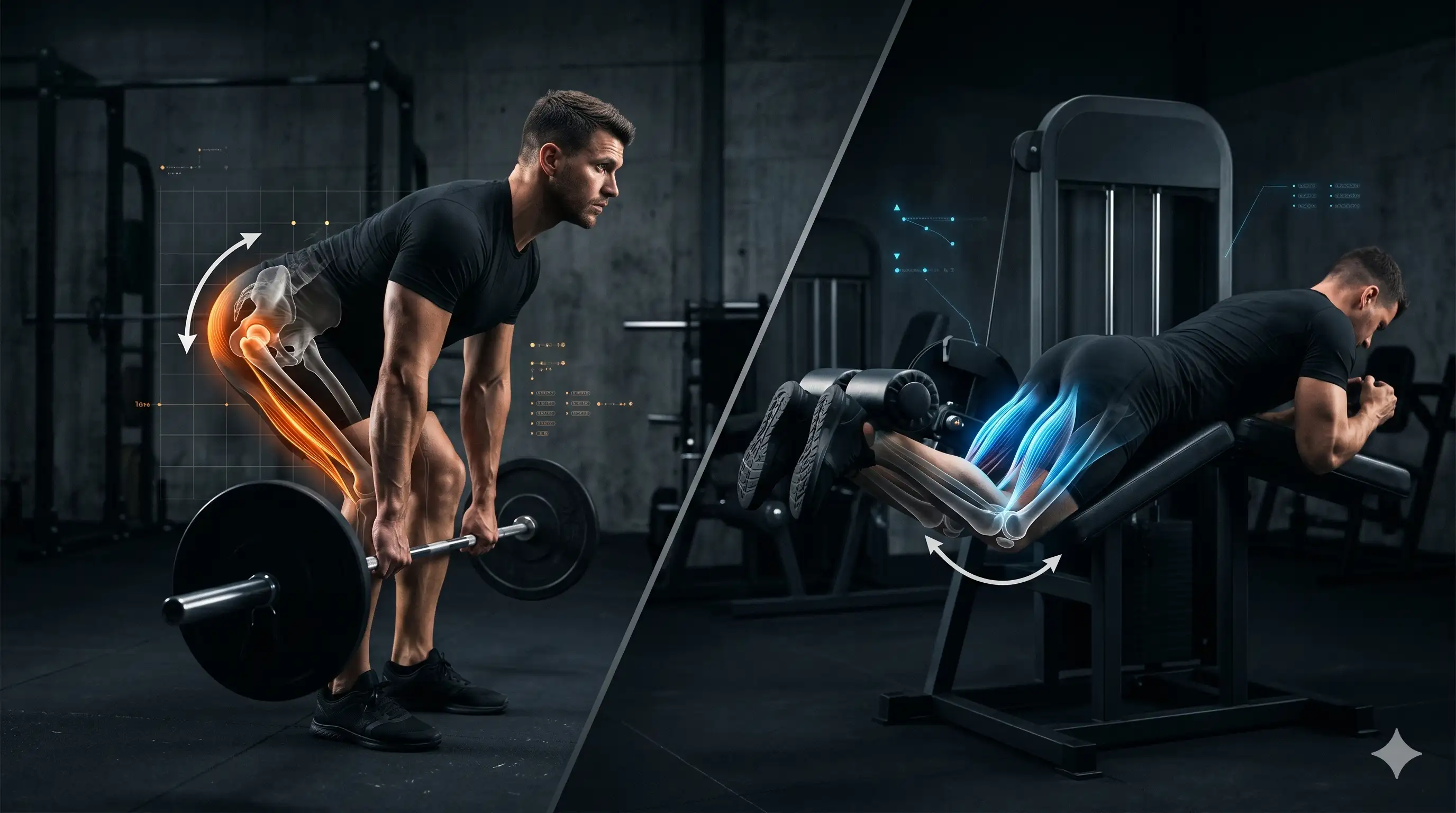
Romanian Deadlifts (RDLs) and leg curls both effectively train your hamstrings, but they do so through different movement patterns and with different muscle emphasis. Research shows the RDL maximises hamstring activity overall, especially the semitendinosus (medial hamstring), while the leg curl selectively targets the biceps femoris (lateral hamstring) [1]. The RDL also involves the glutes and lower back, making it a more comprehensive posterior chain exercise. For injury prevention, the single-leg RDL has been shown to reduce hamstring strain risk in athletes [2]. The best approach: use both – RDL for overall hamstring and posterior chain development, leg curls for targeted biceps femoris hypertrophy and knee flexion strength.


Research source disclaimer. Research cited in this article is sourced from peer-reviewed studies indexed in PubMed, NIH/NCBI-linked sources, or reputable journals where available.
Introduction
The hamstrings are arguably one of the most important yet under-trained muscle groups in the gym. Weak or imbalanced hamstrings are a primary contributor to knee injuries, lower back pain and reduced athletic performance. But when it comes to training them, two exercises dominate the conversation: the Romanian Deadlift (RDL) and the leg curl.
Both are effective, but they are not interchangeable. One is a compound, hip-dominant movement that builds the entire posterior chain. The other is an isolation, knee-dominant movement that specifically targets the hamstrings at the knee joint. Which one is better? The answer depends on your goals, your injury history and how you structure your training.
This guide cuts through the noise. We'll look at what peer-reviewed research actually says about RDLs and leg curls – for muscle activation, hypertrophy, injury prevention and practical application – then give you clear instructions you can use in your next workout.
Anatomy and biomechanics: what changes?
The hamstring muscles
The hamstring group consists of three muscles:
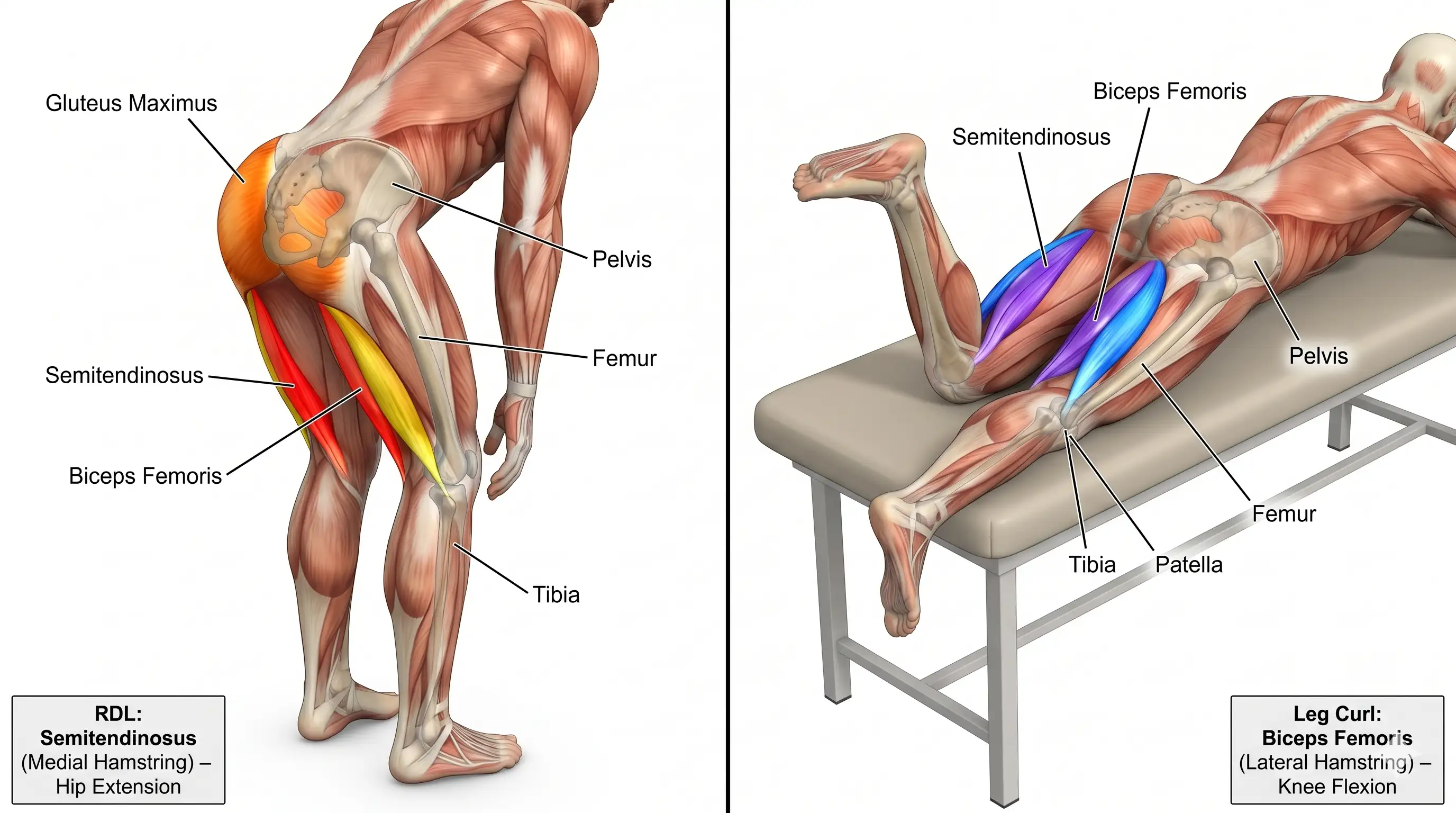
- Biceps femoris (lateral hamstring) – has a long head (hip extension) and a short head (knee flexion).
- Semitendinosus (medial hamstring) – involved in both hip extension and knee flexion.
- Semimembranosus (medial hamstring) – involved in both hip extension and knee flexion.
Importantly, the hamstrings are bi-articular – they cross both the hip and the knee joints. This means they can be trained in two ways:
- Hip extension – bringing the thigh backwards (e.g., RDL, good morning, hip thrust).
- Knee flexion – bending the knee (e.g., leg curl, Nordic hamstring curl).
The RDL emphasises the hip extension function, with the hamstrings working to control the descent and drive the hips forward. The leg curl emphasises the knee flexion function, with the hamstrings working to curl the lower leg towards the glutes.
The science: what the research reveals
Kettlebell swing and RDL targeted the semitendinosus (medial hamstring) 17-22% more than biceps femoris at very high EMG levels (73-115% of MVC). In contrast, the supine leg curl targeted the biceps femoris 20-23% more than semitendinosus.
Hamstring activity was maximised in the RDL and glute-ham raise. The semitendinosus was substantially more active than the biceps femoris across all exercises.
Leg curls and Nordic curls elicited higher biceps femoris activation than RDLs. Gluteus maximus activation was lowest during leg curls compared to all other exercises.
Nordic hamstring curls had the highest peak hamstring forces. The single-leg deadlift (similar to RDL) produced the longest fascicle lengths, suggesting different adaptations.
Source 1: Hamstring activation balance – RDL targets the medial hamstring, leg curl targets the lateral
Study: Zebis MK, et al. Kettlebell swing targets semitendinosus and supine leg curl targets biceps femoris: an EMG study with rehabilitation implications. Br J Sports Med. 2013;47(18):1192-8. PubMed ID: 22736206
What it found: Sixteen female elite athletes performed 14 exercises while EMG activity of the biceps femoris (lateral) and semitendinosus (medial) hamstrings was measured. The Romanian deadlift and kettlebell swing targeted the semitendinosus over the biceps femoris by 17-22% at very high activation levels (73-115% of MVC). In contrast, the supine leg curl and hip extension targeted the biceps femoris over the semitendinosus by 20-23% at similarly high levels (75-87% of MVC) [1].
Key takeaway: RDLs preferentially activate the medial hamstring (semitendinosus), while leg curls preferentially activate the lateral hamstring (biceps femoris). This is crucial for targeted training and injury prevention, as the medial hamstring plays a key role in stabilising the knee.
Source 2: Hamstring activity maximised in RDL and glute-ham raise
Study: McAllister MJ, et al. Muscle activation during various hamstring exercises. J Strength Cond Res. 2014;28(6):1573-80. PubMed ID: 24343361
What it found: Twelve healthy, weight-trained men performed leg curls, good mornings, glute-ham raises and RDLs at 85% 1RM. EMG analysis showed that hamstring activity was maximised in the RDL and glute-ham raise. The semitendinosus was substantially more active than the biceps femoris across all exercises [3].
Key takeaway: If your goal is to maximise overall hamstring activation, the RDL is one of the most effective exercises you can choose.
Source 3: Biceps femoris activation differs between RDL and leg curl
Study: Stevens BM, et al. Muscle activation patterns of the proximal medial and distal biceps femoris and gluteus maximus among 6 hip extension and knee flexion exercises in trained women. Int J Exerc Sci. 2022;15(1):1179-1189. PubMed ID: 35989703
What it found: Fifteen trained women performed RDLs, step-ups, hip extensions, kickbacks, Nordic hamstring curls and leg curls at 75% estimated 1RM. Biceps femoris activation was significantly higher in the leg curl, Nordic and kickback exercises compared to the RDL. Gluteus maximus activation was lowest during the leg curl compared to all other exercises [4].
Key takeaway: Leg curls are superior for isolating the biceps femoris, but they do very little for the glutes. RDLs are more balanced for the entire posterior chain.
Source 4: Muscle forces and fascicle behaviour – different exercises, different adaptations
Study: Van Hooren B, et al. Muscle forces and fascicle behaviour during three hamstring exercises. Scand J Med Sci Sports. 2022;32(6):997-1012. PubMed ID: 35307884
What it found: Ten male participants performed Nordic hamstring curls, single-leg Roman chair and single-leg deadlifts (similar to RDL). Mean fascicle length was highest in the deadlift, followed by the Roman chair and Nordic curl. The Nordic curl had the highest peak hamstring forces and resulted in more fascicle lengthening [5].
Key takeaway: RDL-style exercises promote longer fascicle lengths, which may be beneficial for injury prevention and muscle architecture. Leg curls and Nordic curls produce higher peak forces, which may be better for maximal strength development.
Source 5: Single-leg RDL for hamstring injury prevention
Study: The Effect of Single Leg Romanian Deadlift on the Risk of Hamstring Strain Injuries in Track and Field Athletes: A Cohort Study. PMC, 2025. PMC ID: 11890578
What it found: This cohort study examined the effect of the single-leg Romanian deadlift (SLRDL) on hamstring strain injury (HSI) risk in track and field athletes. The SLRDL was found to be an effective alternative to the Nordic hamstring exercise for HSI prevention, with the advantage of being easy to perform without requiring partners or special equipment [2].
Key takeaway: The single-leg RDL is a practical, evidence-based exercise for reducing hamstring injury risk, especially in athletes.
Practical application
Step-by-step instructions
Romanian Deadlift (RDL)
- Stand with feet hip-width apart, barbell in front of you.
- Grip the bar just outside your knees (double overhand or mixed grip).
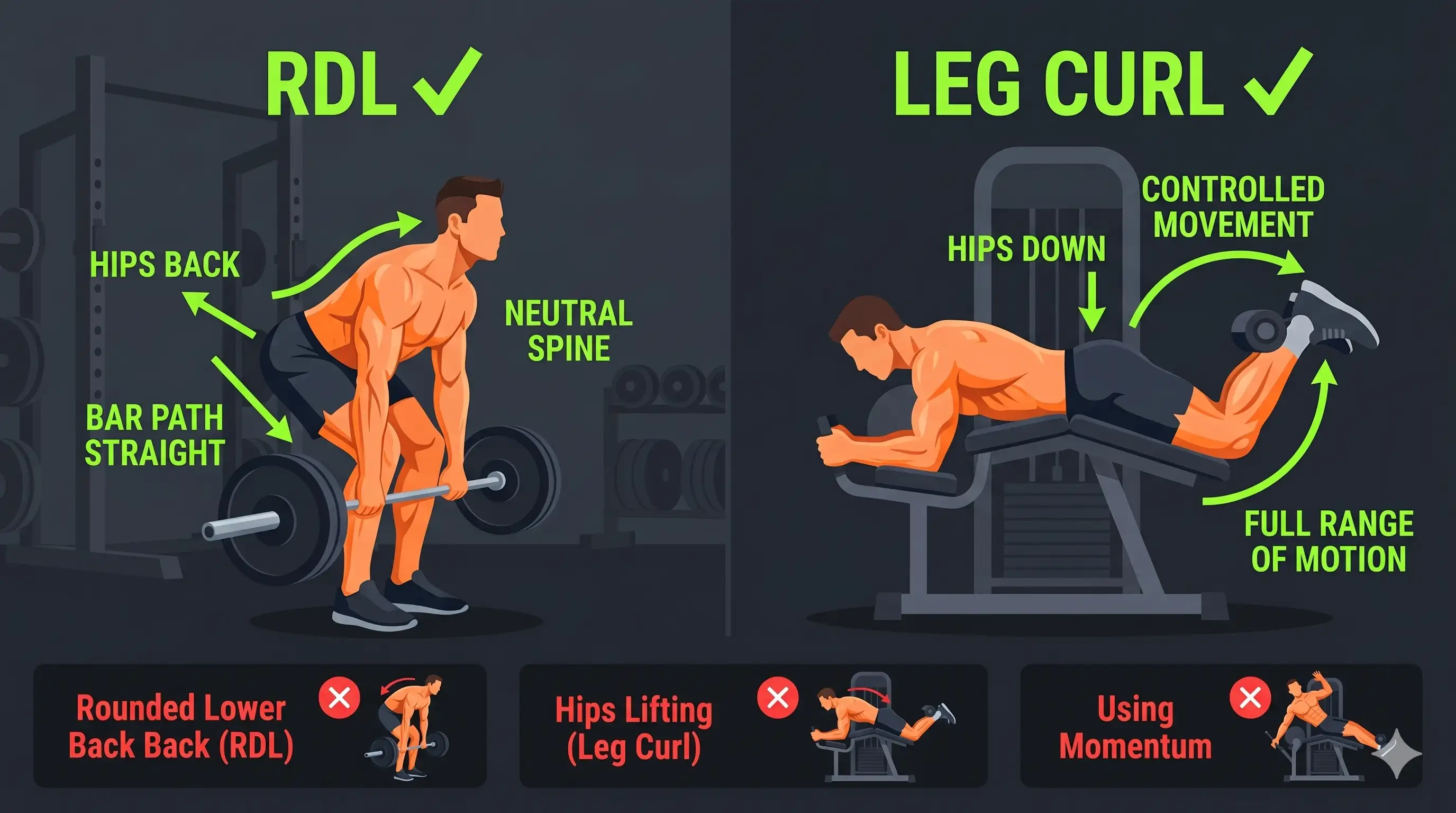
- Push your hips back while keeping your chest up and back straight.
- Lower the bar down your shins – do not round your lower back.
- Stop when you feel a deep stretch in your hamstrings (typically just below the knees).
- Drive your hips forward to return to standing.
- Keep the bar close to your body throughout.
Leg Curl (Lying or Seated)
- Adjust the machine so the pad sits just above your heels.
- Lie face down (or sit, depending on the machine) with your hips firmly against the pad.
- Keeping your hips stationary, curl your legs towards your glutes.
- Squeeze at the top for 1 second.
- Lower the weight under control (2-3 seconds).
- Avoid using momentum – keep the movement smooth and controlled.
Single-Leg RDL
- Stand on one leg, holding a dumbbell in the opposite hand.
- Keep a slight bend in the standing knee.
- Hinge at the hip, lowering the dumbbell towards the floor while your free leg extends backwards.
- Keep your back straight and core braced.
- Lower until you feel a stretch in the standing hamstring.
- Drive through the standing heel to return to the start.
Who should use which option?
| Option | Best for | Muscle emphasis | Joint / safety note | Practical cue |
|---|---|---|---|---|
| Romanian Deadlift (RDL) | Overall posterior chain development, glute emphasis, athletes | Semitendinosus (medial hamstring), glutes, erector spinae | Lower back stress if form is poor; start light | "Hips back, chest up, bar against shins" |
| Leg Curl | Isolated hamstring hypertrophy, biceps femoris emphasis, knee rehab | Biceps femoris (lateral hamstring) | Low joint stress; safe for most populations | "Hips down, curl with your knees" |
| Single-Leg RDL | Injury prevention, balance, unilateral strength | Semitendinosus, gluteus medius (stabilisers) | Requires balance; start with bodyweight | "Stand tall, hinge, reach" |
| Both (periodised) | Complete hamstring development, long-term progress | Full hamstring group + posterior chain | Balanced stress; reduces overuse risk | "Train both for complete development" |
Common mistakes
| Mistake | Why it is a problem | Fix |
|---|---|---|
| RDL: rounding the lower back | Increases shear stress on lumbar spine; injury risk | Brace core; maintain neutral spine; reduce load; push hips back, not down |
| RDL: bending the knees too much | Turns the exercise into a squat; reduces hamstring stretch | Keep knees slightly bent (15-20°); focus on hip hinge |
| Leg curl: using momentum | Reduces tension on hamstrings; increases injury risk | Lower the weight under control (2-3 seconds); pause at the top |
| Leg curl: lifting hips off the pad | Shifts load to lower back; reduces hamstring isolation | Keep hips pressed firmly into the pad throughout |
| Single-leg RDL: losing balance | Reduces effectiveness; increases fall risk | Start with bodyweight; use a wall or rack for support; focus on a fixed point |
| Not controlling the eccentric phase | Reduces muscle damage stimulus; limits growth | Lower all reps under control (2-3 seconds for RDL, 3-4 seconds for leg curl) |
Safety warning
Stop immediately if you experience:
- Sharp, stabbing pain in the lower back, hip or knee
- Pain that worsens as you lower the weight (not just muscle burn)
- Joint locking, catching or giving way
- Pain that persists after your workout
Modify if:
- You have a history of lower back injury – start with light RDLs or use a trap bar to reduce lumbar stress
- You have knee pain – leg curls are generally safer than RDLs for the knees
- You lack hamstring flexibility – reduce your range of motion; do not force depth
- You're new to these exercises – start with bodyweight or very light loads and master the form first
Key safety principles:
- Form over weight – a heavy RDL with a rounded back is not productive
- Progress gradually – increase load by 2.5–5 kg per session
- Listen to your body – pain is information, not something to push through
- Warm up properly – include dynamic stretches and light warm-up sets
Takeaway
Romanian Deadlifts and leg curls are both effective, but they are not interchangeable.
- RDLs are a compound, hip-dominant exercise that builds the entire posterior chain. They preferentially activate the semitendinosus (medial hamstring) and involve the glutes and lower back. They are excellent for overall strength, athletic performance and injury prevention – especially the single-leg RDL.
- Leg curls are an isolation, knee-dominant exercise that specifically targets the biceps femoris (lateral hamstring). They are safe for the lower back and knees, making them ideal for hypertrophy, knee rehab and targeted lateral hamstring development.
The best approach for most lifters is to use both. Periodise your training – use RDLs for your main posterior chain work and leg curls as an accessory to target the lateral hamstring and add volume. This gives you complete hamstring development, reduces injury risk and keeps your training varied and effective.
Complete reference list
- Zebis MK, et al. Kettlebell swing targets semitendinosus and supine leg curl targets biceps femoris: an EMG study with rehabilitation implications. Br J Sports Med. 2013;47(18):1192-8. – RDL targets semitendinosus; leg curl targets biceps femoris.
- The Effect of Single Leg Romanian Deadlift on the Risk of Hamstring Strain Injuries in Track and Field Athletes: A Cohort Study. PMC. 2025. – Single-leg RDL reduces hamstring injury risk.
- McAllister MJ, et al. Muscle activation during various hamstring exercises. J Strength Cond Res. 2014;28(6):1573-80. – Hamstring activity maximised in RDL and glute-ham raise.
- Stevens BM, et al. Muscle activation patterns of the proximal medial and distal biceps femoris and gluteus maximus among 6 hip extension and knee flexion exercises in trained women. Int J Exerc Sci. 2022;15(1):1179-1189. – Leg curls elicit higher biceps femoris activation than RDLs.
- Van Hooren B, et al. Muscle forces and fascicle behaviour during three hamstring exercises. Scand J Med Sci Sports. 2022;32(6):997-1012. – Deadlift promotes longest fascicle lengths; Nordic curl has highest peak forces.