The short answer
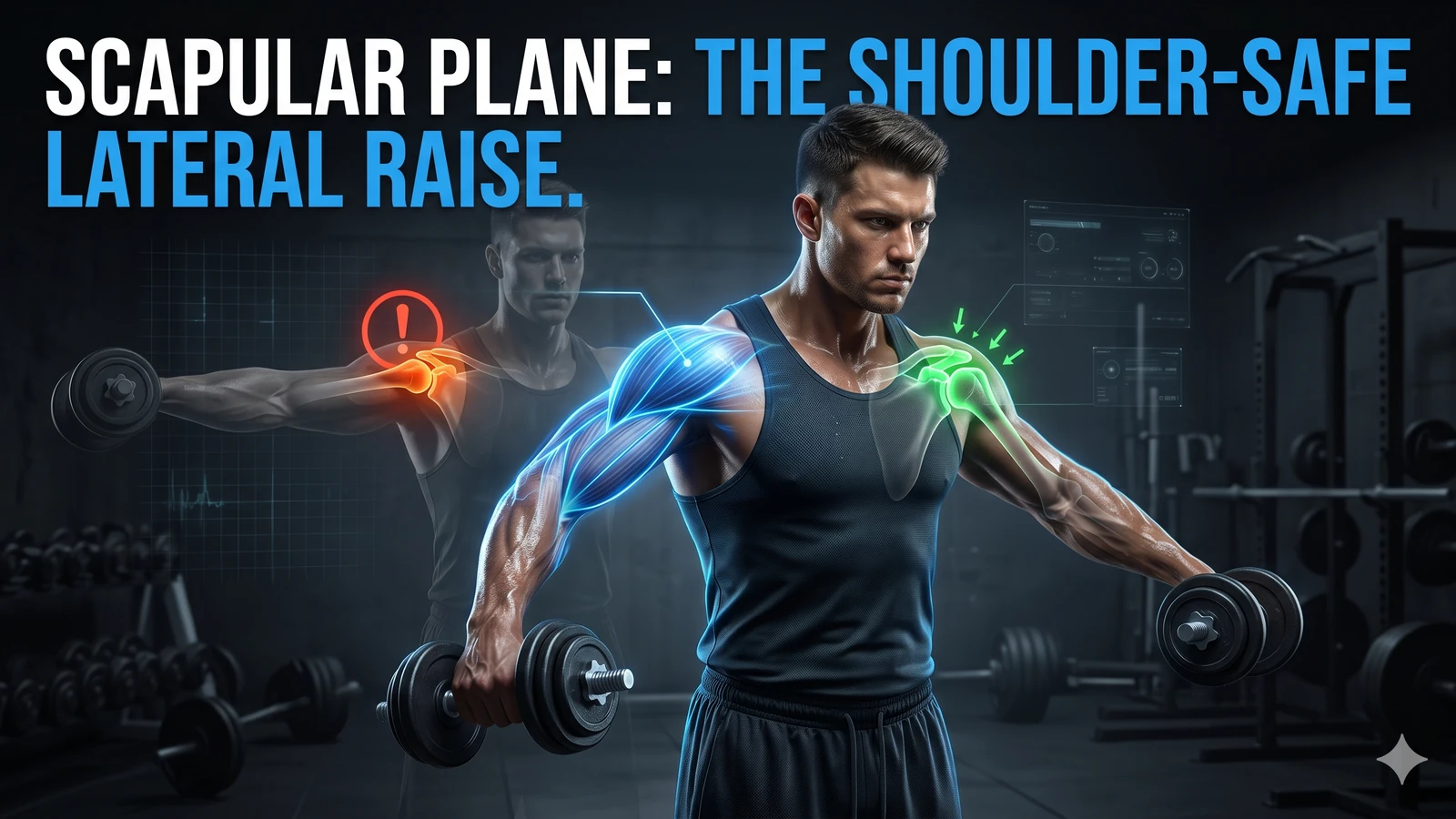
If you perform lateral raises in the scapular plane, moving the dumbbells roughly 30 degrees forward instead of straight out to your sides, you align the lift with the shoulder blade. That can maintain strong lateral-deltoid tension while reducing the subacromial compression that often irritates shoulders.
Research source disclaimer
All research cited in this article is sourced from peer-reviewed studies indexed in the NIH National Library of Medicine through PubMed or NCBI-linked pages. Links to the original studies are provided below.

Research links are PubMed-indexed. This guide uses PubMed-linked studies for the science discussion. PubMed is a research database; it does not endorse this article.
Introduction: the shoulder’s hidden vulnerability
The lateral raise is one of the most popular shoulder exercises in the gym. Most lifters raise the dumbbells straight out to the sides because it looks simple and feels direct. The problem is that the shoulder is the most mobile joint in the body, and that mobility comes with a narrow margin for error.
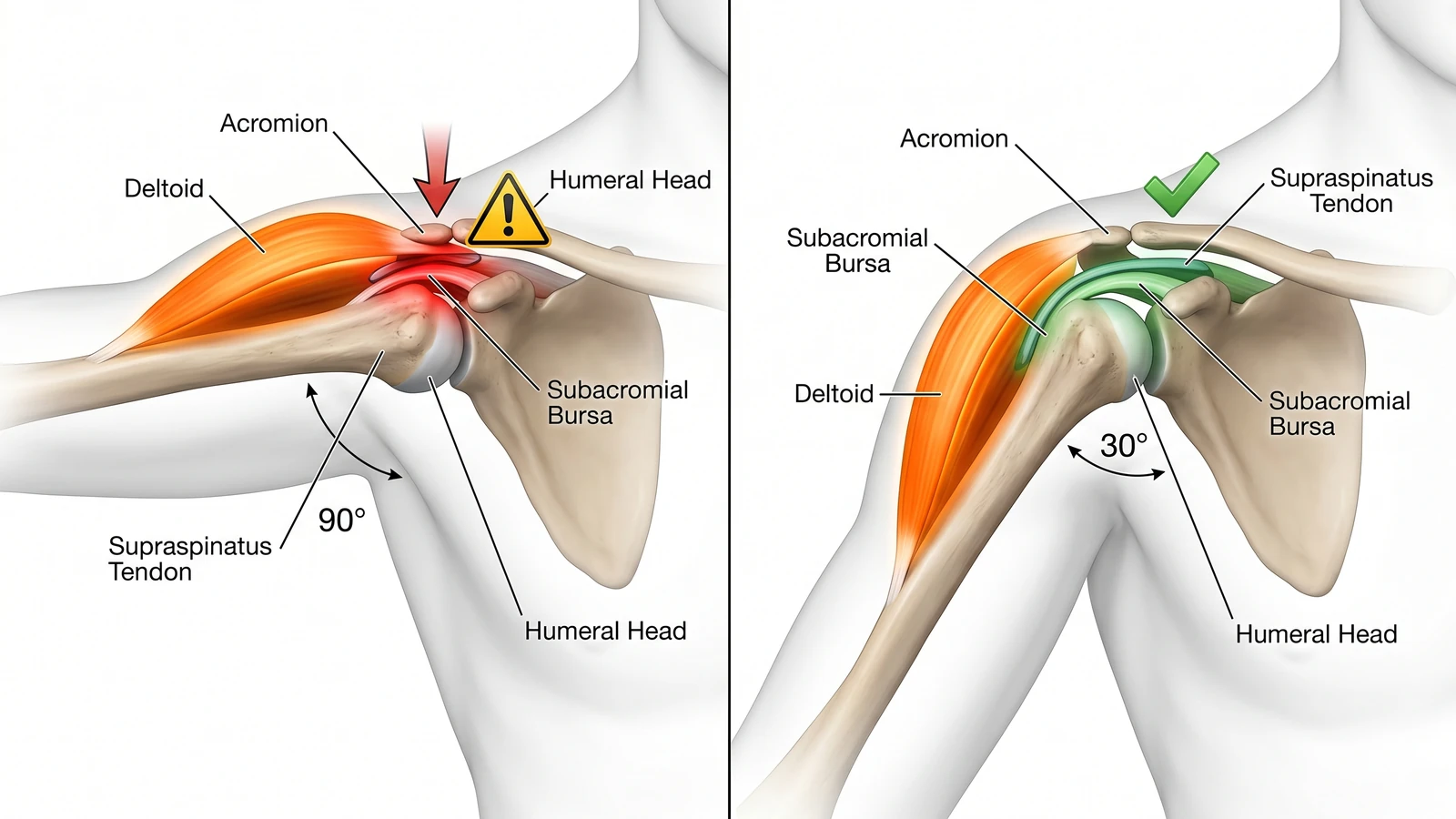
When the arm moves straight out in the frontal plane, the subacromial space can narrow. That is the passage where the supraspinatus tendon and subacromial bursa travel. Repeated compression in that area can contribute to pain, inflammation and rotator-cuff irritation in sensitive shoulders.
The fix is small: rotate the movement about 30 degrees forward. This is the scapular plane, and it follows the natural angle of the shoulder blade on the ribcage.
The anatomy: deltoid and subacromial space
The deltoid has three heads: anterior, lateral and posterior. Lateral raises mainly target the lateral head, the portion that gives the shoulder a capped look. But the lateral deltoid works around a crowded joint, with the rotator cuff and subacromial space influencing how safe the movement feels.
The subacromial space sits between the acromion and the head of the humerus. A healthy shoulder may have only a small space here. If the movement angle narrows that corridor too much, the supraspinatus tendon and bursa can become irritated.
The science: what the research reveals
Compared subacromial space width during shoulder exercises and found shoulder position changes how much room the tendon has under the acromion.
Reviewed science-based shoulder-injury prevention for overhead athletes, supporting scapular control and safer exercise selection.
Provided standardized EMG testing for shoulder muscles, useful context for understanding deltoid and rotator-cuff activation.
Examined direction-specific rotator-cuff recruitment during standard shoulder exercises.
Practical application: how to perform the scapular plane lateral raise
- Stand tall with a dumbbell in each hand and palms facing your body.
- Keep a slight elbow bend, roughly 10-15 degrees, and hold that bend throughout the rep.
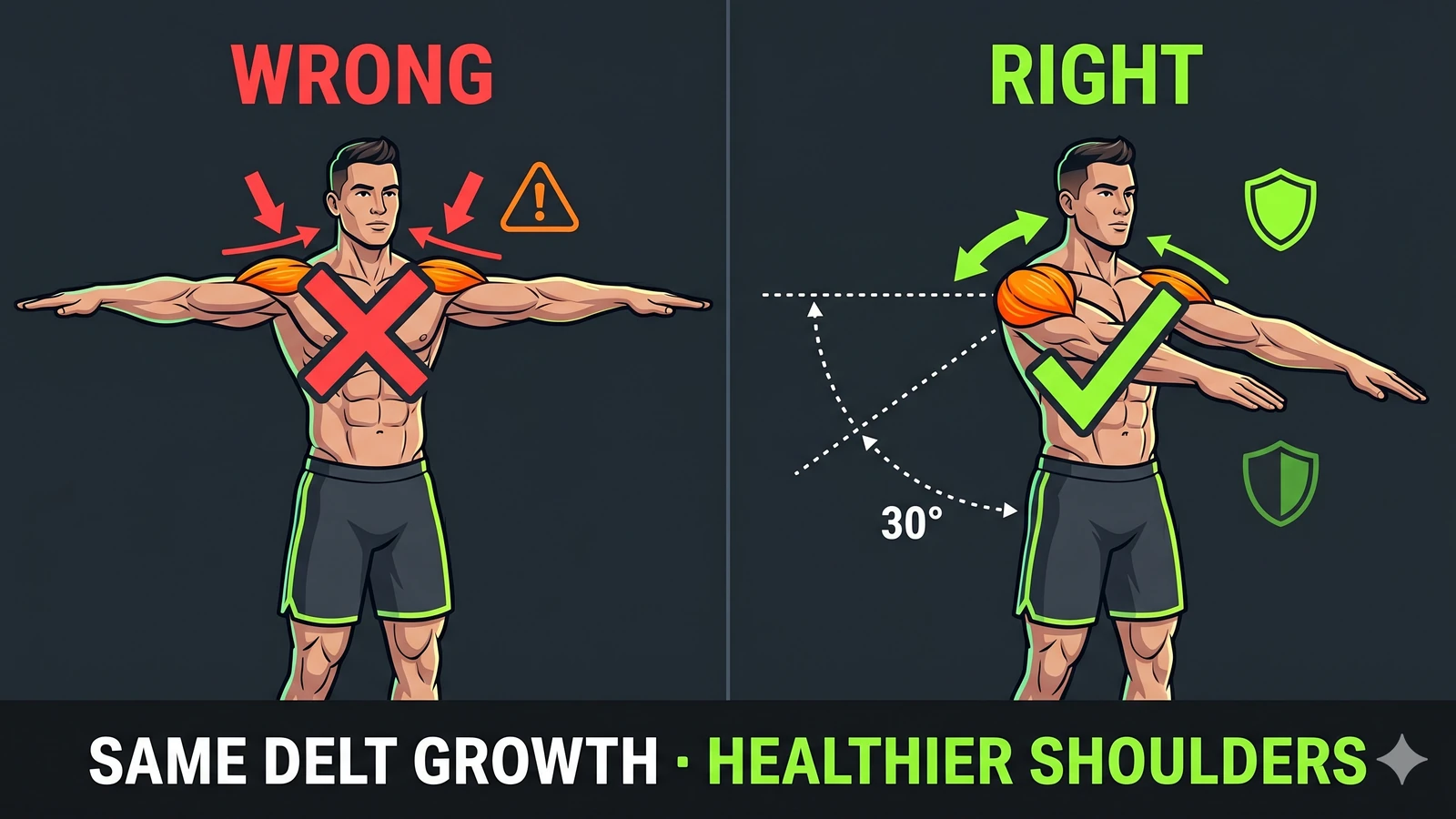
- Move your arms 30 degrees forward from your sides. Think “slightly forward,” not straight out.
- Raise from the shoulders until your upper arms are around shoulder height.
- Pause briefly at the top and feel the lateral delt, not the neck or traps.
- Lower under control while keeping the same forward angle.
Common mistakes to avoid
| Mistake | Why it is risky | Fix |
|---|---|---|
| Using momentum | Reduces delt tension and increases joint stress. | Use lighter dumbbells and slower reps. |
| Raising above 90 degrees | Can shift tension to traps and increase irritation. | Stop at shoulder height or slightly below. |
| Thumbs hard down | Can crowd the shoulder in some lifters. | Use neutral to slight external rotation. |
| Pure frontal plane | May narrow the subacromial space. | Angle arms about 30 degrees forward. |
Why this matters for long-term shoulder health
The best shoulder program is not just the one that builds size this month. It is the one you can keep training for years. The frontal plane lateral raise is not “wrong,” but for many lifters it is less forgiving than the scapular plane.
By moving the arms slightly forward, you keep the exercise targeted while respecting the natural line of the shoulder blade. That matters if your shoulders already get irritated from pressing, dips, upright rows or high-volume upper-body work.
Stop or modify if this happens
Sharp pain, pinching at the top of the shoulder, numbness, weakness, or pain that remains after training is not normal delt burn. Reduce load, change the angle, shorten the range, or get assessed by a qualified clinician if symptoms persist.
The takeaway
The scapular plane lateral raise is a simple science-backed adjustment: raise the dumbbells slightly forward instead of straight out to the sides. You still train the lateral deltoid, but you give the shoulder more room to move.
Build shoulders that look strong and stay strong. The best technique is the one that lets you train hard without turning every session into a shoulder-risk tradeoff.
Sources and references
- Lawrence RL, et al. Comparison of subacromial space width during shoulder exercises in healthy subjects. PubMed PMID: 32771537
- Cools AM, et al. Prevention of shoulder injuries in overhead athletes: a science-based approach. PubMed PMID: 29032364
- Boettcher CE, Ginn KA, Cathers I. Standard shoulder muscle EMG tests. PubMed PMID: 18551430
- Wattanaprakornkul D, et al. Direction-specific recruitment of rotator cuff muscles. PubMed PMID: 32148161
- Varacallo M, Mair SD. Rotator cuff tendinopathy. PubMed PMID: 31765200
- Ludewig PM, Borstad JD. Home exercise programme and shoulder pain. PubMed PMID: 12857886