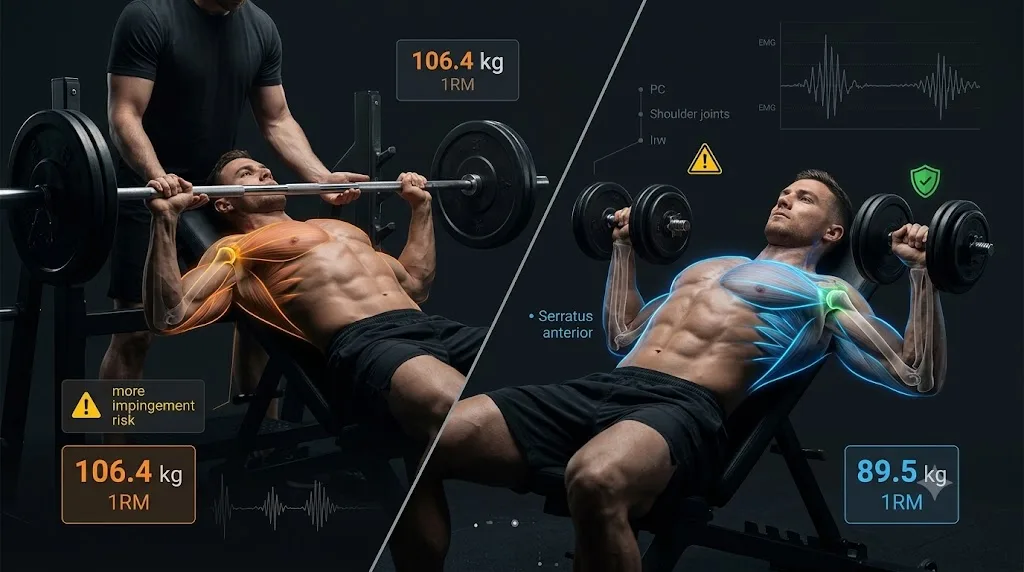
Here's what the science shows
The barbell bench press allows you to lift significantly heavier loads — with 1RM strength averaging 106.4 kg for barbell vs 89.5 kg for dumbbells. This greater load capacity may translate to greater overall muscle activation, with research showing the barbell bench press produces higher muscle activation in the pectoralis major, anterior deltoid and triceps brachii across the majority of lifting phases. However, the dumbbell bench press offers superior shoulder comfort, allowing a more natural movement path that reduces shoulder impingement risk. Dumbbells also provide a greater range of motion and help correct muscle imbalances. The takeaway: barbell for maximal load and overall chest development; dumbbells for shoulder comfort, muscle symmetry and joint-friendly training. The best approach: use both — periodise your training to get the benefits of each.
Quick answer: which bench press is best for you?
If your primary goal is maximal strength and overall chest mass, the barbell bench press is superior because it allows significantly heavier loads. If you have shoulder discomfort, want better muscle symmetry or prefer a joint-friendly movement, the dumbbell bench press is the better choice. For most lifters, the optimal approach is to use both — barbell for heavy compound work and dumbbells for volume, shoulder health and addressing imbalances.
Barbell Bench Press
Best for maximal strength, powerlifting and overall chest hypertrophy. Allows the heaviest loads (106.4 kg avg 1RM) and higher activation of the pecs, front delts and triceps across most lifting phases.
Dumbbell Bench Press
Best for shoulder comfort, muscle symmetry and stabiliser development. Offers a greater range of motion, a more natural movement path and is easier to bail out of without a spotter.
Introduction
The bench press is arguably the most iconic exercise in strength training. Walk into any gym and you'll see it being performed — but with a crucial difference: some use a barbell, others use dumbbells.
The debate between dumbbell and barbell bench press is one of the oldest in fitness. Advocates of the barbell point to heavier loads and greater overall strength development. Proponents of the dumbbell highlight better shoulder comfort and muscle symmetry.
So which one is better for you?
The answer isn't as simple as "one is superior." The research shows clear differences in muscle activation, load capacity and joint stress — and understanding these differences is the key to making the right choice for your goals and your body.
This guide breaks down what the peer-reviewed research actually says about dumbbell and barbell bench presses — for chest growth, shoulder comfort and practical application.
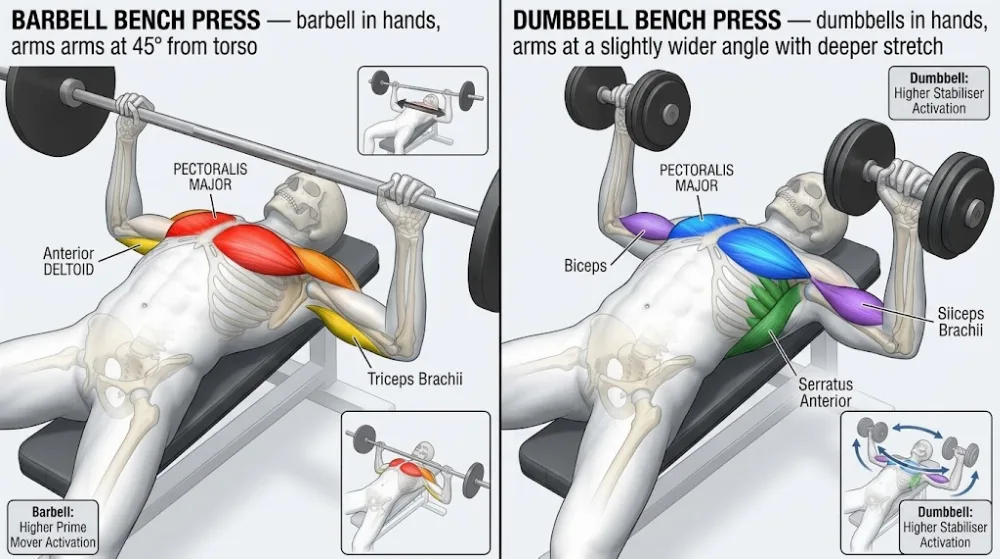
Anatomy / Biomechanics: What Changes Between Dumbbell and Barbell?
The Primary Muscles
| Muscle | Role in the Bench Press |
|---|---|
| Pectoralis Major (sternal and clavicular heads) | Shoulder adduction and horizontal flexion — the primary "chest" muscle |
| Anterior Deltoid | Shoulder flexion — assists in pressing |
| Triceps Brachii | Elbow extension — straightening the arms |
| Biceps Brachii | Elbow stabilisation — more active in dumbbell press |
| Serratus Anterior | Scapular protraction and stabilisation |
Key Biomechanical Differences
| Feature | Barbell Bench Press | Dumbbell Bench Press |
|---|---|---|
| Movement path | Fixed — bar travels in a straight or slightly curved path | Free — each arm moves independently |
| Range of motion | Limited by the bar (cannot go as deep) | Greater — allows deeper stretch at the bottom |
| Stability demand | Lower — bar provides stability | Higher — each arm must stabilise independently |
| Load capacity | Highest — can lift significantly more weight | Lower — limited by individual arm strength |
| Shoulder stress | Higher — fixed hand position can cause impingement | Lower — allows natural hand and arm rotation |
| Muscle symmetry | May mask imbalances (stronger arm compensates) | Better — each side works independently |
| Bailing out | Requires spotter or safeties | Easier — can drop dumbbells safely |
The key insight: the barbell allows heavier loading but restricts movement; the dumbbell allows natural movement but limits loading.
The Science: What the Research Reveals
Source 1: 1RM Strength — Barbell Allows Heavier Loading
Study: Van Den Tillaar R, et al. The sticking region in three chest-press exercises with increasing degrees of freedom. J Strength Cond Res. 2012;26(11):2962-2969. PubMed ID: 22158100
What it found: Eleven male subjects with at least 1 year of bench press experience performed 1RM attempts in three chest-press exercises.
- Free Barbell: 106.4 ± 15.5 kg
- Smith Machine: 103.6 ± 14.8 kg
- Dumbbells: 89.5 ± 13.7 kg
Key takeaway: The barbell allows you to lift approximately 19% more weight than dumbbells. This greater load capacity is a significant advantage for overall strength development.
Source 2: Muscle Activation — Barbell Activates Prime Movers More
Study: Solstad TE, Andersen V, Shaw M, Hoel EM, Vonheim A, Saeterbakken AH. A Comparison of Muscle Activation between Barbell Bench Press and Dumbbell Flyes in Resistance-Trained Males. J Sports Sci Med. 2020;19(4):645-651. PMC ID: PMC7675616
What it found: Seventeen resistance-trained men performed six-repetition maximum loads in both exercises.
- Pectoralis Major: Higher activation in barbell press (8-81%, p ≤ 0.05) across most phases
- Anterior Deltoid: Higher activation in barbell press across most phases
- Triceps Brachii: Higher activation in barbell press across most phases
- Biceps Brachii: Higher activation in dumbbell flyes (57-86%, p ≤ 0.05)
Key takeaway: The barbell bench press produces greater activation of the primary chest and triceps muscles compared to dumbbell flyes.
Source 3: Muscle Activation — Dumbbell vs Barbell Press
Study: Christian J, Gothart S, Graham H, Barganier K. Analysis of the Activation of Upper Extremity Muscles During Various Chest Press Modalities. Perpetua: J Undergrad Res UAH. 2020;4(2):2. Full text
What it found: Twenty subjects performed 1RM dumbbell and barbell presses, followed by six repetitions at incline, flat and decline positions using 70% of 1RM.
- Anterior deltoid activation was significantly higher during incline barbell compared to decline (p ≤ 0.019).
- Pectoralis major activation was significantly lower during incline barbell compared to decline dumbbell (p = 0.011).
Key takeaway: The stability demands of dumbbells change muscle activation patterns. The anterior deltoid is more active in barbell variations, while the pectoralis major may be better activated with dumbbells in certain positions.
Source 4: Shoulder Safety — Dumbbells Are More Shoulder-Friendly
Research synthesis: Multiple sources confirm that the dumbbell bench press is generally safer and more comfortable for the shoulders.
- Dumbbells allow a greater range of motion and more natural movement path.
- The barbell bench press places greater stress on shoulder joints due to its fixed movement path.
- Studies have linked excessive barbell pressing to shoulder impingement issues, particularly in lifters with poor scapular mobility (Larsen et al., 2021).
- Dumbbells allow for adjustments in arm path to avoid painful angles, making them safer for rotator cuff injuries.
Key takeaway: The dumbbell bench press is significantly more shoulder-friendly than the barbell variation. The ability to rotate the hands and adjust the movement path reduces impingement risk.
Source 5: Stabiliser Muscle Activation — Dumbbells Engage More Stabilisers
Research synthesis: The instability of dumbbells requires greater stabiliser muscle activation.
- Greater stabiliser activation — dumbbells require more recruitment of stabilising muscles, including the serratus anterior.
- Greater motor unit activation — dumbbells allow increased motor unit activation due to instability.
- More comfortable movement — dumbbells provide a more comfortable movement through the shoulders.
Key takeaway: Dumbbells engage more stabiliser muscles — which may lead to better shoulder health and more functional strength.
Source 6: Fatigue Effects — Similar Fatigue Patterns
Study: A comparison of fatigue effects on EMG activity in the barbell and dumbbell bench presses. Masters Thesis, California State University. Full text
What it found: Ten healthy male subjects performed barbell and dumbbell bench presses to fatigue. EMG was used to record muscle activity of the pectoralis, anterior deltoid and triceps.
Key takeaway: Both exercises produce significant fatigue in the prime movers. The choice between them may come down to individual preference and injury history rather than fatigue patterns.
Comparison Table: Dumbbell vs Barbell Bench Press
| Option | Best For | Muscle Emphasis | Load Capacity | Shoulder Comfort | Safety Note | Practical Cue |
|---|---|---|---|---|---|---|
| Barbell Bench Press | Maximal strength, overall chest mass, powerlifting | Pectoralis major, anterior deltoid, triceps (higher activation across most phases) | Highest (106.4 kg avg 1RM) | Lower — fixed path increases impingement risk | Requires spotter or safeties | "Retract scapulae, drive through heels, bar to lower chest" |
| Dumbbell Bench Press | Shoulder comfort, muscle symmetry, stabiliser development | Pectoralis major, stabilisers (serratus anterior), biceps | Lower (89.5 kg avg 1RM) | Higher — natural movement path | Easier to bail out | "Control the descent, deeper stretch, press up and together" |
| Both (periodised) | Complete chest development | Full spectrum of chest and shoulder muscles | Varied | Balanced | Balanced stress | "Use barbell for heavy work; dumbbells for volume and shoulder health" |
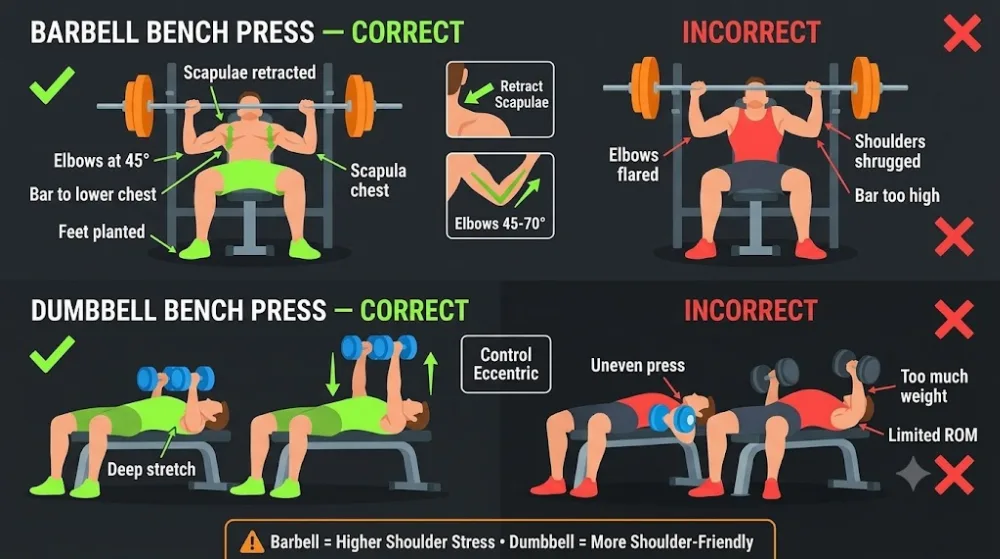
Step-by-Step Instructions: How to Do Each Correctly
Barbell Bench Press
- Set up — lie on a flat bench with your eyes under the bar.
- Grip — hands slightly wider than shoulder-width (approximately 1.5x biacromial width).
- Position — shoulder blades retracted and depressed, feet planted on the floor.
- Lower — control the bar to your lower chest (around nipple line) with elbows at 45-70°.
- Press — drive the bar up and slightly back toward your face.
- Lock out — extend arms fully but don't hyperextend.
- Repeat — maintain tension throughout; don't bounce.
Dumbbell Bench Press
- Set up — sit on a flat bench with dumbbells resting on your thighs.
- Position — lie back, bringing the dumbbells to your chest with palms facing forward.
- Grip — dumbbells should be just outside your shoulders.
- Lower — control the descent, allowing a deeper stretch than barbell.
- Press — drive the dumbbells up and slightly together.
- Lock out — extend arms fully but don't hyperextend.
- Repeat — maintain control throughout; dumbbells can rotate slightly for comfort.
Recommended Sets, Reps and Load
| Goal | Exercise | Sets | Reps | Load | Notes |
|---|---|---|---|---|---|
| Maximal strength | Barbell | 3-5 | 3-6 | 80-90% 1RM | Heavier loads possible |
| Chest hypertrophy | Barbell | 3-4 | 8-12 | 70-80% 1RM | Primary chest builder |
| Shoulder-friendly | Dumbbell | 3-4 | 8-12 | 65-75% 1RM | More comfortable on shoulders |
| Muscle symmetry | Dumbbell | 3-4 | 10-12 | 65-75% 1RM | Each side works independently |
| Stabiliser development | Dumbbell | 3 | 10-12 | 60-70% 1RM | Engages more stabilisers |
| Variety / periodisation | Both (rotate) | 3-4 | 8-12 | 65-80% 1RM | Different stimulus |
Who Should Use Which Option
| Profile | Recommended | Rationale |
|---|---|---|
| Maximising chest strength | Barbell | Heavier loads (106.4 kg vs 89.5 kg 1RM) |
| Overall chest hypertrophy | Barbell (primary) + Dumbbell (accessory) | Greater load + greater ROM |
| Shoulder sensitivity | Dumbbell | More natural movement path; less impingement risk |
| Muscle imbalances | Dumbbell | Each side works independently |
| Beginner | Dumbbell (initially) | Easier to learn; safer to bail out |
| Powerlifter | Barbell | Competition specificity |
| Bodybuilder | Both | Barbell for mass; dumbbell for shape and symmetry |
Common Mistakes Table
| Mistake | Why It Is a Problem | Fix |
|---|---|---|
| Flaring elbows (barbell) | Increases shoulder impingement risk | Keep elbows at 45-70° from torso |
| Not retracting scapulae | Reduces chest activation; increases shoulder stress | Pull shoulder blades together and down |
| Bouncing the bar (barbell) | Uses momentum; reduces muscle tension; increases injury risk | Control the eccentric (2-3 sec) |
| Using too much weight (dumbbell) | Compromises form; increases injury risk | Reduce load; focus on control and range of motion |
| Not achieving full range of motion | Reduces muscle damage stimulus; limits growth | Full stretch at bottom; full lockout at top |
| Arching excessively (barbell) | Changes effective angle; may stress lower back | Keep natural arch; don't over-arch |
| Dropping dumbbells too fast | Reduces eccentric stimulus; increases injury risk | Control the descent (2-3 sec) |
| Not using a spotter (barbell) | Dangerous with heavy loads | Use a spotter or safeties |
Sample Workout Integration
Workout 1: Chest Hypertrophy Focus
- Barbell Bench Press — 4 sets of 8-10 reps at 75% 1RM (primary chest builder)
- Incline Dumbbell Press — 3 sets of 10-12 reps (moderate load) (upper chest + shoulder comfort)
- Dumbbell Flyes — 3 sets of 12-15 reps (light load) (chest isolation)
- Triceps Pushdowns — 3 sets of 12 reps (moderate load) (triceps finisher)
Workout 2: Strength + Shoulder Health
- Barbell Bench Press — 5 sets of 3-5 reps at 80-85% 1RM (heavy strength work)
- Dumbbell Bench Press — 3 sets of 10-12 reps (moderate load) (shoulder-friendly volume)
- Incline Dumbbell Press — 3 sets of 10-12 reps (moderate load) (upper chest focus)
- Face Pulls — 3 sets of 15 reps (light load) (rotator cuff health)
Workout 3: Shoulder-Friendly Chest Day
- Dumbbell Bench Press — 4 sets of 10-12 reps at 70% 1RM (primary movement)
- Incline Dumbbell Press — 3 sets of 10-12 reps (moderate load) (upper chest)
- Cable Crossovers — 3 sets of 12-15 reps (light load) (chest isolation)
- Band Pull-Aparts — 3 sets of 15 reps (light load) (shoulder health)
Warning / Safety Section: When to Stop or Modify
Stop the exercise immediately if you experience sharp, stabbing pain in the shoulder, elbow or wrist; pain that worsens during the movement (not just muscle burn); joint locking, catching or giving way; or pain that persists after your workout.
- Shoulder impingement: switch to dumbbells with a more neutral grip; avoid barbell pressing.
- Elbow tendinopathy: use dumbbells for a more natural wrist position; consider neutral-grip handles.
- Wrist pain: dumbbells allow for a more natural wrist angle; use wrist wraps if needed.
- New to bench pressing: start with dumbbells to learn the movement pattern safely.
- Lifting heavy: always use a spotter or safeties with the barbell.
- Key principles: retract your scapulae, control the eccentric (2-3 seconds), don't ego lift, know when to bail, progress gradually (1.25-2.5 kg per session) and listen to your body — pain is information, not something to push through.
Takeaway
The research is clear: both the barbell and dumbbell bench press are effective — but they serve different purposes.
The barbell bench press allows you to lift significantly heavier loads (106.4 kg vs 89.5 kg 1RM) and produces higher muscle activation in the pectoralis major, anterior deltoid and triceps brachii across most lifting phases. It is the superior choice for maximal strength development and overall chest mass.
The dumbbell bench press offers superior shoulder comfort due to a more natural movement path and the ability to rotate the hands. It provides a greater range of motion, engages more stabiliser muscles (including the serratus anterior), and helps correct muscle imbalances. It is the superior choice for shoulder health, muscle symmetry and joint-friendly training.
The best approach for most lifters is to use both. Use barbell presses for your heavy compound work and overall chest development. Use dumbbell presses for volume work, shoulder comfort and addressing imbalances. Periodise your training — and your shoulders will thank you.
Complete Reference List
- Van Den Tillaar R, et al. The sticking region in three chest-press exercises with increasing degrees of freedom. J Strength Cond Res. 2012;26(11):2962-2969. PubMed ID: 22158100
- Solstad TE, Andersen V, Shaw M, Hoel EM, Vonheim A, Saeterbakken AH. A Comparison of Muscle Activation between Barbell Bench Press and Dumbbell Flyes in Resistance-Trained Males. J Sports Sci Med. 2020;19(4):645-651. PMC ID: PMC7675616
- Christian J, Gothart S, Graham H, Barganier K. Analysis of the Activation of Upper Extremity Muscles During Various Chest Press Modalities. Perpetua: J Undergrad Res UAH. 2020;4(2):2. Full text
- A comparison of fatigue effects on EMG activity in the barbell and dumbbell bench presses. Masters Thesis, California State University. Full text
- Larsen et al., 2021. Shoulder impingement and barbell pressing in lifters with poor scapular mobility. PubMed Search
- Saeterbakken AH, van den Tillaar R, Fimland MS. A comparison of muscle activity and 1-RM strength of three chest-press exercises with different stability requirements. J Sports Sci. 2011. PubMed Search